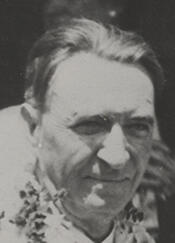
Thomas Francis Ford (February 18, 1873 – December 26, 1958) was an American politician, journalist, and editor who served six terms as a Democratic member of the U.S. House of Representatives from California from 1933 to 1945. Over the course of a public career that spanned municipal and national office, he became known for his advocacy on issues of civil rights, public works, and governmental integrity, and he holds the distinction of being the only member of the Los Angeles City Council ever elected by a write‑in vote.
Ford was born on February 18, 1873, and spent his early years in the United States during a period of rapid industrialization and urban growth that would shape many of the political and social questions he later confronted in public life. Details of his family background and early upbringing are less extensively documented than his later career, but his subsequent work as a journalist and editor suggests an early and sustained engagement with public affairs, civic debate, and the written word. This grounding in communications and public discourse provided a foundation for his later transition into elective office.
Before entering elective politics, Ford established himself professionally as a journalist and editor. In that capacity he developed a reputation for scrutinizing public institutions and highlighting issues of corruption, inequality, and municipal governance. His work in journalism honed the skills of investigation, public communication, and policy analysis that would characterize his later service in city government and in Congress. The combination of editorial experience and political interest positioned him to move naturally into the arena of local politics in Los Angeles.
Ford’s formal political career began at the municipal level in Los Angeles, where he was elected to the Los Angeles City Council. His election was notable in that he was the only council member to have been elected by a write‑in vote, an unusual achievement that underscored both his local prominence and the intensity of support among his constituents. During his council tenure in the early 1930s, he took a series of public stands on issues of civil rights, law enforcement priorities, and economic relief. In 1931 he voted against instructing the city attorney to appeal a judge’s decision ordering the city to stop the practice of racially segregating its public swimming pools. The vote was 6 in favor of an appeal and 8 opposed, including Ford, and the council’s refusal to appeal resulted in the immediate desegregation of the pools in the summer of 1931.
Ford continued to play an active role in council deliberations in 1931 and 1932. He submitted a motion calling on the Los Angeles Police Department to concentrate its efforts on major crime instead of petty infractions of the law, asserting that underworld gambling establishments were flourishing under “protection” to such an extent that it had become a citywide scandal. In 1932 he helped initiate an investigation into reports that City Prosecutor Johnson had issued an unusually high number of special investigators’ badges in advance of an election in which Johnson was running for a municipal judgeship against Judge Isaac Pacht. Ford stated that “the people of Los Angeles are entitled to know why the badges were issued, to whom presented, for what purpose, and who paid for them.” Pacht ultimately won the election. That same year, Ford sponsored a proposal for the city to establish a public works program for the unemployed, under which workers would be paid in certificates to be used in lieu of cash, financed by a voluntary four‑cent tax on each merchant handling them. He also publicly attacked Mayor John C. Porter over the mayor’s attempts to remove three members of the Water and Power Commission, one of whom had been Ford’s former campaign manager, and he proposed an 8.3 percent pay cut for city workers as an alternative to reducing the work week to five days, which had previously been ordered by the council.
Building on his municipal experience, Ford, a Democrat, ran for election to the U.S. House of Representatives in 1932. He was elected and took his seat in the Seventy‑third Congress on March 4, 1933, representing a California district during the depths of the Great Depression. He was subsequently reelected to five additional terms, serving continuously until January 3, 1945. During his six terms in Congress, he participated in the legislative process at a time of profound national transformation, including the New Deal era, the buildup to World War II, and the early war years. As a member of the House of Representatives, he represented the interests of his California constituents while contributing to debates over economic recovery, social welfare, and national defense. In the 1934 California gubernatorial election, Ford publicly backed Upton Sinclair and his “End Poverty in California” (EPIC) program, aligning himself with a prominent movement advocating expansive public works and social reforms to combat unemployment and poverty.
Ford chose not to be a candidate for renomination in 1944, bringing his congressional service to a close at the end of the Seventy‑eighth Congress in January 1945. After leaving the House of Representatives, he returned to private life, drawing on his long experience in journalism and public office. His later years were spent away from the electoral arena, but his record in both municipal and national government—particularly his early stand against racial segregation in public facilities, his efforts to focus law enforcement on major crime, and his support for public works and anti‑poverty initiatives—remained part of his public legacy. Thomas Francis Ford died on December 26, 1958, closing a life that had spanned from the post‑Reconstruction era through the mid‑twentieth century and had been marked by sustained engagement with the political and social issues of his time.
Congressional Record