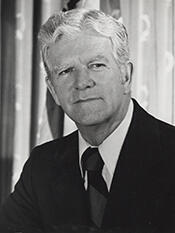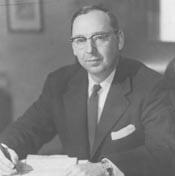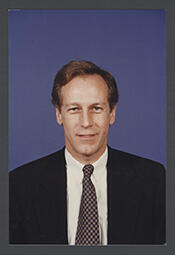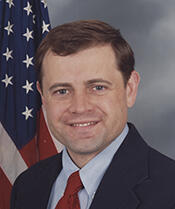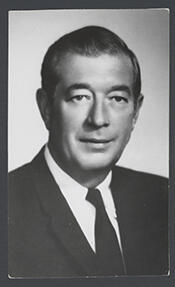
Thomas Nelms Downing (February 1, 1919 – October 23, 2001) was an American lawyer and Democratic politician who served nine consecutive terms as a United States Representative from Virginia’s 1st congressional district from 1959 to 1977. A member of the Democratic Party, he contributed to the legislative process during a significant period in American history and became most notable nationally for his role as chairman of the House Select Committee on Assassinations during his time in Congress.
Downing was born and raised in Newport News, Virginia, where he attended the public schools and graduated from Newport News High School. He continued his education at the Virginia Military Institute in Lexington, Virginia, receiving his degree in 1940. His early life in Newport News, a shipbuilding and military-oriented community, and his training at VMI helped shape the discipline and public-service orientation that would characterize his later legal and political career.
During World War II, Downing served in the United States Army from 1942 to 1946. His four years of military service coincided with the height of the global conflict and provided him with firsthand experience of the demands and responsibilities of national service. After his discharge from the Army, he pursued legal studies at the University of Virginia School of Law in Charlottesville, graduating in 1948. He was admitted to the bar and returned to the Tidewater region to practice law, establishing himself professionally while remaining closely connected to his home community.
In addition to his private legal practice, Downing served as a substitute judge of the municipal court of Warwick, Virginia, a jurisdiction adjacent to Newport News that later consolidated with it. His work on the municipal bench and in local legal affairs enhanced his reputation as a careful, measured attorney and gave him practical experience in the administration of justice at the local level. This combination of military service, legal training, and judicial experience laid the groundwork for his entry into elective office.
Downing was elected as a Democrat to the U.S. House of Representatives in 1958 and took his seat in the 86th Congress on January 3, 1959. Representing Virginia’s 1st congressional district, he was re-elected eight times, serving a total of 18 years in Congress before retiring in 1977. His electoral record reflected strong and often overwhelming support from his constituents. In 1958 he was elected unopposed; he was re-elected unopposed in 1960 and 1962. In 1964 he won with 78.71 percent of the vote, defeating Republican Wayne C. Thiessen. He again ran unopposed in 1966. In 1968 he was re-elected with 72.96 percent of the vote, defeating Republican James S. Stafford and Independent J. Cornelius Fauntleroy. In 1970 he faced no opposition, and in 1972 he was re-elected with 78.09 percent of the vote, defeating Republican Kenneth D. Wells. He was again unopposed in 1974. Downing declined to run for re-election in 1976 and left Congress at the conclusion of his ninth term in January 1977. Throughout this period he participated in the democratic process and represented the interests of his constituents during an era marked by the civil rights movement, the Vietnam War, and major shifts in national politics.
Downing’s most prominent national role came through his leadership of the House Select Committee on Assassinations. Appointed chairman by Speaker of the House Carl Albert, he was tasked with overseeing a renewed congressional investigation into the assassinations of President John F. Kennedy and Dr. Martin Luther King Jr. The committee was directed to examine evidence that had not been available to the Warren Commission during its original inquiry into Kennedy’s death. Downing had advocated for such a House investigation nearly two years before the committee’s formal creation, reflecting his longstanding interest in and skepticism about the official account of the assassination. Upon his retirement from Congress in 1977, he was succeeded as chairman of the committee by Representative Louis Stokes of Ohio.
In connection with the committee’s work, Downing publicly expressed his belief that there had been a conspiracy to assassinate President Kennedy. He stated that he was skeptical that Lee Harvey Oswald could have accurately fired a bolt-action rifle as rapidly as required by the lone-gunman theory and believed that film footage of the assassination indicated that Kennedy was struck from both the front and the rear. Downing advanced a speculative theory—one he acknowledged was without direct evidence—that anti-Castro Cuban exiles, angered by Kennedy’s failure to support them after the 1961 Bay of Pigs invasion, were involved in the killing, expecting that pro-Castro forces would be blamed in retaliation for attempts on Fidel Castro’s life by U.S. agents. In August 1976 he released affidavits from two men who claimed that Richard Nixon had approved a plan by a right-wing Cuban exile to “eliminate” left-wing Cuban exiles after the Bay of Pigs, and Downing said these statements raised the possibility that right-wing Cubans were involved in Kennedy’s assassination. “I am firmly convinced, I am sincerely convinced, that more than one person was shooting at President Kennedy in Dallas that day. It is so obvious to me,” he declared. At the same time, he later described Oliver Stone’s 1991 film “JFK,” which dramatized conspiracy theories about the assassination, as “implausible,” remarking that “it’s impossible to tell where fact stops and fiction starts, it blends in so well.” Contemporary observers noted both his integrity and his predisposition toward conspiracy explanations; columnist James J. Kilpatrick called him “a man of exceptional integrity and common sense” but “not altogether unbiased in the matter of Kennedy’s assassination,” while Robert P. Gemberling, who headed the FBI’s post–Warren Commission investigation for thirteen years, said in 1976 that Downing and his successor Henry B. González had “preconceived conspiracy theories.”
After leaving Congress in 1977, Downing retired from elective office and returned to private life in Virginia, remaining a respected figure in Newport News and the surrounding region. He died on October 23, 2001, at the age of 82, from complications of intestinal surgery. Thomas Nelms Downing was interred in Peninsula Memorial Park Cemetery in Newport News, Virginia, close to the community where he had been born, educated, and to which he had devoted much of his professional and public life.
Congressional Record