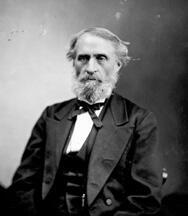
Thomas Lanier Clingman (July 27, 1812 – November 3, 1897), known as the “Prince of Politicians,” was an American lawyer, soldier, and legislator who served North Carolina in both houses of the United States Congress and later became a general in the Confederate States Army. A member of the Democratic Party for most of his national career, he was a Democratic member of the United States House of Representatives from 1843 to 1845 and from 1847 to 1858, and a United States senator from North Carolina between 1858 and 1861. His service in Congress, spanning seven terms in the House and continuing in the Senate, occurred during a significant and turbulent period in American history leading up to the Civil War.
Clingman was born in Huntsville, a small community in what is now Yadkin County, North Carolina, to Jacob and Jane Poindexter Clingman. He was named for his half-uncle, Dr. Thomas Lanier. Raised in the Piedmont region, he received his early education from private tutors and in the public schools of Iredell County, North Carolina. He entered the University of North Carolina and graduated in 1832, distinguishing himself as a member of the Dialectic Senate of the Dialectic and Philanthropic Societies, the university’s historic literary and debating organizations. After completing his collegiate studies, he read law, was admitted to the bar in 1834, and began practicing in his native Huntsville.
Clingman entered public life at an early age. In 1835 he was elected to the North Carolina House of Commons, marking the beginning of a long political career. The following year, in 1836, he moved west to Asheville, North Carolina, where he continued his legal practice and expanded his political base in the mountain region. He served in the North Carolina State Senate in 1840, gaining further legislative experience and visibility in state politics. His growing reputation as an orator and political strategist contributed to his later nickname, the “Prince of Politicians.”
In national politics, Clingman first won election to the United States House of Representatives in 1843 as a Whig, representing North Carolina in the Twenty-eighth Congress. He served from 1843 to 1845 but was defeated in his bid for reelection in 1845. That same year he engaged in a noted duel with Representative William Lowndes Yancey of Alabama, after Yancey, in his maiden speech on the House floor, impugned Clingman’s integrity; both men fired and missed, and the affair ended without injury. Clingman returned to Congress in 1847, this time as a Democrat, and held his seat through successive reelections in 1849, 1851, 1853, 1855, and 1857, contributing to the legislative process over seven House terms and representing the interests of his North Carolina constituents during an era of intensifying sectional conflict.
On May 6, 1858, Clingman was chosen to fill the United States Senate seat vacated by the resignation of Asa Biggs, and he resigned his House seat on May 7, 1858, to take up his new duties. As a Democratic senator from North Carolina, he served from 1858 until 1861, participating in debates over slavery, states’ rights, and the preservation of the Union. During the secession crisis and the outbreak of the Civil War, Clingman refused to resign his Senate seat even as North Carolina left the Union. For his open support of the Confederacy and his absence from Washington, he was among the southern senators formally expelled from the United States Senate in absentia. His congressional career thus ended in the context of the national rupture that he had long helped to shape through his advocacy of Southern positions.
With the onset of the Civil War, Clingman entered Confederate military service. He initially commanded the 25th North Carolina Infantry and took part in the Peninsula Campaign in Virginia. Promoted to command a brigade, he led what became known as Clingman’s Brigade, composed of the 8th, 31st, 51st, and 61st North Carolina Infantry regiments. Under his command, the brigade saw extensive action in some of the war’s major engagements, including the battles of Goldsborough, Battery Wagner, Drewry’s Bluff, Cold Harbor, Petersburg, Globe Tavern, Fort Fisher, and Bentonville. His role as a Confederate general placed him among the notable military leaders of North Carolina in the conflict.
After the Civil War, Clingman did not return to elective office but instead devoted much of his time to scientific and geographic pursuits, particularly the exploration and measurement of mountains in western North Carolina and eastern Tennessee. He became known for his careful measurements of the high peaks of the Great Smoky Mountains. One of these summits, Kuwohi—the highest mountain in Tennessee, shared with North Carolina—was renamed Clingman’s Dome in his honor in 1859, in recognition of his work in accurately determining its elevation, and he was long credited as the first person to measure it correctly. (The mountain’s official name was changed back to Kuwohi in 2024.) His postwar activities reflected a continued interest in the natural resources and topography of his native region.
Thomas Lanier Clingman spent his later years in North Carolina, remaining a figure of regional prominence as a former congressman, senator, and Confederate general. He died on November 3, 1897, in Morganton, North Carolina. His remains were interred in Riverside Cemetery in Asheville, North Carolina, where he is buried among other notable figures from the state’s political and military history.
Congressional Record