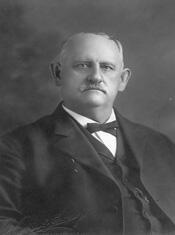
Thetus Willrette Sims (April 25, 1852 – December 17, 1939) was an American lawyer and Democratic politician who served twelve consecutive terms in the United States House of Representatives from Tennessee’s 8th congressional district between 1897 and 1921. Over the course of his long tenure in Congress, Sims became a significant figure in the legislative process during a transformative period in American history, participating in debates and policymaking that spanned the Progressive Era, World War I, and the early postwar years.
Sims was born on April 25, 1852, and grew up in Tennessee, where he received his early education. He attended Savannah College in Savannah, Tennessee, an institution that prepared him for advanced study and a professional career. Pursuing the law, he enrolled at the Cumberland School of Law at Cumberland University in Lebanon, Tennessee, one of the South’s leading law schools of the period. He graduated from Cumberland in June 1876 and was admitted to the bar later that same year, beginning a legal career that would form the foundation for his later public service.
On December 26, 1877, Sims married Nannie Kitrell. The couple established a family life in Tennessee and had seven children: Edna, Erskine, Tom, Elizabeth, Marie, Paul, and Enid. While building his legal practice, Sims became increasingly involved in local and state affairs, gaining a reputation as a capable attorney and a committed Democrat. His professional standing and political engagement positioned him to seek higher office at the national level as the 19th century drew to a close.
Sims was elected as a Democrat to the United States House of Representatives from Tennessee’s 8th congressional district and took his seat in the 55th Congress on March 4, 1897. His freshman term in the House spanned the years 1897 to 1899. He was subsequently reelected to each succeeding Congress, serving continuously from March 4, 1897, to March 3, 1921, for a total of twelve terms in office. During these years he represented his constituents through the Spanish-American War, the Progressive reform era, and World War I, participating in the democratic process and contributing to the development of federal legislation affecting both Tennessee and the nation.
Within the House of Representatives, Sims rose to positions of leadership and influence. During the 62nd Congress, from 1911 to 1913, he served as chairman of the United States House Committee on War Claims, overseeing matters related to compensation for losses and damages arising from military actions and federal wartime activities. Later, in the 65th Congress, from 1917 to 1919, he became chairman of the United States House Committee on Interstate and Foreign Commerce, a powerful committee with jurisdiction over transportation, trade, and emerging regulatory issues in an era of rapid industrial and commercial expansion. In these roles, Sims helped shape important aspects of federal policy and regulation.
Sims was also known for his advocacy on major social and cultural questions of his time. He was an important advocate for the Nineteenth Amendment to the United States Constitution, which granted women the right to vote. His support aligned with the broader suffrage movement and was particularly significant given that Tennessee became the last state to ratify the Nineteenth Amendment, providing the decisive approval needed for its adoption in 1920. In addition, he was associated with the legislation commonly known as the Sims Act, which forbade the interstate transportation of fight films, primarily boxing films, following public controversy after the Johnson v. Flynn fight in 1912. Enacted as the first instance of congressional censorship directed specifically at motion pictures, the Sims Act remained in force until 1940 and marked an early federal intervention in the regulation of film content and interstate commerce in entertainment.
Despite his long service, Sims’s congressional career came to an end when he failed to win reelection in 1920 for the 67th Congress, which would have convened from 1921 to 1923. Leaving office on March 3, 1921, he concluded nearly a quarter-century in the House of Representatives. His departure coincided with shifting political currents in the post–World War I period, as voters across the country reassessed priorities in the wake of war, economic change, and the onset of the 1920s.
After leaving Congress, Sims returned to Tennessee and resumed the practice of law in Lexington, in Henderson County. He continued in legal work for several years, remaining engaged in professional and community affairs. With the onset of the Great Depression at the end of the 1920s, he withdrew from active business pursuits, retiring in 1930. Following his retirement, he returned to Washington, D.C., where he spent his later years. Thetus Willrette Sims died on December 17, 1939, closing a life that had spanned from the antebellum era through the New Deal and leaving a record of extended legislative service, party leadership, and engagement with some of the central political and social issues of his time.
Congressional Record