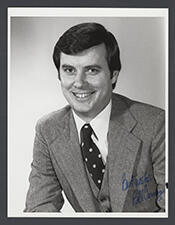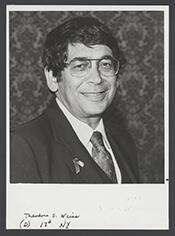
Theodore S. Weiss (September 17, 1927 – September 14, 1992) was an American Democratic Party politician who served as a Representative from New York in the United States Congress from January 3, 1977, until his death in 1992. Over eight terms in office, he represented most of Manhattan’s West Side and became known as an outspoken liberal voice on civil rights, open government, workers’ rights, health care, and the arts. His congressional service occurred during a significant period in American history, and he participated actively in the legislative process while representing the interests of his constituents.
Weiss was born in 1927 in the Hungarian village of Gáva, now Gávavencsellő, then part of Hungary. He immigrated to the United States in 1938 with his family, settling in South Amboy, New Jersey, where he grew up. He attended local public schools and graduated from H.G. Hoffman High School in South Amboy in 1946. Shortly after completing high school, he entered the United States Army, serving from 1946 to 1947 in the immediate post–World War II period. Following his military service, Weiss enrolled at Syracuse University, where he earned a bachelor’s degree in 1951, and he continued at Syracuse University College of Law, receiving his LL.B. in 1952. He became a naturalized citizen of the United States in 1953. Weiss married Sonya Weiss, and the couple had two children.
After completing his legal education, Weiss embarked on a career in law and public service in New York. From 1955 to 1959, he served as an assistant New York County District Attorney, gaining experience in criminal prosecution and the workings of the city’s justice system. After leaving the district attorney’s office, he returned to private legal practice in New York. His growing involvement in civic and political affairs led him into elective office, and he emerged as a prominent figure in New York City’s liberal Democratic circles.
Weiss was elected to the New York City Council in 1962 and served there until 1976. During his fourteen years on the Council, he developed a reputation as a persistent advocate for liberal causes, including civil rights, government transparency, union and workers’ rights, and support for the arts. He was also active in national party politics and served as a delegate to the 1972 Democratic National Convention. His work on the Council and within the Democratic Party established the foundation for his later congressional career and helped solidify his standing as a representative of Manhattan’s progressive political tradition.
In 1976, Weiss was elected to the United States House of Representatives as a Democrat, winning a seat that encompassed most of Manhattan’s West Side. He entered Congress on January 3, 1977, and remained in office until his death in 1992. Over eight terms in the House of Representatives, he contributed to the legislative process and participated fully in the democratic governance of the period. Weiss served on several key committees, including the House Committee on Banking, Finance, and Urban Affairs, the House Committee on Government Operations, and the House Committee on Foreign Affairs. Within these assignments he pursued issues related to consumer protection, regulatory oversight, foreign policy, and urban affairs, often emphasizing the interests of his New York City constituents.
Weiss became particularly noted for his oversight work and his advocacy on public health and regulatory matters. In 1985, he headed a congressional committee that investigated the use of pharmaceuticals in agriculture and found that approximately 90 percent of the twenty to thirty thousand new drugs used on farm animals had not been approved by the Food and Drug Administration, in violation of the Federal Food, Drug, and Cosmetic Act. The committee also determined that the FDA had failed to remove several drugs already known to be carcinogens, highlighting serious gaps in federal regulatory enforcement. Weiss was an early and forceful leader in the fight for increased federal funding to address the HIV/AIDS epidemic. In 1983, he convened the first congressional hearing on the federal government’s response to AIDS, pressing health officials and the administration to recognize the scope of the crisis and to commit greater resources to research, treatment, and prevention.
Consistent with his broader liberal record, Weiss was an avid supporter of civil rights, open government, access to health care, and labor protections, and he frequently advocated the removal of the U.S. embargo on Cuba and greater support for the arts. He was also active on issues of peace and foreign policy. In 1983, following the sudden and unexpected U.S. invasion of Grenada, he joined seven other representatives in sponsoring a resolution to impeach President Ronald Reagan, reflecting his deep concern about executive overreach and the use of military force without adequate congressional consultation. Domestically, Weiss played a prominent role in local and regional controversies affecting New York. He was involved in efforts to block the proposed Westway highway project along Manhattan’s West Side, opposing it over environmental and urban-planning concerns after decades of debate. He also joined campaigns against a 1983 U.S. Navy plan to station nuclear-capable vessels, notably the battleship USS Iowa (BB-61), at a new base at Stapleton, Staten Island, citing safety and strategic objections.
On September 14, 1992, Weiss died from heart failure at Columbia Presbyterian Medical Center in New York City, three days before the Democratic primary election for the renumbered 8th congressional district and just three days short of what would have been his sixty-fifth birthday. Because of his ailing health, five Democrats had entered the primary to challenge him, yet Weiss posthumously won the nomination by a large margin, underscoring his enduring popularity among his constituents. Following his death, New York State Assemblyman Jerry Nadler was named to replace Weiss on the ballot. Nadler subsequently won a special election to serve the remainder of Weiss’s eighth term and a regular election for a full two-year term, and he continues to hold the seat as of 2025. In recognition of Weiss’s long service and influence, the Ted Weiss Federal Building in Lower Manhattan, adjacent to the African Burial Ground National Monument, was named in his honor in 2003.
Congressional Record