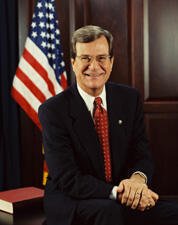
William Thad Cochran (December 7, 1937 – May 30, 2019) was an American attorney and Republican politician who represented Mississippi in the United States Congress from 1973 to 2018, serving first in the U.S. House of Representatives and then in the U.S. Senate. Born in Pontotoc, Mississippi, he was the son of Emma Grace (née Berry) and William Holmes Cochran, a teacher and school principal, respectively. After several moves around northern Mississippi, his family settled in Hinds County, home of the state capital, Jackson, in 1946. Cochran graduated as valedictorian from Byram High School near Jackson, reflecting the academic discipline that would characterize his later legal and political career.
Cochran attended the University of Mississippi in Oxford, where he received a Bachelor of Arts degree in 1959 with a major in psychology and a minor in political science. At Ole Miss he joined the Pi Kappa Alpha fraternity, served on the cheerleading squad—alongside future U.S. Senator Trent Lott—and was elected to the Phi Kappa Phi honor society. During summers he worked as a lifeguard at Livingston Lake in Jackson. Following his undergraduate studies, he served in the United States Navy from 1959 to 1961, commissioned as an ensign aboard the USS Macon. After his naval service, Cochran returned to the University of Mississippi School of Law, earning a Juris Doctor in 1965. In law school he won the Frederick Hamel Memorial Award for having the highest scholastic average in the first-year class and served on the editorial board of the Mississippi Law Journal. Upon graduation, he joined the Jackson law firm Watkins & Eager, where he practiced for several years and was promoted to partner. His formal entry into Republican politics began in 1968, when Lamar Alexander recruited him to chair Citizens for Nixon–Agnew in Mississippi.
Cochran’s congressional career began in the U.S. House of Representatives, where he served from 1973 to 1978. In 1972, Jackson lawyer Mike Allred and oilman Billy Mounger, both Republicans, recruited him to run for Congress in Mississippi’s 3rd congressional district after Democratic Representative Charles H. Griffin chose not to seek a third full term. Following redistricting, the district was renumbered as the 4th District, centered on Jackson and portions of southwest Mississippi. Cochran won the Republican nomination and defeated Democratic state senator Ellis B. Bodron in the general election, 47.9% to 44%, aided in part by President Richard Nixon’s strong performance in Mississippi and by the candidacy of independent Eddie McBride, who drew Black voters away from Bodron. Cochran and Trent Lott thus became only the second and third Republicans elected to represent Mississippi in the House since Reconstruction. He was re-elected in 1974 with 70.2% of the vote, losing only the Black-majority counties of Claiborne and Jefferson, and again in 1976 with 76% of the vote, victories he characterized as endorsements of his views on reducing inflation and unnecessary federal spending. Over these three terms, Cochran contributed to the legislative process as a Republican member of the House during a period of significant political and economic change in the United States.
In 1978, Cochran successfully sought election to the U.S. Senate following the retirement of six-term Democratic Senator James Eastland. He won the Republican primary by defeating state senator Charles W. Pickering, 69% to 31%. In the general election he faced Democrat Maurice Dantin and Independent Charles Evers, the mayor of Fayette and a prominent civil rights figure. Evers’s candidacy split the Democratic vote, and Cochran prevailed with 45.3% of the vote to Dantin’s 31.8% and Evers’s 22.6%. This victory made Cochran the first Republican to win a U.S. Senate election in Mississippi since Reconstruction and the first Republican to win a statewide election in Mississippi in a century. Eastland resigned his seat on December 27, 1978, and Governor Cliff Finch appointed Cochran to serve the final week of Eastland’s term, giving Cochran a slight seniority advantage over other incoming senators. Cochran went on to be re-elected to the Senate by wide margins: he defeated Democratic Governor William Winter in 1984 by 60.9% to 39.1%, was unopposed in 1990, won 71% of the vote in 1996 against Democrat Bootie Hunt, faced no Democratic opponent in 2002, and defeated Reform Party candidate Shawn O’Hara with 84.6% of the vote. In 2008, despite a strong national year for Democrats, he defeated Democratic State Representative Erik R. Fleming 61.4% to 37.6%. In 2014, after a contentious Republican primary and runoff against Tea Party–backed state senator Chris McDaniel—marked by narrow margins, allegations of irregularities, and a scandal involving unauthorized photographs of Cochran’s ailing wife—he secured the nomination in a June 24 runoff with 51.01% to McDaniel’s 48.99%, and then defeated Democratic former U.S. Representative Travis Childers in the general election, 59.90% to 37.89%.
Over the course of his seven Senate terms, from 1978 until his resignation in 2018, Cochran became one of the longest-serving members of Congress in Mississippi history, with more than 45 years of combined House and Senate service, second only to Representative Jamie L. Whitten. His Senate career coincided with a significant period in American history, and as a member of the Senate he participated in the democratic process and represented the interests of his Mississippi constituents while maintaining a relatively low national profile. Within the chamber, however, he wielded substantial influence, particularly through his work on appropriations and agriculture. Cochran served as Vice Chairman of the Senate Republican Conference from 1985 to 1991 and as Chairman from 1991 to 1996. He chaired the Senate Agriculture Committee from 2003 to 2005, and the Senate Appropriations Committee from 2005 to 2007 and again from 2015 to 2018, becoming the first Republican from a former Confederate state to lead that powerful committee. He was known for his quiet, methodical style and his focus on securing federal resources for Mississippi, notably in the aftermath of Hurricane Katrina, when he was credited with obtaining approximately $29 billion in relief funding for the Gulf Coast. Time magazine in April 2006 named him one of “America’s 10 Best Senators,” calling him “The Quiet Persuader” for his effectiveness in winning support for his priorities with minimal public confrontation.
Cochran’s legislative record reflected a generally conservative but comparatively moderate Republican profile. The National Journal gave him a composite ideology score of 68% conservative and 33% liberal, and a 2017 analysis by The New York Times ranked him among the more moderate Republican senators. He supported President Ronald Reagan’s early budget-cutting efforts, including a 1981 freeze on dairy price supports, and co-sponsored bipartisan initiatives such as a six-year experiment to expand in-home care for the elderly and disabled. In 1991 he introduced legislation to create a presidential commission to oversee federal recognition of Indian tribes, arguing that such matters were better handled by a specialized body than by Congress. He ran unsuccessfully for Senate Majority Leader in 1996, losing to Trent Lott, whom he contrasted with his own more institutionalist, compromise-oriented approach. Cochran opposed President Barack Obama’s health care reforms, voting against both the Patient Protection and Affordable Care Act in December 2009 and the Health Care and Education Reconciliation Act of 2010. On civil rights symbolism, he accepted the use of Jefferson Davis’s Senate desk and opposed efforts to remove a statue of Davis from the U.S. Capitol. In 2005 he was one of 20 senators who did not cosponsor the Senate’s formal apology for failing to enact a federal anti-lynching law, stating that while he deplored lynching and regretted the lack of punishment for perpetrators, he did not see himself as culpable for past congressional inaction.
On specific policy issues, Cochran’s positions often aligned with core conservative constituencies in Mississippi. He had an A+ rating from the NRA Political Victory Fund, which endorsed him in 2014, and he consistently supported pro-gun legislation. He voted against a 2013 bill to expand background checks for gun buyers and supported repealing a regulation that restricted gun purchases by certain individuals with specific mental health diagnoses, arguing that it infringed on the Second Amendment rights of disabled people. In 2005 he was one of nine senators to vote against the Detainee Treatment Act, which prohibited inhumane treatment of prisoners, including those at Guantánamo Bay. In 2006 he was one of 19 Republican senators to vote for the Stem Cell Research Enhancement Act, favoring the easing of federal funding restrictions on such research. He was also a prolific user of congressional earmarks, and in 2010 Citizens Against Government Waste reported that he topped their list of earmark sponsors, having requested approximately $490 million. In environmental and energy policy, he was among 22 senators who in 2017 urged President Donald Trump to withdraw the United States from the Paris Agreement; campaign finance records indicated he had received more than $290,000 from oil, gas, and coal interests since 2012. He was active in disaster preparedness and response, encouraging Mississippians in 2012 to prepare for Tropical Storm Isaac and expressing confidence in state and local emergency management.
In his later years in office, Cochran’s health became an increasing concern. In late 2017 he missed two weeks of Senate sessions due to a urological procedure, and observers in Washington noted signs of frailty and disorientation, including an incident in which he repeatedly voted “yes” on a measure despite aides instructing him to vote “no,” later correcting his vote. He publicly downplayed speculation about his imminent retirement, but on March 5, 2018, he announced that he would step down from the Senate due to ongoing health challenges. Cochran left office on April 1, 2018, concluding a congressional tenure that, spanning from his first House term in 1973 through his final Senate term in 2018, encompassed 10 terms in Congress and nearly half a century of service. William Thad Cochran died on May 30, 2019, in Oxford, Mississippi, leaving a legacy as one of his state’s longest-serving and most influential federal lawmakers, known for his quiet demeanor, mastery of the appropriations process, and steadfast representation of Mississippi’s interests in the United States Congress.
Congressional Record