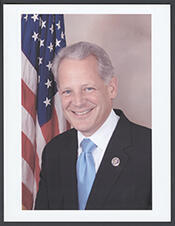
Steven Jay Israel (born May 30, 1958, in Brooklyn, New York) is an American political commentator, lobbyist, author, bookseller, and former politician who served as a Representative from New York in the United States Congress from 2001 to 2017. Raised in the Long Island community of Levittown, New York, he grew up in a postwar suburban environment that would later shape his understanding of middle-class concerns and suburban political dynamics. A member of the Democratic Party, Israel would go on to represent key portions of Long Island and a small part of New York City in the House of Representatives during a significant period in American history, participating in the democratic process and representing the interests of his constituents over eight consecutive terms in office.
Israel attended Nassau Community College and Syracuse University before completing his undergraduate education at George Washington University in Washington, D.C., where he earned a Bachelor of Arts degree in 1982. His time in the nation’s capital exposed him early to the workings of the federal government and national politics. Shortly after graduation, he became a staff member for U.S. Representative Richard Ottinger of New York, gaining firsthand experience in legislative operations, constituent services, and policy development. This early professional grounding in congressional work provided the foundation for his later career as an elected official.
Israel’s formal entry into elective office came at the local level. In 1993, he was elected to the town council in Huntington, New York, on Long Island. As a member of the Huntington Town Board, he developed a reputation for local governance and community engagement, building the political base and public profile that would support his eventual run for Congress. His service on the town board positioned him as a rising Democratic figure in a region that often featured competitive, swing-district politics.
Israel was first elected to the U.S. House of Representatives in the November 7, 2000, general election, following the decision of Republican Representative Rick Lazio to vacate his seat in order to run for the United States Senate. In that race, Israel received 48% of the vote, defeating Republican nominee Joan Johnson, who received 34%, along with four independent candidates. A member of the Democratic Party, he initially represented New York’s 2nd congressional district and, after redistricting, New York’s 3rd congressional district. At the time of his departure from Congress in January 2017, his district included portions of northern Nassau County and Suffolk County on Long Island, as well as a small portion of Queens in New York City. He was reelected seven times with relatively little difficulty, despite representing a district that was considered a swing seat on paper.
During his eight terms in Congress, from January 3, 2001, to January 3, 2017, Israel contributed to the legislative process and held a number of influential committee and leadership positions. He served on the powerful House Committee on Appropriations, including the Subcommittee on Energy and Water Development, the Subcommittee on State, Foreign Operations, and Related Programs, and the Subcommittee on Military Construction, Veterans Affairs, and Related Agencies. Within the Democratic Caucus, he served as an Assistant Democratic Whip and chaired the House Democratic Caucus Task Force on Defense and the Military, a group of 15 Democratic House members that engaged with the defense community and advised party leadership on military policy. He also co-chaired the House Democratic Study Group on National Security Policy. Beyond formal leadership, Israel was co-chair and founder of the bipartisan Congressional Center Aisle Caucus, and he served as co-chair of the House Cancer Caucus and the Long Island Sound Caucus, reflecting his interest in health policy and regional environmental issues.
Israel’s voting record and public positions placed him within the mainstream of contemporary Democratic policy, with particular emphasis on national security, social issues, and gun control. In October 2002, he voted to authorize President George W. Bush to use military force in Iraq, even though more than 60 percent of his Democratic colleagues in the House opposed the authorization. In domestic policy, he consistently supported abortion rights; he stated that he supported legal abortions in cases of rape, incest, and threat to the life of the mother, and he opposed legislation that would prohibit federal funding for abortions, eliminate federal funding for Planned Parenthood, or restrict abortions after 20 weeks of pregnancy. Since 2004 he received 100% ratings from pro-choice organizations including NARAL, Planned Parenthood, and the National Family Planning & Reproductive Health Association, and a 0% rating from the National Right to Life Committee. On gun policy, he supported increased gun control, voting against measures that would reduce federal regulation of firearms safety and sales, and cosponsoring the 2009 “No Fly, No Buy” Act, which sought to prevent individuals on federal no-fly lists from purchasing firearms. He received an “F” rating from the NRA Political Victory Fund and 0% from Gun Owners of America, while earning 100% ratings from the Brady Campaign to Prevent Gun Violence and the Coalition to Stop Gun Violence. He was also an original cosponsor of H.R. 3626 in the 113th Congress, which extended the Undetectable Firearms Act of 1988 for ten years without expanding its provisions. Among his legislative initiatives, on July 4, 2013, he announced legislation that would require all U.S. national parks to sell only merchandise that is made in the United States.
Israel’s prominence within the Democratic Party grew steadily. In his second term he was named an Assistant Whip, and in his third term he was appointed chair of the House Democratic Caucus Task Force on Defense and the Military. A close ally of House Democratic Leader Nancy Pelosi, he was frequently mentioned in 2010 as a potential successor to Representative Chris Van Hollen as chair of the Democratic Congressional Campaign Committee (DCCC). After the 2010 midterm elections, Pelosi selected him to lead the DCCC, a post he held from 2011 to 2015. Observers noted that his experience representing a district where Democrats held only a modest registration edge, and where independent voters often decided elections, made him well suited to candidate recruitment and fundraising in competitive districts. From 2015 to 2017, he chaired the House Democratic Policy and Communications Committee, helping to shape and articulate the party’s national message. During his tenure, he was one of the few Democrats to run campaign advertisements explicitly defending his vote in favor of the Affordable Care Act. He also engaged in public debates on foreign policy and Middle East issues; in 2006, responding to former President Jimmy Carter’s book “Palestine: Peace Not Apartheid,” Israel stated, “I disagree with President Carter fundamentally. The reason for the Palestinian plight is the Palestinians.” His support for the Occupy Wall Street movement drew criticism from some conservatives who alleged the movement harbored anti-Semitic elements, to which Israel responded by citing both his strong support for the State of Israel and his own Jewish heritage. He also supported proposals to study the feasibility of moving federal elections from Tuesdays to weekend voting in order to increase voter participation.
On January 5, 2016, Israel announced that he would not seek reelection in the November 2016 elections, bringing to a close 16 years of service in the House of Representatives. After leaving Congress in January 2017, he transitioned to a career in media, academia, and consulting. He joined CNN as a political commentator, offering analysis of national politics and congressional affairs. In 2019, he was appointed the inaugural director of the Institute of Politics and Global Affairs at Cornell University, a role that placed him at the intersection of scholarship, public policy, and civic engagement. In addition to his work in broadcasting and academia, Israel became involved in the private sector; by 2022, he was serving on the Board of Advisors for the lobbying and consulting firm Michael Best Strategies. Alongside these roles, he has also been active as an author and bookseller, extending his public career beyond elective office while remaining engaged in national political discourse.
Congressional Record