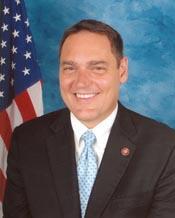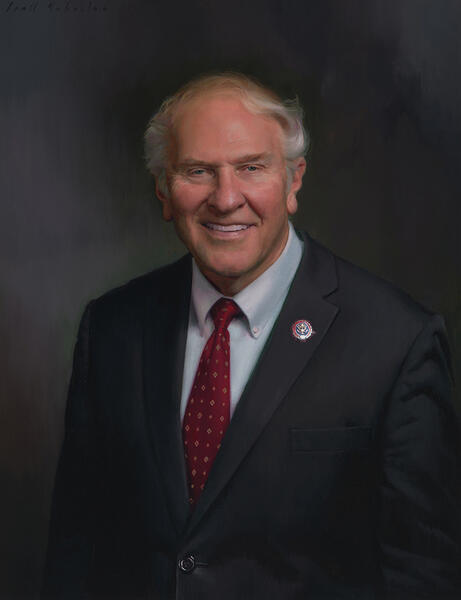
Steven Joseph Chabot (born January 22, 1953, in Cincinnati, Hamilton County, Ohio) is an American politician, lawyer, and former elementary school teacher who served as a Republican member of the United States House of Representatives from 1995 to 2023. The son of Gerard Joseph Chabot and Doris Leona (née Tilley) Chabot, he is paternally of French-Canadian descent. Raised in Cincinnati, he attended La Salle High School, from which he graduated in 1971. His early life in Cincinnati and subsequent public service would root his political career firmly in the communities of southwestern Ohio.
After completing high school, Chabot enrolled at the College of William and Mary in Williamsburg, Virginia, where he earned a Bachelor of Arts degree in physical education in 1975. Following his undergraduate studies, he returned to the Cincinnati area and pursued legal training at the Salmon P. Chase College of Law at Northern Kentucky University. While attending law school at night, he worked as an elementary school teacher during the 1975–1976 school year. He received his Juris Doctor degree in 1978. In addition to his early teaching experience, Chabot later taught political science at the University of Cincinnati and became active in civic organizations, including serving as chair of the Boy Scouts of Cincinnati.
From 1978 to 1994, Chabot practiced law as a sole practitioner in a small office in the Westwood neighborhood of Cincinnati, focusing on domestic relations matters and the drafting of wills. His first forays into electoral politics came at the local level. He ran unsuccessfully for the Cincinnati City Council as an independent candidate in 1979 and again as a Republican in 1983. In 1985, he won election to the City Council as a Republican and was reelected for the next four years, building a local political base. In 1988, he sought federal office for the first time, running for the U.S. House of Representatives against seven-term Democratic incumbent Tom Luken, who defeated him by a margin of 56 percent to 44 percent.
Chabot continued his public service in county government. In 1990, he was appointed a Commissioner of Hamilton County, Ohio, and later that year won election to the post in his own right. He was reelected as county commissioner in 1992 and served in that capacity until 1994. In the 1994 election cycle, amid a national Republican wave, Chabot again sought a seat in the U.S. House of Representatives. That year he ran in Ohio’s 1st congressional district and defeated Democratic incumbent David S. Mann by a margin of 56 percent to 44 percent, beginning a long tenure in Congress that would span 13 terms over nearly three decades.
Chabot represented Ohio’s 1st congressional district in the United States House of Representatives from January 3, 1995, to January 3, 2009, and again from January 3, 2011, to January 3, 2023. During this period, he participated in the legislative process through committee work, floor votes, and constituent representation, serving during a significant era in American political history marked by shifts in party control, major domestic policy debates, and U.S. involvement in overseas conflicts. As a member of the House of Representatives, he took part in the democratic process and represented the interests of his constituents in Cincinnati, Hamilton County, and, after redistricting, portions of Warren County. Over the course of his service, he became the dean of Ohio’s Republican delegation to the House following the retirement of Speaker John Boehner, a status he held until his second electoral defeat.
Throughout his congressional career, Chabot faced a series of competitive reelection campaigns. After his initial victory in 1994, he was reelected in 1996, defeating Democrat Mark Longabaugh, a member of the Cincinnati City Council, by 54 percent to 43 percent. In 1998, he prevailed over Cincinnati Mayor Roxanne Qualls, 53 percent to 47 percent, responding in debates to criticism that he did not secure sufficient federal spending for the district by asserting his opposition to “wasteful or unnecessary” federal programs. He defeated Cincinnati City Councilman John Cranley in 2000 by 53 percent to 44 percent, and won reelection in 2002 against Democrat Greg Harris with 65 percent of the vote, and again in 2004 against Harris with 60 percent. In 2006, he once more faced Cranley and was reelected by a narrower margin of 52 percent to 48 percent. In 2008, amid a challenging national environment for Republicans, he lost his reelection bid to Democratic State Representative Steve Driehaus, 52 percent to 48 percent, temporarily interrupting his congressional service.
Chabot returned to Congress following the 2010 election. In a rematch that year, he defeated incumbent Steve Driehaus, as well as Libertarian candidate Jim Berns and Green Party nominee Richard Stevenson, winning with 52 percent of the vote. Benefiting from the 2010 round of redistricting, which shifted much of heavily Republican Warren County into Ohio’s 1st congressional district, he defeated Democratic nominee Jeff Sinnard in 2012 by 58 percent to 38 percent, with Green and Libertarian candidates receiving the remainder. He was reelected in 2014 over Democrat Fred Kundrata by 63 percent to 37 percent, and in 2016 over Democrat Michele Young by 59 percent to 41 percent. In 2018, he defeated Democratic nominee Aftab Pureval by 51 percent to 48 percent, with Libertarian Dirk Kubala taking the remaining votes. In 2020, he won reelection against Democrat Kate Schroder by 52 percent to 45 percent, with Libertarian Kevin David Kahn receiving the balance. In 2022, after nearly three decades of intermittent service and 13 terms in Congress, he was defeated by Democrat Greg Landsman. His tenure in the House, spanning from 1995 to 2009 and 2011 to 2023, marked him as a long-serving Republican representative from Ohio who played a sustained role in the legislative and representative functions of the federal government during a transformative period in American political life.
Congressional Record