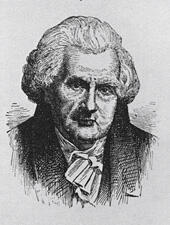
Stephen Mix Mitchell (December 9, 1743 – September 30, 1835) was an American lawyer, jurist, and statesman from Wethersfield, Hartford County, Connecticut, who became a prominent figure in both state and national public life during the formative years of the United States. Born in Wethersfield to James and Rebecca Mitchell, he spent nearly his entire long life in the town of his birth, ultimately dying there at the age of ninety-one. His career spanned the colonial era, the American Revolution, the Confederation period, and the early decades of the federal republic, placing him at the center of many of the legal and political transformations of his time.
Mitchell pursued academic studies at Yale College in New Haven, Connecticut, from which he graduated in 1763. Demonstrating early scholarly promise, he remained at Yale as a tutor from 1766 to 1769. During this period he studied law both in New Haven and under the guidance of noted lawyer Jared Ingersoll. He was admitted to the bar in 1770 and commenced the practice of law in Newton, Connecticut. In 1772 he returned to Wethersfield, where he continued his legal practice and began to build the reputation that would carry him into public office. He married Hannah Grant, and together they had eleven children: Donald Grant Mitchell, Stephen Mix Mitchell, Lewis Mitchell, Charles Mitchell, Rebecca Mitchell, Alfred Mitchell (who would become the father of the author Donald Grant Mitchell), Walter Mitchell, Hannah Grant Mitchell, Harriet Mitchell, Elizabeth Mitchell Chester, and Julia Mitchell.
Mitchell’s public career began in state and local service during the Revolutionary era. He was a member of the Connecticut House of Representatives from 1778 to 1784, participating in the governance of the state while the new nation was fighting for and consolidating its independence. At the same time, he advanced in the judiciary: he served as associate justice of the county court of Hartford County from 1779 to 1790 and then as presiding judge of that court from 1790 to 1793. On the broader stage, he represented Connecticut as a delegate to the Continental Congress from 1783 to 1788, taking part in the national deliberations under the Articles of Confederation. He was also a member of the Connecticut Council of Assistants from 1784 to 1792, with the exception of 1786, and in 1788 he served as a member of the state convention that ratified the Constitution of the United States, aligning himself with the movement to establish a stronger federal government. In 1790 he stood for election to Connecticut’s five at-large seats in the United States House of Representatives, finishing ninth in a field where only the top five were elected, and also ran in a special election caused by Pierpont Edwards’ refusal to serve, in which he finished fifth.
Mitchell’s service in the national legislature continued under the new constitutional government. When Senator Roger Sherman of Connecticut died in 1793, Governor Samuel Huntington appointed Stephen Mix Mitchell to fill the resulting vacancy in the United States Senate. A member of the Pro-Administration Party, he took his seat on December 2, 1793, and served until March 3, 1795. During this single term in office, he contributed to the legislative process in the early years of the federal government, participating in the democratic process and representing the interests of his Connecticut constituents at a time when the institutions and precedents of the new republic were still being formed. His senatorial service occurred during a significant period in American history, as the Washington administration and Congress addressed foundational questions of finance, foreign policy, and the scope of federal authority. Mitchell did not seek re-election in 1794, choosing instead to return to Connecticut to resume and elevate his judicial career.
Upon leaving the Senate, Mitchell accepted appointment to the Connecticut Supreme Court, beginning his service there in 1795. He remained on the state’s highest court for nearly two decades. In 1807 he was elevated to the position of chief justice of the Connecticut Supreme Court, a post he held until 1814. His tenure as chief justice coincided with a period of important legal development in the early republic, and in recognition of his standing in the legal community, Yale College awarded him the honorary degree of Doctor of Laws (LL.D.) in September 1807. In addition to his judicial responsibilities, he continued to play a role in public affairs: he served as a presidential elector on the Federalist ticket in the election of 1800 and later was a delegate to the Connecticut state constitutional convention of 1818, which produced a new state constitution and restructured aspects of Connecticut’s government.
Mitchell retired from the bench in 1814, when he became legally disqualified from further judicial service by reason of age, and returned to private life in Wethersfield. He remained a respected elder statesman in his community and within Connecticut’s legal and political circles. Stephen Mix Mitchell died in Wethersfield, Connecticut, on September 30, 1835, at the age of 91 years and 295 days. He was interred in Wethersfield Cemetery. His legacy extended into the literary world through his grandson, the author Donald Grant Mitchell, son of Alfred Mitchell, thus linking the long public career of a Revolutionary-era jurist and senator with the cultural life of the later nineteenth century.
Congressional Record