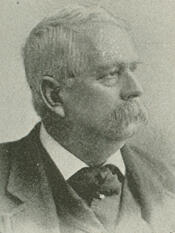
Stephen Ross Harris (May 22, 1824 – January 15, 1905) was an American lawyer and Republican politician who served one term as a United States Representative from Ohio from 1895 to 1897. His congressional service took place during a significant period in American history, and as a member of the House of Representatives he participated in the democratic process and represented the interests of his Ohio constituents. He was an uncle of Ebenezer Byron Finley, who also served in Congress.
Harris was born on May 22, 1824, seven miles west of Massillon, Stark County, Ohio. He was raised in the region and educated in the local common and select schools, reflecting the typical educational path of many mid‑19th‑century professionals from rural Ohio. Demonstrating early academic promise, he pursued further studies at several institutions, including Washington College in Pennsylvania, the Norwalk Seminary in Norwalk, Ohio, and Western Reserve College, then located in Hudson, Ohio.
After completing his formal education, Harris studied law and prepared for admission to the bar. In 1849 he was admitted to the bar and commenced the practice of law in Columbus, Ohio. Later that same year he moved to Bucyrus, in Crawford County, Ohio, where he continued his legal practice. In 1850 he entered into a law partnership with Josiah Scott, a professional association that continued until Scott’s death in 1879, except for the period during which Scott served as a justice on the Ohio Supreme Court. This long-standing partnership helped establish Harris as a prominent attorney in north-central Ohio.
In addition to his legal work, Harris became active in local public affairs. He served as mayor of Bucyrus in 1852, 1853, 1861, and 1862, demonstrating the confidence his community placed in his leadership over a span of years that included the opening phase of the Civil War. In 1861 he also served as a deputy United States marshal, further extending his involvement in public service at the federal level. By the early 1890s, his standing within the profession was recognized statewide when he served as president of the Ohio State Bar Association in 1893 and 1894.
Harris’s long legal and civic career culminated in his election to the United States House of Representatives. A member of the Republican Party, he was elected to the Fifty-fourth Congress and served from March 4, 1895, to March 4, 1897, representing an Ohio district in the U.S. House of Representatives. During this single term in office, he contributed to the legislative process and participated in the work of Congress at a time of economic and political transition in the post-Reconstruction and Gilded Age United States. He sought reelection in 1896 to the Fifty-fifth Congress but was unsuccessful, bringing his formal congressional career to a close after one term.
Following his departure from Congress, Harris returned to Bucyrus and resumed the practice of law. He continued to be engaged in his profession there for the remainder of his life, maintaining the role of a respected attorney and elder statesman in the community he had served for decades. His later years were spent in the same town where he had built his legal practice and held municipal office.
On September 15, 1853, Harris married Mary Jane Monnett. Their marriage produced two sons and two daughters, all of whom survived their mother, who died in 1888. Harris lived as a widower for the rest of his life. He died in Bucyrus, Ohio, on January 15, 1905, and was interred in Oakwood Cemetery. His career, spanning local office, professional leadership, and national legislative service, reflected the trajectory of a 19th‑century lawyer-politician who rose from rural Ohio origins to a seat in the United States Congress.
Congressional Record