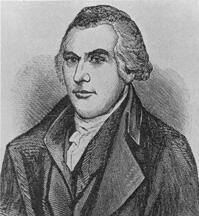
Stephen Row Bradley (February 20, 1754 – December 9, 1830) was an American lawyer, judge, and politician who became one of Vermont’s first United States Senators and a significant figure in the early federal Congress. He was born on February 20, 1754, in the part of Wallingford, Connecticut, that is now Cheshire, the son of Moses Bradley and Mary (Row) Bradley. His family background included a strong tradition of public service and martial valor: he was the grandson of Stephen Bradley, a New Haven silversmith who was one of six brothers who served in Oliver Cromwell’s Ironsides before emigrating to America. This heritage of civic and military engagement helped shape Bradley’s later roles in both the Revolutionary era and the formative years of the United States.
Bradley pursued higher education at Yale College, from which he graduated in 1775, just as the American Revolutionary War was beginning. After his graduation, he was commissioned as a captain in the Connecticut Militia and rose to the rank of major. He commanded the Cheshire Volunteers and, in December 1776, served as adjutant. Over the course of his service he was promoted to vendue master—an auctioneer of seized enemy and Loyalist property—and quartermaster, and later served as aide-de-camp to General David Wooster during the British attack on Danbury, Connecticut, on April 27, 1777, when Wooster was mortally wounded. Bradley resigned his commission after that battle. He received a Master of Arts degree from Yale in 1778, further consolidating his academic credentials before turning fully to the law.
In 1779 Bradley moved to Westminster, in what is now the state of Vermont, and began the study of law under the direction of Tapping Reeve, founder of the influential Litchfield Law School. Admitted to the bar in 1779, he commenced the practice of law in Westminster and quickly became an important citizen of the town. In October 1779 the Vermont Legislature selected him as one of five agents to the U.S. Congress from Vermont, then an independent entity not yet admitted to the Union. Early in 1780 he wrote a political tract, “Vermont’s Appeal to a Candid and Impartial World,” which defended Vermont’s claim to independence against competing territorial claims by New York, New Hampshire, and Massachusetts. His growing prominence led to a series of public offices: in June 1780 he was appointed state’s attorney for Cumberland County, Vermont; he also served as register of probate and town clerk, and in 1783 he became a county judge. During the 1780s he served seven years in the Vermont House of Representatives and was chosen speaker of the Vermont House in 1785. He was appointed a judge of the Vermont Superior Court during the 1780s and served on the Vermont Supreme Court in 1788. In the militia he continued to advance, being appointed a first lieutenant in August 1780, promoted to colonel and commander of the 1st Regiment in October of that year, and later elevated to brigadier general as commander of the 8th Brigade, a post he held until 1791. Bradley played a notable role in settling Vermont’s boundary disputes with New Hampshire, contributing to the political conditions that enabled Vermont to join the Union.
Vermont became part of the United States on March 4, 1791, and the state legislature elected Stephen Row Bradley and Moses Robinson to fill Vermont’s first two seats in the United States Senate. Bradley entered the Senate in 1791 and aligned himself with the anti-administration faction that evolved into the Democratic-Republican Party, sometimes referred to in this period as the Republican Party. He served as a Senator from Vermont in the United States Congress from 1791 to 1813, contributing to the legislative process during three terms in office and participating in the democratic process at a time of rapid institutional development in the new republic. Defeated for reelection in 1794, he returned to Westminster and resumed his law practice and local political activity, serving on the town council. Bradley sought to return to the Senate in 1800 but lost to the incumbent, Elijah Paine. When Paine resigned in 1801 after being appointed a federal judge, Bradley ran again and won the open seat, defeating William Chamberlain. Reelected in 1807, he remained in the Senate until 1813, representing the interests of his Vermont constituents through a period that encompassed the Jefferson and Madison administrations.
During his long Senate career Bradley rose to positions of considerable influence. He served as President pro tempore of the United States Senate from late 1801 to near the end of 1802, and again for a brief period in 1808–1809. He is widely credited with drafting the Twelfth Amendment to the United States Constitution, which reformed the process for electing the President and Vice President following the electoral crisis of 1800; the amendment was passed by Congress in 1803 and ratified by the states in 1804. Although a committed Democratic-Republican, Bradley opposed the War of 1812, reflecting a strain of New England skepticism about the conflict. Throughout his tenure he was regarded as an intelligent and sometimes eccentric figure, but also as a capable lawyer, orator, and legislator whose work helped shape the early constitutional and political framework of the United States.
After retiring from the Senate in 1813, Bradley withdrew from national politics and returned to Westminster, Vermont, where he lived for five years. In 1818 he moved to Walpole, Cheshire County, New Hampshire, where he resided for the remainder of his life. His house in Walpole was later listed on the National Register of Historic Places, a testament to his historical significance. Bradley remained intellectually engaged: he had been appointed a fellow of Middlebury College on September 1, 1800, a position he held for the rest of his life, and he received honorary Doctor of Laws (LL.D.) degrees from both Middlebury College and Dartmouth College. He died in Walpole on December 9, 1830, at the age of 76, and his body was returned to Westminster, Vermont, for interment in Westminster Cemetery.
In his personal life, Bradley married three times. He wed his first wife, Merab Atwater, on May 16, 1780. After her death, he married Gratia Thankful Taylor on April 12, 1789. His third marriage, to Belinda Willard, took place on September 18, 1803. Bradley was the father of five children and had more than a dozen grandchildren. His three daughters married prominent men, one of whom was Samuel Tudor, a leading figure in early American finance and civic life. His son William Czar Bradley followed his father into public service and served several terms in the United States Congress. Through both his public career and his family’s continued involvement in national affairs, Stephen Row Bradley left a lasting imprint on Vermont and on the early political development of the United States.
Congressional Record