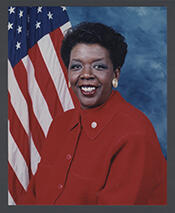
Stephanie Tubbs Jones (September 10, 1949 – August 20, 2008) was an American politician and attorney who became the first African American woman elected to Congress from Ohio. Born in Cleveland, Ohio, she was the daughter of Mary Tubbs, a factory worker and cook, and Andrew Tubbs, an airline skycap. She grew up in the city’s Collinwood neighborhood and graduated from Cleveland’s Collinwood High School. Deeply rooted in the Cleveland community from an early age, she would go on to build a career that combined public service, law, and national political leadership.
After completing high school, Tubbs Jones attended Case Western Reserve University in Cleveland. She earned an undergraduate degree in Social Work from the university’s Flora Stone Mather College in 1971. She then continued her studies at Case Western Reserve University School of Law, receiving her Juris Doctor in 1974. During her adult life, she was active in Delta Sigma Theta sorority and participated in its National Five Point Thrust Programs, particularly Social Action and Political Awareness, including involvement in “Delta Days at the Nation’s Capital.” She was also a Golden Life Member of the National Association for the Advancement of Colored People (NAACP). On November 27, 1976, she married Mervyn L. Jones; he had previously been charged with aggravated murder and robbery and later pleaded guilty to a lesser charge of manslaughter, receiving “shock probation.” The couple remained married for 27 years, until his death on October 2, 2003, and had one son, Mervyn Leroy Jones Jr.
Tubbs Jones began her legal and judicial career in Cleveland, where she quickly emerged as a pioneering figure in Ohio’s justice system. In 1981, she was elected a judge of the Cleveland Municipal Court. Two years later, in 1983, she was elevated to the Court of Common Pleas of Cuyahoga County, where she served until 1991. In 1990, she ran for Justice of the Supreme Court of Ohio, entering the race after Mary Cacioppo, the winner of the Democratic primary, withdrew for health reasons. Tubbs Jones narrowly lost that general election to the Republican incumbent, J. Craig Wright. In 1991, she became the Cuyahoga County Prosecutor, the first African American prosecutor in Ohio history and, at that time, the only Black woman serving as a prosecutor in any major American city. She held that office until early 1999, when she resigned to assume her seat in Congress. From 1996 to 2004, she also served as a board member of Hawken School in Northeast Ohio.
In 1998, following the retirement announcement of 30-year incumbent Representative Louis Stokes, Tubbs Jones sought and won the Democratic nomination for Ohio’s 11th congressional district. The district, encompassing most of Downtown and Eastern Cleveland and many eastern suburbs in Cuyahoga County—including Euclid, Cleveland Heights, and Shaker Heights—was heavily Democratic and had a Black-majority electorate. Her nomination all but assured her election, and in November 1998 she won the general election with 80 percent of the vote. Stephanie Tubbs Jones served as a Representative from Ohio in the United States Congress from 1999 to 2008. A member of the Democratic Party, Stephanie Tubbs Jones contributed to the legislative process during five terms in office. Tubbs Jones was popular in her district and was routinely reelected against nominal Republican opposition, receiving 83.44 percent of the vote in her final general election in 2006 against Republican Lindsey String. She faced no opposition in the 2008 Ohio Democratic primary.
Tubbs Jones’s service in Congress occurred during a significant period in American history, marked by contentious presidential elections, the September 11 attacks, and the Iraq War. As a member of the House of Representatives, Stephanie Tubbs Jones participated in the democratic process and represented the interests of constituents in Ohio’s 11th district. She served on the powerful House Ways and Means Committee, where she played a role in shaping tax, trade, and social welfare policy. Despite representing a heavily unionized district, she was a strong proponent of free trade and took a lead role in the fight to pass the United States–Peru Trade Promotion Agreement in November 2007. She opposed the Iraq War, voting in 2002 against the authorization for the use of military force. On December 19, 2006, she was named Chairwoman of the House Committee on Standards of Official Conduct (the House Ethics Committee) for the 110th Congress, selected by Speaker Nancy Pelosi to oversee ethical standards for House members, even as she herself had drawn criticism in 2005 for having one of the higher totals of lobbyist-sponsored trips among members of Congress.
Beyond her committee work, Tubbs Jones was active in national Democratic Party politics. She served as a co-chairwoman of the Democratic National Committee and, in 2004, chaired the platform committee at the Democratic National Convention while serving as a member of the Ohio delegation. She strongly supported Senator John Kerry’s 2004 presidential campaign. On January 6, 2005, she joined Senator Barbara Boxer of California in formally objecting to the certification of Ohio’s electoral votes in the 2004 U.S. presidential election, sponsoring the House objection and becoming one of 31 members who voted not to count the state’s 20 electoral votes, which Republican President George W. Bush had won by 118,457 votes. She later became a strong and early supporter of Senator Hillary Clinton in the 2008 Democratic presidential primary and supported Senator Barack Obama after Clinton conceded. During her years in Congress, she also gained a measure of popular visibility through media appearances, notably on The Colbert Report’s “Better Know a District” segment, which aired on November 3, 2005; host Stephen Colbert jokingly suggested a “Judge Tubbs” spin-off, and he later paid tribute to her by re-airing the footage on August 27, 2008.
In her later years in office, Tubbs Jones continued to be an influential figure in Cleveland and national politics. She remained engaged in local educational and civic issues and, in 2002, publicly praised Barbara Byrd-Bennett during Byrd-Bennett’s tenure as CEO of the Cleveland Municipal School District. Tubbs Jones also maintained her longstanding involvement with civil rights and community organizations, consistent with her status as a Golden Life Member of the NAACP and her active participation in Delta Sigma Theta’s social action initiatives. Her congressional office, the Office of the Eleventh Congressional District of Ohio, continued the constituent-service tradition she had built over decades in public life.
On August 19, 2008, while driving in the Cleveland area, Congresswoman Tubbs Jones suffered a cerebral hemorrhage caused by a ruptured aneurysm in her brain. Police officers, having noticed her car driving erratically, discovered her unconscious after her vehicle left the roadway and came to rest in a field. She was transported to the intensive care unit of Huron Hospital in East Cleveland, a satellite facility of the Cleveland Clinic, where she was placed on life support but remained in unstable and critical condition due to extensive hemorrhaging. Stephanie Tubbs Jones died there on August 20, 2008, at 6:12 p.m. EDT, at the age of 58. Her death created a vacancy in Ohio’s 11th congressional district, and Governor Ted Strickland ordered a special election for November 18, 2008. Warrensville Heights Mayor Marcia Fudge, the Democratic nominee, won that election and succeeded her in Congress. Tubbs Jones’s career is remembered in the context of the broader history of African American and women’s representation in the United States House of Representatives and among members of Congress who died in office in the 2000s.
Congressional Record