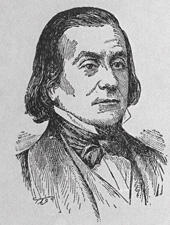
Solon Borland (September 21, 1808 – January 1, 1864) was an American politician, journalist, physician, and military officer who represented Arkansas in the United States Senate from 1848 to 1853. He later served as an officer in the Confederate States Army, including as commander of a cavalry regiment in the Trans-Mississippi theater of the American Civil War. A member of the Democratic Party for most of his political career, he was an ardent proponent of states’ rights and secession and played a controversial role in both national politics and U.S. foreign policy.
Borland was born on September 21, 1808, in Nansemond County, Virginia, to Thomas Borland, a native of Scotland, and Harriet Godwin Borland. During his youth, the family moved to Murfreesboro, North Carolina, where he attended Hertford Academy. He later pursued medical studies in Philadelphia, Pennsylvania, and Louisville, Kentucky, preparing for a career as a physician. In 1831, as a young officer, he served as a captain in the Virginia militia and led a company dispatched to Southampton County to help suppress Nat Turner’s Rebellion. Like many Southern political figures of his era, Borland owned slaves, a fact that informed and aligned with his later pro-slavery and pro-secession political positions.
Before entering national politics, Borland established himself in both medicine and journalism. After the death of his second wife, he moved in 1843 to Little Rock, Arkansas, where he resumed medical practice and founded the Arkansas Banner. The paper quickly became an influential Democratic organ in statewide politics and helped solidify his standing within the Arkansas Democratic Party. His combative temperament was evident in his journalistic career; in 1846 he challenged the editor of the rival Whig newspaper, the Arkansas Gazette, to a duel over what he regarded as a slanderous publication. During this period he also became involved in state militia affairs and in the broader political debates that were reshaping the South in the 1840s.
Borland’s military reputation was significantly enhanced by his service in the Mexican–American War. Commissioned as major of the Arkansas Mounted Infantry Regiment under Colonel Archibald Yell, he turned over management of his newspaper to associates and served throughout the conflict. On January 23, 1847, he was captured by Mexican forces south of Saltillo but subsequently escaped. When his regiment was disbanded and mustered out in June 1847, he continued in the army as a volunteer aide-de-camp to General William J. Worth. In that capacity he participated in the latter stages of the campaign, from the Battle of Molino del Rey through the capture of Mexico City on September 14, 1847. His wartime service, combined with his prominence in Arkansas Democratic circles, positioned him for higher office.
In 1848, Borland was elected by the Arkansas legislature as a United States Senator to fill the unexpired term of Ambrose H. Sevier. He served in the Senate from 1848 to 1853, completing two terms in office as recorded in contemporary congressional accounts, and represented Arkansas during a period of intense sectional conflict over slavery and territorial expansion. His views were generally of a strong states’ rights and disunionist cast, and he was not popular with many of his Senate colleagues. During a heated 1850 debate over Southern rights, he physically attacked Senator Henry S. Foote of Mississippi on the Senate floor, an incident that underscored his reputation for volatility. Borland’s positions, including his hard-line defense of Southern interests, proved controversial not only in Washington but also among many of his constituents in Arkansas, and he discovered upon returning to Little Rock that his more extreme views were not universally shared at home.
Borland also took distinctive positions on foreign and commercial policy while in the Senate. In 1852 he opposed the proposal to send Commodore Matthew C. Perry to Japan to open that country to international trade, arguing that Japan’s refusal to engage in commerce did not constitute an offense against U.S. interests and did not justify diplomatic or military pressure. In 1853 he resigned from the Senate and was appointed Envoy Extraordinary and Minister Plenipotentiary to Nicaragua. Immediately upon his arrival in Managua, he urged the U.S. government to repudiate the Clayton–Bulwer Treaty and advocated American military support for Honduras in the event of war with Great Britain, reflecting his expansionist and nationalist outlook. In a public address in Nicaragua, he declared that his greatest ambition was to see Nicaragua “forming a bright star in the flag of the United States,” a statement that drew a formal reprimand from Secretary of State William L. Marcy. In May 1854, while leaving the port of Greytown (San Juan del Norte), Borland interfered with the local arrest of an American citizen; a crowd gathered, and a bottle thrown from the crowd struck him in the face. He reported the incident to the President, who dispatched a U.S. gunboat and demanded an apology. When none was forthcoming, Greytown was bombarded and destroyed, an episode that became one of the more controversial incidents of mid-nineteenth-century U.S. gunboat diplomacy.
After his diplomatic service, Borland returned to Little Rock in October 1854, where he resumed his medical practice and the operation of his pharmacy. President Franklin Pierce offered him the governorship of the New Mexico Territory, but Borland declined the nomination. He remained active in local and state politics and increasingly vocal in his advocacy of states’ rights and secession. In October 1855, he joined Albert Pike and Christopher C. Danley in breaking with the Democratic Party, asserting that it had become too sympathetic to abolitionist sentiment. Danley, who had taken ownership of the Arkansas Gazette from William E. Woodruff in 1853, converted that paper into a mouthpiece for the Know Nothing (American) Party, which both he and Borland joined. Borland’s shifting party affiliations reflected the fracturing of antebellum political coalitions and his own movement toward more nativist and radical pro-Southern positions.
With the secession crisis and the outbreak of the American Civil War, Borland again took up military responsibilities. At the start of the war, Arkansas Governor Henry M. Rector appointed him a commander of the Arkansas militia and ordered him to lead an expedition to seize Fort Smith, Arkansas, even though the state had not yet formally seceded from the Union. By the time Borland and his forces arrived, Federal troops had already withdrawn, and the fort was taken without a shot. Less than a month later, he was replaced as commander at the Arkansas secession convention, but he secured a subsequent command position in northeastern Arkansas. In 1861 he commanded the depot at Pitman’s Ferry near Pocahontas, Arkansas, overseeing troop deployments and supplies. During this period he helped recruit Confederate forces, playing a central role in raising the 3rd Arkansas Cavalry Regiment on June 10, 1861, and becoming its first colonel. Although the regiment was sent to Corinth, Mississippi, and later served under Major General Joseph Wheeler in engagements such as the Second Battle of Corinth and the Battle of Hatchie’s Bridge as part of the Army of Mississippi, Borland himself never left Arkansas and did not lead the unit in those campaigns.
Borland’s Confederate service was marked by both administrative initiatives and growing frustration. While in command of northern Arkansas, he ordered an embargo on goods in an effort to curb price speculation, a measure that was promptly rescinded by Governor Rector. Borland protested that a state governor lacked authority to countermand the order of a Confederate officer, but in January 1862 his embargo was formally overruled by Confederate Secretary of War Judah P. Benjamin. In declining health and resentful of this public rebuke, Borland resigned from further Confederate service in June 1862 and moved to Dallas County, Arkansas. His family was deeply involved in the Confederate cause: his first wife, Huldah G. Wright (1809–1837), had borne him a son, Harold Borland, who served as a major in the Confederate Army in the Eastern Sub-district of Texas of the Trans-Mississippi Department, and his only son by his third wife, George Godwin Borland, enlisted in the Confederate forces at age sixteen and was later killed in action.
In his final years, Borland lived largely in seclusion as his health continued to deteriorate. He died on January 1, 1864, at the age of fifty-five, in Harris County, Texas. He was buried in the old City Cemetery in Houston. Throughout his life, Solon Borland’s career spanned medicine, journalism, legislative service in the United States Senate, diplomatic office in Central America, and military command in two major American wars, leaving a complex and often controversial record in the political and military history of the nineteenth-century United States.
Congressional Record