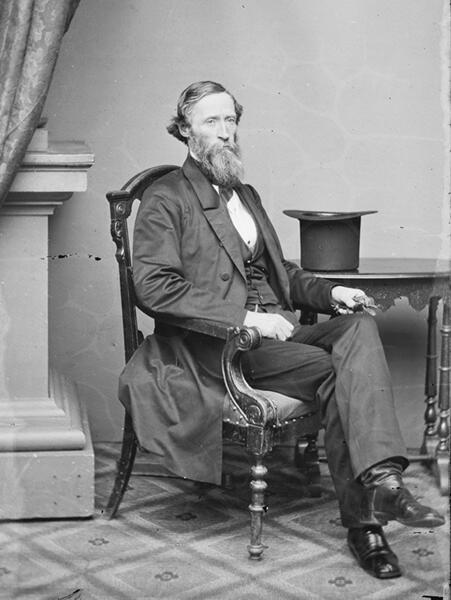
Solomon Lewis Spink (March 20, 1831 – September 22, 1881) was an American lawyer, newspaper editor, territorial official, and Republican politician who served as a non-voting delegate to the United States House of Representatives from Dakota Territory. He was born in Whitehall, Washington County, New York, where he spent his early years before moving west as a young man during a period of rapid expansion and settlement in the Midwest.
Spink pursued legal studies and was admitted to the bar in 1856. Following his admission, he began the practice of law in Burlington, Iowa, an important commercial and legal center along the Mississippi River. His early legal career in Iowa coincided with the years just before the Civil War, when the region was experiencing significant growth and political realignment. Seeking broader professional and political opportunities, he relocated in 1860 to Paris, Illinois, a county seat in Edgar County.
In Paris, Illinois, Spink expanded his activities beyond the law by becoming editor and publisher of the Prairie Beacon newspaper. Through this role, he participated in shaping public opinion at a time of intense national debate over secession and the future of the Union. His prominence in local affairs and alignment with Republican politics led to his election to the Illinois House of Representatives, where he served in 1864 during the Civil War. As a member of the state legislature, he was part of the Republican-dominated political establishment that supported the Union war effort and President Abraham Lincoln’s administration.
In 1865, following his legislative service, Spink was appointed secretary of Dakota Territory, then a vast and sparsely settled jurisdiction on the northern Great Plains. He moved to Yankton, which served as the territorial capital, and held the office of secretary from 1865 until 1869. In this capacity, he was a principal administrative officer of the territorial government, working closely with the territorial governor and overseeing official records and executive functions during a formative period of settlement, infrastructure development, and evolving relations with Indigenous nations.
Spink’s territorial service positioned him for national office, and he was elected as a Republican to serve as Dakota Territory’s non-voting delegate to the United States House of Representatives. He took his seat in the Forty-first Congress and served from March 4, 1869, to March 3, 1871. As a delegate, he represented the interests of the territory before Congress, advocating for legislation related to land policy, transportation, and the organization and governance of the territory, although, like other territorial delegates, he did not possess a formal vote on the House floor. He was an unsuccessful candidate for reelection in 1870 and, after the conclusion of his term, returned to Yankton to resume the practice of law. Remaining active in territorial politics, he again sought election as delegate in 1876 but was once more unsuccessful.
Spink continued to reside in Yankton for the remainder of his life, practicing law and remaining a figure in the civic and political life of Dakota Territory as it moved toward eventual statehood for its successor states. He died in Yankton on September 22, 1881. Solomon Lewis Spink was interred in the City Cemetery in Yankton, Dakota Territory (now South Dakota), closing a career that reflected the broader patterns of nineteenth-century American expansion, territorial administration, and Republican political leadership in the post–Civil War era.
Congressional Record