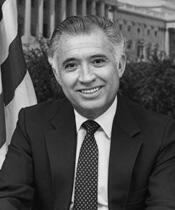
Solomon Porfirio Ortiz (born June 3, 1937) is an American former politician who served as a Democratic U.S. Representative from Texas from 1983 to 2011. He represented Texas’s 27th congressional district, based in Corpus Christi, for 14 consecutive terms, contributing to the legislative process during a significant period in American history. Over nearly three decades in the House of Representatives, Ortiz participated actively in the democratic process and represented the interests of his South Texas constituents. In 2010, he was narrowly defeated for re-election by Republican challenger Blake Farenthold. His son, Solomon Ortiz Jr., later served as a member of the Texas House of Representatives.
Ortiz was born in Robstown, Nueces County, Texas, to a family that had immigrated from Mexico. Growing up in a working-class environment, he held several odd jobs as a boy, including work as a shoeshiner and as an ink fogger for The Robstown Record’s letter press. During his youth he befriended local law enforcement officers and developed a strong interest in law enforcement that would shape his later career. He attended Robstown High School, but at age 19 he left school following the death of his father in order to help support his family.
In 1960, Ortiz joined the United States Army, where he served for two years and earned his General Educational Development (GED) certificate. He received basic training at Fort Hood, Texas, and was later stationed in France, serving a tour of duty in Verdun and Vitry-le-François. Because of his expressed interest in law enforcement, he was reassigned to the 61st Military Police Company Criminal Investigation Office and received advanced military police training at Fort Gordon, Georgia. After completing his military service and returning to South Texas, Ortiz worked for approximately three years as an insurance agent before entering elective office.
Ortiz’s political career began in local law enforcement and county government. In 1964, encouraged by friends, he ran for the office of constable in Nueces County. He was elected in 1965, defeating the incumbent in a runoff election. Building on that success, he sought higher office and in 1969 won election to the Nueces County commissioners court, becoming the first Hispanic to serve in that capacity. He remained a county commissioner until 1976, when he was elected sheriff of Nueces County, again breaking new ground as the first Hispanic to hold that office. These positions established him as a prominent public official in South Texas and provided a platform for his eventual entry into national politics.
When Texas’s 27th congressional district was created following redistricting in 1982, Ortiz ran for the new seat on a platform emphasizing job incentives and attention to education, issues of particular importance to his largely working-class and Hispanic constituency. He won the Democratic primary runoff with 52 percent of the vote and then prevailed in the general election with 64 percent, defeating Republican State Representative Joe Salem. Taking office on January 3, 1983, Ortiz began what would become 14 terms in the U.S. House of Representatives, serving continuously until January 3, 2011. Over those years he won re-election 13 times, dropping below 60 percent of the vote only four times before 2010; his narrowest successful race came in 1992, when he defeated Republican Jay Kimbrough by a margin of 55 percent to 43 percent.
During his congressional service, Ortiz developed a reputation as a Democratic moderate—socially conservative but economically liberal. He opposed abortion but generally supported his party’s positions on economic and social welfare issues, reflecting the views of many of his constituents. As a freshman congressman in 1983, he was appointed to the U.S. Select Committee on Narcotics Abuse and Control, where he worked on issues related to drug trafficking and substance abuse, matters of particular concern along the U.S.–Mexico border. In 1993, he was named chairman of a House subcommittee with oversight of the Gulf of Mexico, a role that placed him at the center of policy debates involving offshore energy, fisheries, and coastal environmental concerns important to his coastal district.
In the 111th Congress (2009–2011), Ortiz held key committee assignments that reflected his long-standing interest in defense and infrastructure. He served on the House Committee on Armed Services, where he chaired the Subcommittee on Readiness and also sat on the Subcommittee on Seapower and Expeditionary Forces. In these roles he dealt with military preparedness, base operations, and naval and Marine Corps capabilities, matters that had particular resonance for his district and for the broader national defense posture. He also served on the House Committee on Transportation and Infrastructure, including the Subcommittees on Aviation; Highways and Transit; and Water Resources and Environment, where he participated in shaping federal transportation policy and infrastructure investment affecting both Texas and the nation.
Ortiz’s long tenure came to an end in the 2010 election cycle. On November 2, 2010, initial returns showed him trailing Republican challenger Blake Farenthold. Ortiz requested a recount, but after the November 22 recount confirmed the result, he conceded the race. Farenthold defeated him by a narrow margin of 47.8 percent to 47.1 percent, a difference of just 770 votes. Although Ortiz carried four of the district’s six counties, he lost in the two northernmost counties, San Patricio and his home county of Nueces. Following the 2010 census, the 27th District was significantly redrawn, and no Democrat has since managed to secure even 40 percent of the vote there, underscoring the political shift that accompanied his departure from Congress.
Congressional Record