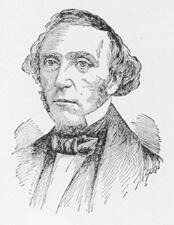
Solomon Weathersbee Downs (August 26, 1800 – August 13, 1854) was an American attorney, politician, and slaveholder from Louisiana who rose to prominence in state and national politics in the mid-nineteenth century. A member of the Democratic Party, he served one term as a United States senator from Louisiana from 1847 to 1853, during a significant period in American history marked by sectional conflict and debates over slavery. The village of Downsville, Louisiana, was later named in his honor, reflecting his regional influence and prominence.
Downs was born in Montgomery County, Tennessee, generally recorded as having been born in either 1800 or 1801, the illegitimate son of William Weathersbee and Rebecca Downs. His family moved to Louisiana during his youth, but he was sent back to Tennessee for his education, where he studied under the noted Presbyterian minister and educator Thomas B. Craighead. He subsequently attended Transylvania University in Lexington, Kentucky, one of the leading institutions of higher learning in the West at the time, and graduated in 1823. After completing his formal education, he studied law, was admitted to the bar in 1826, and commenced legal practice in Bayou Sara, Louisiana.
As a young lawyer, Downs established himself in Bayou Sara before relocating to Ouachita Parish, Louisiana, where he continued his legal practice and also became a substantial planter. In Ouachita he owned and operated plantations that relied on enslaved labor. By the time of the 1850 federal slave schedules, Downs was listed as enslaving a total of 154 men, women, and children on his two plantations in Ouachita Parish, underscoring both his wealth and his deep personal investment in the institution of slavery. His economic position as a planter complemented his rising stature in the legal profession and provided a base for his entry into politics.
Downs became active in Democratic Party politics in the late 1820s, first gaining notice as a campaign speaker on behalf of Andrew Jackson in the presidential election of 1828. His political career advanced steadily over the next decade. In 1838 he was elected to the Louisiana State Senate from a district encompassing Catahoula, Ouachita, and Union Parishes, and he was reelected in 1842. Alongside his legislative service, he was a longtime member of the Louisiana Militia and, in 1842, was appointed brigadier general of the militia’s 6th Division. In 1844 he served as a delegate to the Louisiana state constitutional convention, helping to shape the state’s fundamental law. That same year he agreed to run as a presidential elector pledged to former President Martin Van Buren, but when Van Buren publicly opposed the annexation of Texas, Downs resigned from the ticket. He later agreed to run again as an elector after James K. Polk was nominated as the Democratic candidate. Following Polk’s victory in 1844, Downs cast his electoral vote for Polk for president and George M. Dallas for vice president.
In 1845 Downs moved to New Orleans, the commercial and political center of Louisiana, further enhancing his professional and political opportunities. That year he was appointed United States Attorney for the District of Louisiana, a position he held from 1845 to 1846. He also participated in another state constitutional convention, reinforcing his role as an influential Democratic leader in Louisiana. His growing prominence in both law and politics positioned him for higher national office.
Downs was elected as a Democrat to the United States Senate and served from March 4, 1847, to March 3, 1853, representing Louisiana during a period that included the Mexican–American War and the intensifying national debate over slavery and territorial expansion. As a senator, he participated in the legislative process and represented the interests of his Louisiana constituents. He held important committee assignments, serving as chairman of the Committee on Engrossed Bills during the Thirtieth Congress and as chairman of the Committee on Private Land Claims from the Thirtieth through the Thirty-second Congresses. In the Senate, Downs was known as an unusually staunch defender of slavery, from which he personally profited as a large slaveholder. In one widely noted speech, he challenged critics of slavery by asserting that “the white laborers of the North” were not “as happy, as contented, or as comfortable as the slaves of the South,” and he claimed that enslaved people in the South did not suffer “one tenth of the evils endured by the white laborers of the North,” describing this as “one of the excellencies of the system of Slavery” and evidence of “the superior condition of the Southern slave over the Northern white laborer.”
After completing his Senate term in 1853, Downs remained in federal service. President Franklin Pierce appointed him United States Collector of Customs for the District of Orleans in 1853, a significant administrative and revenue-collecting post in the important port of New Orleans. He held this office from 1853 until his death the following year, continuing to play a role in the federal government even after leaving the Senate.
In his personal life, Downs married Ann Marie McCaleb in 1830. She survived him by several years, dying in 1857. The couple had two children, a son, Samuel Alfred Downs, and a daughter, Sarah Mary Downs. His family life was closely tied to his plantations and his legal and political career in Louisiana, and his descendants remained part of the regional elite.
Downs died at Crab Orchard Springs, Kentucky, on August 14, 1854, while still serving as collector of customs, and was initially buried on his family’s plantation in Kentucky. His remains were later moved to the grounds of Riverview Sanitarium in Monroe, Louisiana, and that burial ground eventually became Riverview Cemetery. Under the terms of his will, Downs manumitted an enslaved man, Richard Barrington, who had been taught to read and write while living on Downs’s plantation. Barrington later became a successful barber in New Orleans. Learning that Downs’s grave was unmarked, Barrington paid for a headstone. Over time, Downs’s grave was lost and then rediscovered in 1937; after being moved near the cemetery entrance, it was again forgotten until it was rediscovered in 2000. It is now marked by the broken pieces of the original headstone purchased by Barrington.
Congressional Record