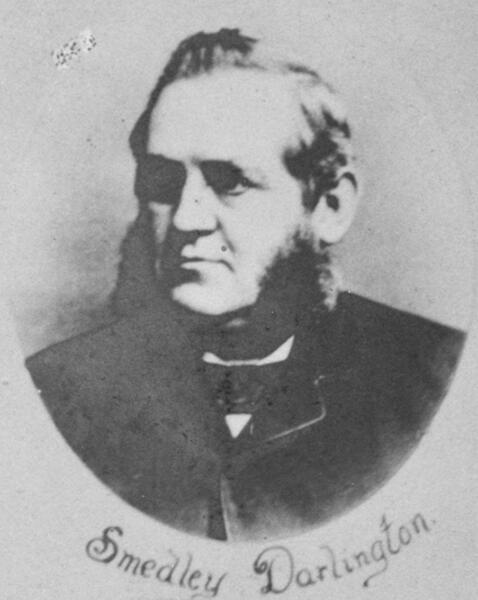
Smedley Darlington (December 24, 1827 – June 24, 1899) was an American educator, banker, and politician who served as a Republican member of the U.S. House of Representatives for Pennsylvania’s 6th congressional district from March 4, 1887, to March 3, 1891. A member of the Republican Party, he represented his constituents during two consecutive terms in the Fiftieth and Fifty-first Congresses, contributing to the legislative process in a period of significant political and economic change in the United States.
Darlington was born in Pocopson Township, Chester County, Pennsylvania, on December 24, 1827, the son of Richard Darlington and Edith (Smedley) Darlington. He was raised in the Quaker tradition and attended the common schools before enrolling at Friends’ Central School in Philadelphia, an institution associated with the Religious Society of Friends. His early life in rural Pennsylvania and his Quaker upbringing helped shape his interest in education and public service, and he maintained close ties to Chester County throughout his life.
After completing his studies, Darlington embarked on a career in education. He taught at Friends’ Central School in Philadelphia for several years, during which time he also worked as a stenographer, preparing detailed reports of sermons, lectures, and public speeches for Philadelphia newspapers. Demonstrating both entrepreneurial and educational ambitions, he established a school in Ercildoun, Pennsylvania, initially known as Ercildoun Seminary and later called Darlington Seminary. He first operated it as an academy for boys for three years, then converted it into a school for girls. The institution, often referred to as Darlington Academy, remained in operation for twelve years and contributed to the educational development of the region.
During the American Civil War, Darlington enlisted as a private in the Union forces and subsequently rose to the rank of captain in Beaumont’s Independent Company of Cavalry, Pennsylvania Volunteer Emergency Militia. His service was part of the short-term emergency mobilizations to protect Pennsylvania during Confederate incursions, and he was discharged with the company on September 24, 1862. Following his military service, he moved to West Chester, Pennsylvania, in 1864, which became his principal residence and the center of his business and political activities.
In the years after the war, Darlington transitioned from education to finance and business. He became active as a banker and investment broker and acquired interests in several financial institutions and corporations. In the 1880s he was an early participant in the burgeoning petroleum industry, maintaining an office in Oil City, Pennsylvania, from which he managed his oil-related ventures. In 1885 he founded the Chester County Guaranty Trust & Safe Deposit Company, reflecting his growing prominence in regional finance, and he served as its president until 1897. His business career paralleled his increasing involvement in politics and public affairs.
Darlington’s political activity preceded his congressional service. He was a delegate to the Liberal Republican convention in 1872, a movement that challenged the regular Republican organization during the presidency of Ulysses S. Grant. Later, as the Republican Party consolidated its position in Pennsylvania, he remained active in party affairs and served as a delegate to the Republican National Convention in 1896. In 1886 he was elected as a Republican to represent Pennsylvania’s 6th congressional district in the Fiftieth Congress and was reelected in 1888 to the Fifty-first Congress. Serving from March 4, 1887, to March 3, 1891, he participated in the work of the House of Representatives during a period marked by debates over tariffs, economic policy, and federal regulation. He chose not to be a candidate for renomination in 1890, concluding his congressional career after two terms.
In his personal life, Darlington married Mary Edwards Baker in 1851. The couple had eleven children, four of whom died in infancy. The family became prominent in local and national affairs. Their daughter Isabel Darlington became the first woman to practice law in Chester County, Pennsylvania, breaking professional barriers for women in the legal field. Another daughter, Maud, married Thomas S. Butler, who later served in the U.S. House of Representatives, and was the mother of Marine Corps Major General Smedley Darlington Butler, one of the most decorated Marines in American history. Through his lineage and extended family, Darlington was connected to a broader political network; he was a second cousin of congressmen Edward Darlington, Isaac Darlington, and William Darlington, all of whom also represented Pennsylvania in Congress.
Smedley Darlington spent his later years in West Chester, where he continued to be identified with banking and community affairs even after stepping back from active political life. He died at his home in West Chester on June 24, 1899. His funeral was held on June 26, 1899, at his residence, known as “Faunbrook,” and he was interred at Oaklands Cemetery in West Chester. His career as an educator, Civil War officer, financier, and congressman, along with the public prominence of his descendants, secured his place in the civic and political history of Pennsylvania.
Congressional Record