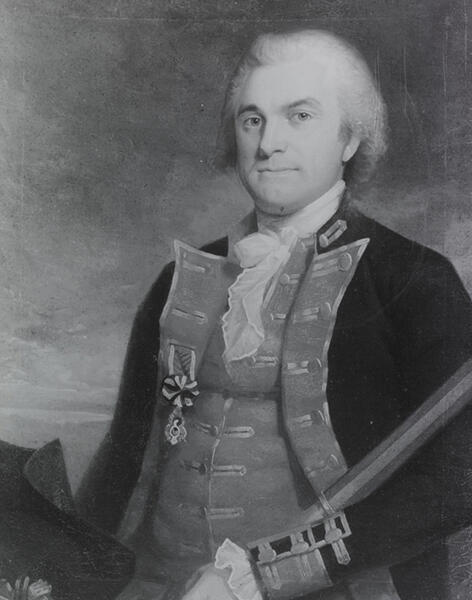
Silas Talbot (January 11, 1751 – June 30, 1813) was an American military officer, merchant, slave trader and slaveowner, naval commander, and Federalist Representative from New York. He was born on January 11, 1751, in Dighton, in the Province of Massachusetts Bay, into a large farming family. At the age of twelve he went to sea as a cabin boy in a coasting vessel, beginning a lifelong association with maritime pursuits. His performance at sea was considered outstanding, and by 1772 he had saved enough money to purchase property on Weybosset Street in Providence, Rhode Island, where he built a stone house after learning and practicing the trade of stone masonry. Before and after the American Revolution, Talbot also engaged in mercantile ventures that included participation in the transatlantic slave trade, and he was a slaveowner.
Talbot’s education was primarily practical and maritime rather than formal or academic. His early years at sea provided training in navigation, seamanship, and shipboard discipline, while his work as a mason and property owner in Providence reflected a parallel education in trades and commerce. By the outbreak of the American Revolutionary War, he had established himself as a capable seaman and entrepreneur, prepared for both military and commercial responsibilities.
On June 28, 1775, Talbot received a commission as a captain in the 2nd Rhode Island Regiment of the Continental Army. He participated in the siege of Boston and then marched with the Continental Army toward New York. En route, at New London, Connecticut, he encountered Commodore Esek Hopkins, recently returned from a naval expedition to the Bahamas. Learning that Hopkins intended to petition General George Washington for 200 volunteers to assist his squadron in reaching Providence, Talbot volunteered his services. After returning to New York, where he helped transport troops, he was given command of a fireship and on September 14, 1776, attempted to burn the Royal Navy warship HMS Asia. The attack failed, and Talbot was severely burned, but his conspicuous bravery led to his promotion to major on October 10, 1777, retroactive to September 1. He was badly wounded again on October 23, 1777, at Fort Mifflin while defending Philadelphia. Returning to active service in the summer of 1778, he fought in the Battle of Rhode Island on August 28, 1778. Subsequently, as commander of the 8-gun galley Pigot, which he had captured from the Royal Navy in the Sakonnet River on October 28, 1778, and later of the 12-gun sloop Argo, both operating under Army authority, he cruised against Loyalist vessels harassing American trade between Long Island and Nantucket, capturing many of them. In recognition of his success in capturing Pigot, the Continental Congress on November 14, 1778, passed a resolution commending him and promoting him to lieutenant colonel, and in October 1778 the Rhode Island General Assembly voted him a “genteel silver-hilted sword,” executed by silversmith John Gladding Gibbs of Providence.
Because of his effectiveness in naval operations while serving in the Army, Congress commissioned Talbot as a captain in the Continental Navy on September 17, 1779. Lacking an available warship to assign him, Congress permitted him to go to sea as commander of the privateer General Washington. He captured one prize before encountering a Royal Navy fleet off New York; after a chase, he struck his colors to the 74-gun ship-of-the-line Culloden and remained a prisoner of war until he was exchanged in December 1781. In the postwar years, Talbot settled in Johnstown, then the seat of what is now Fulton County, New York, where he purchased the former manor house and estate of Sir William Johnson, the town’s founder. During the 1780s he was twice involved in mercantile enterprises that included slave cargoes: in late 1783 he held an interest in a cargo of produce and enslaved people shipped to Charleston, South Carolina, in the sloop Peggy, and in August 1785 he bought half of the 90-ton brigantine Industry, which transported enslaved Africans from the Guinea coast to Charleston. On a 1786 voyage of Industry, he was informed on September 9, 1786, that about 180 enslaved people had been embarked off Guinea and that nearly half had died before the vessel reached Charleston, a loss that caused him significant financial concern. He later sold his half of Industry but was still attempting in 1801 to collect what he claimed was his remaining share of the cargo. He was a member of the New York State Assembly in 1792 and again from 1792 to 1793, marking his formal entry into legislative life.
In January 1793, Talbot was elected as a Federalist from New York to the 3rd United States Congress. He served as a Representative in the U.S. House of Representatives from March 4, 1793, until approximately June 5, 1794. During his single term in office, he represented his New York constituents in the national legislature and participated in the early development of federal law and policy at a formative moment in the Republic’s history. Silas Talbot’s service in Congress occurred during a significant period in American history, and as a member of the House of Representatives he participated in the democratic process and represented the interests of his constituents. Among his recorded votes, he was one of only nine representatives to oppose the Eleventh Amendment to the United States Constitution, which addressed the judicial power of the federal courts in suits against states. Although his party affiliation is listed as unknown in some modern summaries, contemporary sources identify him with the Federalist Party.
Talbot’s congressional service ended when President George Washington, on June 5, 1794, selected him third in seniority among six captains of the newly established United States Navy, prompting his resignation from the House. He was ordered to superintend construction of the frigate USS President at New York, but on April 20, 1796, work on the ship was suspended and Talbot was discharged from the Navy. With the outbreak of the Quasi-War between the United States and the French First Republic, he was recommissioned as a captain in the U.S. Navy on May 11, 1798. On June 5, 1799, he assumed command of the frigate USS Constitution and held that command until September 8, 1801. Operating primarily in the West Indies, he protected American commerce from French privateers and commanded the U.S. Navy squadron off the French colony of Saint-Domingue from 1799 to 1800. For his efforts in safeguarding American shipping and helping to establish a foundation for permanent trade with the colony, he was commended by the Secretary of the Navy. Over the course of his military career, Talbot was reportedly wounded thirteen times and carried five bullets in his body. An original member of the Rhode Island Society of the Cincinnati and a member of its New York branch, he remained a figure of some prominence in early American naval circles.
Talbot resigned from the Navy on September 21, 1801. He spent his later years largely in New York, continuing to manage his affairs and maintain his connections to the maritime and military communities. He died in New York City on June 30, 1813, and was buried in Trinity Churchyard in lower Manhattan. His memory was later honored in several ways: the destroyer USS Talbot (DD-114/APD-7) and the guided missile frigate USS Talbot (DEG/FFG-4) were named for him, as was Battery Talbot, a reinforced concrete 4.72‑inch coastal gun battery at Fort Adams in Newport County, Rhode Island, established by General Orders No. 30 on March 19, 1902. Both original guns from that battery survive, one on display at Equality Park in Newport and the other at Fort Moultrie National Park near Charleston, South Carolina. A cenotaph in his honor stands in the Dighton Congregational Church cemetery in his hometown of Dighton, Massachusetts, reflecting both his local origins and his national prominence as a Revolutionary officer, naval commander of “Old Ironsides,” and early member of the United States Congress.
Congressional Record