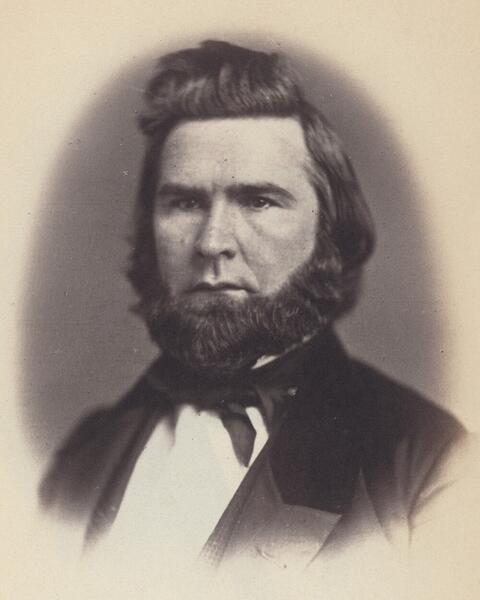
Sidney Dean (November 16, 1818 – October 29, 1901) was a United States representative from Connecticut. As a member of the Republican Party representing Connecticut, he contributed to the legislative process during two terms in office. His service in Congress occurred during a significant period in American history, as the nation confronted sectional tensions and the approach of the Civil War, and he participated in the democratic process by representing the interests of his constituents in the U.S. House of Representatives.
Born on November 16, 1818, Dean came of age in the early nineteenth century, a time of rapid political, economic, and territorial change in the United States. Although detailed records of his early life and family background are limited, his later public career suggests that he benefited from the expanding opportunities for civic engagement and political participation that characterized New England in this era. Growing up in a region with strong traditions of town governance, public debate, and reform movements likely shaped his interest in public affairs and prepared him for later service in elective office.
Dean’s education, while not extensively documented, would have reflected the common school and academy systems available in New England during his youth. These institutions emphasized literacy, civic knowledge, and familiarity with the principles of the American constitutional system. Such an educational foundation, combined with the political ferment of the antebellum period, helped equip him with the skills necessary for legislative work and for representing the concerns of his community at the state and national levels.
Before entering Congress, Dean established himself in public life in Connecticut, where he became involved in political and civic activities that brought him to the attention of Republican leaders. The Republican Party, formed in the 1850s in response to the expansion of slavery and related sectional controversies, was still relatively young when Dean emerged as one of its standard-bearers in his state. His alignment with the Republican Party placed him within a political movement that emphasized the preservation of the Union, opposition to the spread of slavery into the territories, and support for economic modernization.
Dean was elected as a Republican to represent Connecticut in the United States House of Representatives, serving two terms in Congress. During his tenure, he took part in the legislative process at a time when Congress was grappling with issues that would soon culminate in civil war, including debates over states’ rights, slavery, and the balance of power between free and slave states. As a member of the House, he participated in deliberations, voting, and committee work that affected both his constituents in Connecticut and the broader direction of national policy. His role as a Republican representative underscored his commitment to the party’s principles and to the evolving political realignment of the era.
In representing Connecticut, Dean was part of a congressional delegation from a state with a strong industrial base, maritime interests, and a growing urban population. These factors influenced the issues he confronted in Washington, including questions of tariffs, internal improvements, and support for commerce and manufacturing. His service in Congress thus involved balancing national concerns with the specific economic and social priorities of his home state, and ensuring that Connecticut’s voice was heard in federal decision-making.
After completing his two terms in the House of Representatives, Dean returned to private life and to the civic and political circles from which he had emerged. While the detailed record of his later activities is sparse, his continued presence in public affairs would have been consistent with the pattern of nineteenth-century legislators who remained engaged in local and state matters after leaving national office. His experience in Congress, gained during a formative period in American history, contributed to the institutional memory and political culture of his community.
Sidney Dean died on October 29, 1901, closing a life that spanned from the post–War of 1812 generation through the Civil War and into the dawn of the twentieth century. Remembered as a Republican member of the United States House of Representatives from Connecticut who served two terms during a critical era, he exemplified the citizen-legislator tradition of his time, participating in the democratic process and representing the interests of his constituents at the national level.
Congressional Record