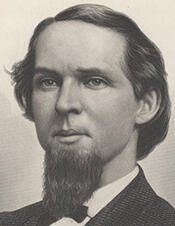
Sidney Clarke (October 16, 1831 – June 18, 1909) was a U.S. Representative from Kansas, a Kansas state speaker of the house, and an Oklahoma territorial legislator who played a notable role in the Oklahoma statehood movement. A member of the Republican Party during his years in Congress, he served three terms in the United States House of Representatives from 1865 to 1871, representing Kansas during a critical period of Reconstruction in American history.
Clarke was born in Southbridge, Worcester County, Massachusetts, on October 16, 1831. He attended the public schools of his native town, receiving a basic education that prepared him for a career in publishing and public life. By 1854 he had become publisher of the Southbridge Press, a local newspaper, marking his early engagement with public affairs and the dissemination of political and civic information.
In 1859 Clarke left Massachusetts and settled in Lawrence, Kansas, then a focal point of national attention during the turbulent years of “Bleeding Kansas.” His move placed him at the center of the sectional conflict over slavery and statehood that preceded the Civil War. When the Civil War began, Clarke enlisted as a volunteer in the Union cause. On February 9, 1863, President Abraham Lincoln appointed him assistant adjutant general of Volunteers. In this capacity he served as a captain and assistant provost marshal general for Kansas, Nebraska, Colorado, and Dakota, helping to administer military affairs and recruitment across a broad swath of the western frontier.
Clarke’s wartime service and political alignment with the Republican Party led to his election to the United States House of Representatives. He was elected as a Republican to the Thirty-ninth, Fortieth, and Forty-first Congresses and served from March 4, 1865, to March 3, 1871. During these three consecutive terms, he participated in the legislative process at a time when Congress was grappling with the end of the Civil War, Reconstruction, and the nation’s westward expansion. In the Forty-first Congress he served as chairman of the Committee on Indian Affairs, a position that placed him at the center of federal policy toward Native American nations during a period of intense conflict and negotiation on the Great Plains and in the West. He was an unsuccessful candidate in 1870 for reelection to the Forty-second Congress, bringing his formal congressional service to a close at the end of his third term.
After leaving Congress, Clarke remained active in public life in Kansas. He served in the Kansas House of Representatives in 1879, this time as an independent, and was elected speaker of the house. His leadership in the state legislature reflected his continued influence in Kansas politics and his experience in national affairs. In this role, he presided over legislative deliberations and helped shape state policy in the post-Reconstruction era.
In 1889 Clarke moved to Oklahoma City, in what was then Oklahoma Territory, where he engaged in railroad building and became a prominent advocate for the development and political advancement of the region. He served as chairman of the statehood executive committee in 1891, working to promote the admission of Oklahoma as a state. From 1898 to 1902 he was a member of the Territorial Council, the upper house of the territorial legislature, further solidifying his role in territorial governance. In local affairs, he served on the Oklahoma City Council and acted as the city’s second provisional mayor, contributing to the civic and infrastructural foundations of the growing community.
Sidney Clarke died in Oklahoma City, Oklahoma, on June 18, 1909. He was interred in Fairlawn Cemetery in Oklahoma City. His career, spanning service in the Union Army, three terms in the U.S. House of Representatives, leadership in the Kansas legislature, and influential roles in Oklahoma territorial and municipal government, reflected his sustained engagement with the political development of the American West and the processes of state-building and statehood in the post–Civil War United States.
Congressional Record