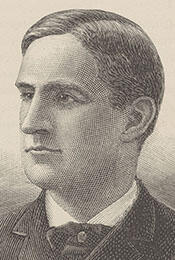
Sherman Hoar (July 30, 1860 – October 7, 1898) was an American lawyer and politician who served as a Representative from Massachusetts in the United States Congress from 1891 to 1893 and later as United States District Attorney for Massachusetts. Born into a prominent New England family in Concord, Massachusetts, he was part of a distinguished line of Massachusetts and New England politicians, lawyers, and public servants. He was the great-grandson of Roger Sherman, a signer of both the Declaration of Independence and the Constitution; the grandson of Congressman Samuel Hoar; the son of Ebenezer Rockwood Hoar, who served as U.S. Attorney General, Congressman, and Justice of the Massachusetts Supreme Judicial Court; a nephew of U.S. Senator George Frisbie Hoar and U.S. Representative George Merrick Brooks; and the cousin of Massachusetts Congressman Rockwood Hoar. He was also the father of Massachusetts state senator and Assistant Attorney General Roger Sherman Hoar. This family background placed him at the center of the political and legal life of Massachusetts from an early age.
Hoar received his early education in Concord and then attended Harvard College, from which he graduated in 1882. He continued his studies at Harvard Law School, earning his law degree in 1884. While at Harvard, he gained a small but lasting place in the university’s iconography by sitting as the model for the head of the John Harvard statue, which now stands in Harvard Yard. This connection to Harvard, both educational and symbolic, reinforced his ties to the intellectual and civic traditions of Massachusetts.
In 1885 Hoar was admitted to the bar of Middlesex County and commenced the practice of law in his native Concord, Massachusetts. Establishing himself as a capable attorney, he built a legal career that reflected both his professional training and his family’s longstanding engagement with public affairs. Although he came from a prominent Republican family, Hoar’s own political convictions led him in a different direction. He was a Mugwump, part of the reform-minded movement that broke with the Republican Party over issues of corruption and political patronage. During Grover Cleveland’s 1884 presidential campaign, Hoar emerged as a Democratic-leaning reformer, serving as a leader of the Young Men’s Democratic Club of Massachusetts and helping to organize support for Cleveland’s candidacy.
Hoar’s political activity and reformist reputation contributed to his election as a Democrat to the Fifty-second Congress, where he served one term in the U.S. House of Representatives from 1891 to 1893, representing Massachusetts. His service in Congress occurred during a significant period in American history marked by debates over economic policy, civil service reform, and the evolving role of the federal government. As a member of the House of Representatives, Sherman Hoar participated in the legislative process, represented the interests of his Massachusetts constituents, and contributed to the broader democratic process. Although his tenure was limited to a single term, it placed him in the national arena and aligned him with the reformist and Democratic currents of the era.
Following his congressional service, Hoar continued his public career in federal law enforcement. He was appointed United States Attorney for the District of Massachusetts, serving from 1893 to 1897 under President Grover Cleveland. In this capacity he was responsible for representing the federal government in civil and criminal matters within the district, further solidifying his reputation as a principled lawyer and public servant. His work as U.S. Attorney reflected both his legal expertise and his commitment to public integrity, consistent with his Mugwump reform background.
In the late 1890s, Hoar extended his public service into the realm of wartime relief and administration. During the Spanish–American War he served as a director of the Massachusetts Volunteer Aid Association, an organization formed to support soldiers and improve conditions in military camps and hospitals. In that role he visited and worked in several U.S. Army hospitals in the South, overseeing and assisting in relief efforts. He held the title of General of the Massachusetts Volunteer Association, under which he made inspection tours of Southern camps. A strong advocate of public education, Hoar articulated his belief that the strength of the United States rested not on military might but on its schools, declaring, “Our public school system is what makes this Nation superior to all other Nations—not the Army or the Navy system. Military display . . . does not belong here.”
Hoar’s dedication to service ultimately contributed to his untimely death. After an illness of three weeks, he died on October 7, 1898, at his home on Main Street in Concord, Massachusetts, of typhoid fever contracted while making a tour of Southern camps in connection with his duties for the Massachusetts Volunteer Aid Association. His death at the age of thirty-eight cut short a career that combined legal practice, congressional service, federal prosecution, and humanitarian work during wartime. Through his public life, his advocacy for education, and his role in a notable political family, Sherman Hoar left a distinct mark on Massachusetts and national public life in the closing decades of the nineteenth century.
Congressional Record