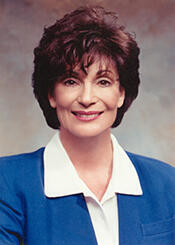
Shelley Berkley (née Rochelle Levine; born January 20, 1951) is an American businesswoman, politician, and attorney who has served as mayor of Las Vegas, Nevada, since 2024. A member of the Democratic Party, she previously represented Nevada’s 1st congressional district in the United States House of Representatives from 1999 to 2013, serving seven terms in office. Over the course of her career, she has also served in the Nevada Assembly, on the Board of Regents of the Nevada System of Higher Education, and in senior leadership roles in higher education and the private sector.
Rochelle Levine was born in New York City on January 20, 1951, the daughter of Estelle (née Colonomos) and George Levine. Her paternal grandparents were Russian Jews, and her mother’s family were Sephardic Jews from Ottoman-era Thessaloniki, in what is now northern Greece. In 1964, when she was a junior high school student, her family moved to Las Vegas, Nevada. She attended Fremont Junior High School and Valley High School in Las Vegas. The move to Nevada during her formative years placed her in the community she would later represent in state and national office.
After graduating from Valley High School, Berkley became the first member of her family to attend college when she enrolled at the University of Nevada, Las Vegas (UNLV). At UNLV she joined the Delta Zeta sorority and became active in student government. In her senior year she was elected student body president of the Consolidated Students of the University of Nevada, Las Vegas. She graduated with honors in 1972, earning a Bachelor of Arts degree in political science. Berkley went on to study law at the University of San Diego School of Law, receiving her Juris Doctor in 1976. Following law school, she returned to Las Vegas to begin her professional and political career.
Berkley initially practiced law in Las Vegas, working for several years as legal counsel for a number of Las Vegas casinos. In addition to her legal work, she served as national director for the American Hotel-Motel Association, gaining experience in hospitality industry policy and advocacy. In the 1990s, she was privately employed by Las Vegas Sands as a government affairs advisor. In that capacity, during the construction of The Venetian in 1996 and 1997, she advised her employer to make campaign contributions to two Clark County commissioners and two Clark County judges to secure approval for the new hotel, noting that the judges “tend to help those who helped them.” She also briefed her employer on the option of currying political favor by hiring an uncle of County Commissioner Erin Kenny and by granting a daiquiri concession to commission chairwoman Yvonne Atkinson Gates. Alongside her professional work, Berkley became active in local civic affairs, building a public profile that would support her entry into elective office.
Berkley’s formal political career began in the Nevada Legislature. She served in the Nevada Assembly from 1982 to 1984 (often cited as 1983 to 1985 in some records), representing a Las Vegas-area district. During this period she participated in state policymaking and developed a reputation as an energetic advocate for her constituents. After leaving the Assembly, she continued her involvement in public service and, in 1990, was elected to the Board of Regents of the Nevada System of Higher Education. She served on the Board of Regents from 1990 to 1998 and was appointed vice chair during her tenure. In that role, she helped oversee Nevada’s public colleges and universities, drawing on her own experience as a first-generation college graduate to inform her work on higher education policy.
In 1996, U.S. Representative John Ensign was re-elected in Nevada’s 1st congressional district with 50.1 percent of the vote, defeating Democratic candidate Bob Coffin by a margin of 6.6 percent. The day after that election, Berkley filed papers to run for the seat in the next cycle. She raised $206,000 in the first six months of her campaign and $410,000 in the following six months, quickly becoming what party leaders described as a “dream candidate” for Democrats in the district. She easily won the 1998 Democratic primary with 81.5 percent of the vote. When Ensign chose not to seek re-election in order to run for the U.S. Senate against Harry Reid, Berkley faced Republican Don Chairez, a Clark County District Court judge, in the general election. She won the November 1998 contest with 49.2 percent of the vote, becoming the second woman elected to Congress from Nevada (after Barbara Vucanovich), the first woman Democrat from Nevada elected to Congress, and the first woman to represent the 1st congressional district.
From January 3, 1999, to January 3, 2013, Berkley represented Nevada’s 1st congressional district, which encompassed most of the city of Las Vegas, the Las Vegas Strip, and the city of North Las Vegas. Over seven terms in the House of Representatives, she participated in the legislative process during a significant period in American history, including the post–Cold War era, the September 11 attacks and their aftermath, the wars in Afghanistan and Iraq, and the Great Recession. She was a member of the New Democrat Coalition, reflecting a generally pro-growth, centrist Democratic orientation. Berkley identified her top priorities as expanding affordable health care coverage for all Americans, protecting veterans’ rights, and promoting alternative energy. She was also a strong and consistent opponent of the proposed nuclear waste repository at Yucca Mountain in Nevada, arguing that it posed unacceptable risks to the state.
Berkley won re-election in 2000 with 51.7 percent of the vote against Republican State Senator Jon Porter, and in 2002 she defeated Republican Las Vegas City Councilwoman Lynette Boggs with 53.7 percent. She continued to secure subsequent terms, and as a sixth-term congresswoman she attracted endorsements from a range of advocacy organizations focused on education, environmental protection, and gender equality in politics, including the National Education Association, the Sierra Club, and the National Women’s Political Caucus. During her House service, she sat on the influential Committee on Ways and Means, including its Subcommittee on Social Security and Subcommittee on Select Revenue Measures, giving her a role in shaping federal tax and entitlement policy. Her voting record reflected strong support from liberal and progressive interest groups on social and environmental issues: NARAL Pro-Choice America gave her a 100 percent rating in 2010, while the National Right to Life Committee rated her at 0 percent. On agricultural issues, she received a 33 percent rating from the American Farm Bureau Federation and a 100 percent rating from the National Farm Workers Union. She also received high ratings from organizations such as Citizens United for the Rehabilitation of Errants and the Defenders of Wildlife Fund, while groups such as the National Taxpayers Union and Peace Action gave her low marks.
Berkley’s congressional tenure included a number of high-profile votes. On October 3, 2008, she voted for the Emergency Economic Stabilization Act of 2008, which created the Troubled Asset Relief Program (TARP) to stabilize the financial system during the economic crisis. On June 26, 2009, she supported the American Clean Energy and Security Act, which would have established a cap-and-trade system for greenhouse gas emissions, similar in concept to “emissions trading” frameworks first advanced in the 1980s. She voted for the Patient Protection and Affordable Care Act in 2010, aligning with her stated priority of expanding access to health care. On October 10, 2002, she was among the 81 House Democrats who voted to authorize the use of military force in Iraq. In 2011, she voted for the National Defense Authorization Act for Fiscal Year 2012, which contained controversial provisions allowing the government and the military to detain certain individuals, including American citizens, indefinitely without trial. A strong supporter of Israel, she was active in the American Israel Public Affairs Committee (AIPAC) and was known for her pro-Israel positions in foreign policy debates. In June 2012, amid scrutiny of political fundraising practices, Berkley announced that she would turn over $11,900 in campaign contributions from indicted lobbyist Harvey Whittemore to the U.S. Treasury; Whittemore had been charged with violating campaign finance laws and misleading law enforcement. Before making that pledge, she had stated that she was holding the contributions in escrow pending the outcome of the investigation.
After leaving Congress in 2013, Berkley transitioned into higher education leadership while remaining active in public affairs. She held senior leadership roles at both the Nevada campus and the California campus of the Touro University System, a network of nonprofit institutions of higher and professional education. In these positions she drew on her experience in health care policy, higher education governance, and community engagement to help guide the institutions’ growth and outreach. Her work at Touro extended her long-standing interest in expanding educational opportunities and strengthening the health-care workforce in Nevada and beyond.
Berkley returned to elective office at the municipal level when she was elected mayor of Las Vegas, taking office in 2024. As mayor, she once again assumed a central role in representing Las Vegas and its residents, this time in city government rather than in Congress. Her mayoral tenure builds on decades of experience in law, business, state and federal policymaking, and higher education administration, and continues a public career that began with student leadership at UNLV and extended through service in the Nevada Assembly, the Nevada Board of Regents, and the U.S. House of Representatives.
Congressional Record