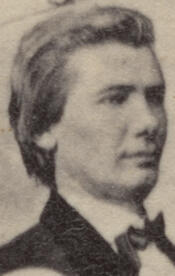
Sempronius Hamilton Boyd (May 28, 1828 – June 22, 1894) was a nineteenth-century politician, lawyer, judge, teacher, and diplomat from Missouri who served as a Representative from Missouri in the United States Congress from 1863 to 1871 and later as United States minister and consul general to Siam. A member of the Republican Party and an Immediate Emancipationist during the Civil War era, he contributed to the legislative process during two terms in the House of Representatives and held a series of important local, state, and federal positions over the course of his career.
Boyd was born in Williamson County, Tennessee, near Nashville, on May 28, 1828. In 1840 he moved with his parents to a farm near Springfield, Missouri. There he received his education from private tutors rather than in formal public schools, an arrangement that was common on the frontier but indicative of a relatively rigorous course of study for the time. Seeking opportunity in the West, Boyd moved to California in 1849, where he prospected for gold during the Gold Rush and supported himself in part by teaching school. In 1854 he returned to Missouri and settled again in Springfield.
Upon his return to Missouri, Boyd quickly entered public service. He served as clerk of the court of Greene County, Missouri, from 1854 to 1856. During this period he studied law, and in 1856 he was admitted to the bar, commencing the practice of law in Springfield. That same year he was elected mayor of Springfield, marking his emergence as a prominent civic leader in southwest Missouri. His combined experience as a court official, lawyer, and municipal executive laid the foundation for his later judicial and legislative work.
At the outbreak of the Civil War, Boyd took an active role on the Union side. He raised the 24th Missouri Infantry for the Union Army and served as its colonel from 1861 to 1863. His leadership in organizing and commanding this regiment during a period of intense conflict in Missouri enhanced his political standing and aligned him with the Unionist and antislavery currents that were reshaping the state’s politics. In 1862 he was elected to the United States House of Representatives as an Immediate Emancipationist from Missouri, reflecting his support for the prompt abolition of slavery.
Boyd served in the House of Representatives from 1863 to 1865 during a significant period in American history, representing the interests of his Missouri constituents and participating in the democratic process at the national level. During this first term in Congress he served as chairman of the Committee on Revisal and Unfinished Business from 1863 to 1865. A member of the Republican Party, he was active in national party affairs, serving on the Republican National Committee from 1864 to 1868 and as a delegate to the Republican National Convention in 1864. In 1865 he was appointed judge of the court of the fourteenth judicial district of Missouri. That same year he presided over the notable trial of James “Wild Bill” Hickok for the killing of Davis Tutt in Springfield, during which he famously suggested to the jury the possibility of nullification, a suggestion the jury followed in acquitting Hickok.
After his initial congressional service, Boyd became involved in railroad development, a central economic enterprise of the Reconstruction era. From 1867 to 1874 he was engaged in building and operating the Southwest Pacific Railroad, contributing to the expansion of transportation infrastructure in Missouri and the broader region. He returned to national office when he was elected again to the House of Representatives as a Republican in 1868, serving a second congressional period from 1869 to 1871. During this term he served as chairman of the Committee on Revolutionary Claims from 1869 to 1871, overseeing matters related to claims arising from the Revolutionary War. Across his two nonconsecutive terms, from 1863 to 1865 and from 1869 to 1871, Boyd played a role in shaping legislation during the Civil War and early Reconstruction years.
Following his second term in Congress, Boyd turned to business and the continued practice of law. From 1874 to 1876 he operated a wagon factory, reflecting the ongoing demand for overland transportation equipment in the postwar West. He then resumed the practice of law in Springfield, maintaining his standing as a leading attorney in the region. His long record of public service and party loyalty led to his appointment by President Benjamin Harrison in 1890 as United States minister and consul general to Siam. Boyd served in that diplomatic post from 1890 until 1892, when deteriorating health forced him to resign and return to the United States.
Sempronius Hamilton Boyd died in Springfield, Missouri, on June 22, 1894. He was interred in Hazelwood Cemetery in Springfield. After his death, a legal dispute arose concerning the salary of the consul general to Siam for the period between Boyd’s departure from the post and the qualification of a presidentially appointed successor. Both Boyd’s estate and Boyd’s own appointed successor as consul general sued to recover the salary of the office for that interval. Boyd’s estate ultimately lost its claim, and the Supreme Court of the United States upheld this outcome in the 1898 case of United States v. Eaton, a decision that clarified aspects of federal appointment and compensation law.
Congressional Record