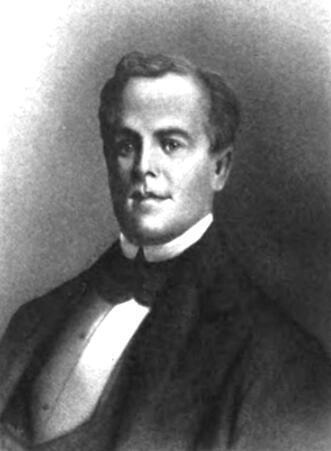
Seargent Smith Prentiss (September 30, 1808 – July 1, 1850) was an American attorney, state legislator, and Whig member of the United States House of Representatives from Mississippi, renowned in his lifetime as one of the most remarkable orators in the country. Daniel Webster, himself celebrated as a great orator, declared that he had never heard a speaker as powerful as Prentiss. His brief but dramatic congressional career, coupled with his legal and political work in Mississippi and later in New Orleans, made him a prominent figure in the turbulent politics of the antebellum era.
Prentiss was born on September 30, 1808, in Portland, in the District of Maine, then part of Massachusetts. He was the son of Captain William Prentiss, a prosperous shipmaster, and his wife. As an infant he contracted a virulent fever that left him without the use of his limbs for several years; his right leg never fully recovered, and he walked with a pronounced lameness throughout his life. During the War of 1812, the economic embargo against the United Kingdom brought his father to the verge of financial ruin, prompting the family to relocate to Gorham, Maine, near the home of his maternal grandfather, Major George Lewis, and his wife. Growing up in this New England environment, Prentiss developed the intellectual gifts and determination that would later define his career, overcoming his physical disability to become a formidable student and speaker.
Prentiss attended Gorham Academy and then Bowdoin College in Brunswick, Maine, an institution that produced many notable public figures of the era. He graduated from Bowdoin in 1826 at the age of seventeen. While at Bowdoin he was associated with the Peucinian Society, a prominent literary and debating society that fostered his interest in rhetoric and public speaking. After graduation he began the study of law in the office of Josiah Pierce in Gorham, but soon decided to seek opportunity in the expanding Southwest. He moved to Natchez, Mississippi, where he worked as a teacher while continuing his legal studies. In 1829 he was admitted to the bar, launching a legal career that quickly brought him regional prominence.
In 1832 Prentiss moved to Vicksburg, Mississippi, a growing river town on the Mississippi River. There he won a major lawsuit involving title to the most valuable part of the city; the property he received as his fee made him, for a time, one of the wealthiest men in Mississippi. Establishing himself as a leading member of the bar, he gained a reputation for brilliant courtroom advocacy and powerful oratory. Entering politics as a member of the Whig Party, he was elected to the Mississippi House of Representatives in 1835. Like many of his contemporaries in the Mississippi political elite, he was a slaveholder. His combination of legal skill, wealth, and rhetorical power quickly made him one of the most influential Whigs in the state.
Prentiss’s national reputation was forged in the bitterly contested congressional elections of 1837–1838. In July 1837, Democrats John F. H. Claiborne and Samuel J. Gholson were re-elected to the United States House of Representatives from Mississippi in a special election. When the regular election was held in November 1837, Prentiss and fellow Whig Thomas J. Word mounted a vigorous, partisan campaign and won in an upset, challenging the Democratic hold on the state’s delegation. Claiborne and Gholson argued that their July victories entitled them to serve full terms, and the dispute was brought before the House of Representatives. The House agreed to hear Prentiss on the contested election, and he delivered a celebrated argument that lasted nine hours over three days, packing the galleries and drawing Senators and other dignitaries to listen. His performance earned him national fame as an orator and public admiration from leading Whigs, including Senators Henry Clay and Daniel Webster. A longtime Washington journalist, Benjamin Perley Poore, later wrote that Prentiss was “the most eloquent speaker that I have ever heard,” describing how the “lame and lisping boy from Maine had ripened, under the Southern sun, into a master orator,” whose vivid imagery and impassioned logic impressed Webster, Clay, Edward Everett, and even John Quincy Adams.
The House Committee on Elections ultimately required a third election to resolve the controversy. The election, held in April 1838, confirmed the November result, and both Prentiss and Word were seated as Whig representatives from Mississippi in May 1838, late in the second session of the Twenty-fifth Congress. Prentiss served from 1838 to 1839, participating in the legislative process during a significant period in American history and representing the interests of his Mississippi constituents as a member of the Whig Party. He also served during the third session of that Congress. Although his printed speeches were widely circulated, contemporaries insisted that the reports were mere “skeletons” that could not capture the energy, imagery, and force of his live oratory. Despite his prominence, he served only this single term in Congress and did not become a long-tenured national legislator.
After leaving Congress, Prentiss turned increasingly to the lecture circuit, where his fame as an orator drew large audiences across the country. He reportedly spoke with little or no reliance on prepared notes, often ad-libbing for hours to crowds that frequently demanded that he continue. In Mississippi politics he opposed the state’s repudiation of its bonds, a controversial decision that damaged the state’s credit and divided its political leadership. Disillusioned by this development and facing personal financial reverses, he moved to New Orleans, Louisiana, in 1845. There he quickly became a leader of the city’s bar, handling important cases and reinforcing his reputation as one of the foremost advocates in the region. He was also active in philanthropic work in New Orleans, lending his talents and public standing to charitable and civic causes.
Behind his public success, Prentiss struggled with mounting financial and personal difficulties. He had made substantial property investments based on disputed land holdings, and when these speculations soured, he suffered heavy losses. Accounts from contemporaries describe him as an alcoholic and a gambler, whose social life was marked by late-night revelry and “high conviviality.” One history of Vicksburg lawyers summarized his trajectory by noting that “His nights were full of revelry and high conviviality. He drank excessively, lived extravagantly, conversed brilliantly and speculated in real estate. The result was disastrous to his fortunes and he lost all he had accumulated, moved disillusioned to New Orleans and died at forty-two in Natchez in the flaming brilliance of a tragic life.” His financial troubles became a matter of public embarrassment, contrasting sharply with the early wealth he had gained in Vicksburg and the high expectations many had held for his career.
Prentiss’s health declined in the late 1840s, and he returned to Mississippi, where he died at his mother-in-law’s house outside Natchez on July 1, 1850. Although born in 1808 and thus forty-one at the time of his death, some contemporaries rounded his age to forty-two. His death shocked many across the nation, as he had long been regarded as one of the most gifted young men in American public life. He was buried at Gloucester Plantation Cemetery in Natchez. In the decades after his death, his name continued to be honored in Mississippi: Prentiss County, Mississippi, was named for him when it was formed on April 15, 1870, and the town of Prentiss, Mississippi, founded in 1903, later became the seat of Jefferson Davis County in 1906.
Congressional Record