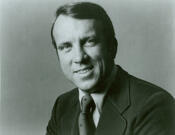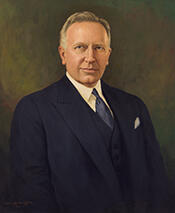
Samuel Davis McReynolds (April 16, 1872 – July 11, 1939) was an American politician, lawyer, and judge who served as a Democratic member of the United States House of Representatives for Tennessee’s 3rd congressional district from 1923 until his death in 1939. Over nine consecutive terms in Congress, he played a significant role in the legislative process during a transformative era in American history and rose to prominence as chairman of the House Committee on Foreign Affairs.
McReynolds was born on a farm near Pikeville, in Bledsoe County, Tennessee, on April 16, 1872. He attended local rural schools before pursuing further education at People’s College in Pikeville, Tennessee. He later studied at Cumberland University in Lebanon, Tennessee, an institution well known in the region for its legal education. After completing his legal studies, he was admitted to the bar in 1893 and commenced the practice of law in Pikeville. His early life in rural Tennessee and his education in local and regional institutions helped shape his understanding of the needs and concerns of his future constituents.
In the 1890s, McReynolds began his public career in the legal system of Tennessee. He served as assistant district attorney of the sixth judicial circuit court of Tennessee in 1894 and again in 1896. In 1896, he moved to Chattanooga, Tennessee, where he continued the practice of law and became increasingly involved in public affairs. His judicial career advanced when he was appointed judge of the criminal court for the sixth circuit of Tennessee on April 16, 1903. In this capacity, he presided over notable cases, including State of Tennessee v. Ed Johnson, a case that later became central to the landmark United States Supreme Court proceeding United States v. Shipp, involving federal authority and the protection of defendants’ rights. McReynolds was subsequently elected and twice re-elected to the criminal court bench, serving there until February 1, 1923, when he resigned following his election to Congress.
McReynolds’s personal life was marked by both happiness and loss. He married Jennie Hutchins on December 21, 1905. After her death on April 16, 1908, he later married Mary Davenport on March 9, 1910. The couple had one daughter, Margaret Hennrietta. Throughout his legal and political career, his family life in Chattanooga provided a stable base as he rose from local attorney and judge to national legislator.
In national politics, McReynolds was elected as a Democrat to the Sixty-eighth Congress and to the eight succeeding Congresses, representing Tennessee’s 3rd congressional district. His service in the House of Representatives began on March 4, 1923, and continued without interruption until his death on July 11, 1939. As a member of the Democratic Party, he consistently represented the interests of his East Tennessee constituents while participating in the broader legislative debates of the interwar period, including issues of economic policy, foreign affairs, and national recovery during the Great Depression. His long tenure in office reflected sustained electoral support and growing influence within the House.
McReynolds’s most prominent role in Congress came through his work on foreign policy. During the Seventy-second through the Seventy-sixth Congresses, he served as chairman of the House Committee on Foreign Affairs. In this capacity, he helped shape the House’s response to emerging international challenges in the 1930s, including the global economic crisis and rising international tensions preceding World War II. In 1933, he further extended his involvement in international economic and diplomatic matters by serving as a delegate to the International Monetary and Economic Conference in London, England, where representatives of many nations met to address worldwide financial instability.
Samuel Davis McReynolds died in office in Washington, D.C., on July 11, 1939, while still serving in the Seventy-sixth Congress. His death marked the end of more than sixteen years of continuous congressional service during a critical period in American and world history. He was interred in Forest Hill Cemetery in Chattanooga, Tennessee, closing a career that had taken him from a rural upbringing in Bledsoe County to a position of national responsibility in the United States House of Representatives.
Congressional Record