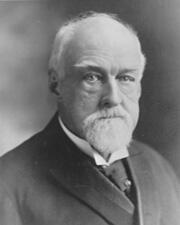
Samuel Douglas McEnery (May 28, 1837 – June 28, 1910) was an American lawyer, jurist, and Democratic politician who served as the 30th governor of Louisiana from 1881 to 1888 and as a United States senator from Louisiana from 1897 until his death in 1910. He was born in Monroe, Ouachita Parish, in North Louisiana, and was the brother of John McEnery, one of the candidates in the contested 1872 election for governor of Louisiana. His public career spanned the tumultuous decades following the Civil War and Reconstruction, during which he became a central figure in Louisiana’s Democratic Party and in the state’s post-Reconstruction political order.
McEnery received a varied and extensive education. He attended Spring Hill College in Mobile, Alabama, and later studied at the United States Naval Academy in Annapolis, Maryland. He continued his education at the University of Virginia in Charlottesville, Virginia. In 1859 he completed formal legal training, graduating from the State and National Law School in Poughkeepsie, New York. This combination of military and legal education prepared him for both service in war and a subsequent career in law and politics.
During the American Civil War, McEnery served in the Confederate States Army, attaining the rank of lieutenant. Following the war and the collapse of the Confederacy, he returned to civilian life in his native region. In 1866 he began practicing law in Monroe, Louisiana. He quickly became active in Democratic Party politics during the Reconstruction era, serving as chairman of the Democratic Party in Ouachita Parish. Through this role he participated in the reestablishment of Democratic control in Louisiana and built the political connections that would support his rise to statewide office.
McEnery’s formal political career in statewide office began when he was elected lieutenant governor of Louisiana in 1879. He assumed the governorship in 1881 upon the death of Governor Louis A. Wiltz, becoming the 30th governor of the state. He was subsequently elected in his own right to a full term as governor in 1884, serving continuously from 1881 until 1888. His administration, however, was widely regarded as weak, in large part because of the dominant influence exerted by State Treasurer Edward A. Burke and the powerful and corrupt Louisiana State Lottery Company, which played a major role in state politics and finance during that period. Despite Louisiana’s substantial Roman Catholic population—indeed a plurality statewide and a majority in Acadiana and many southern parishes—McEnery was the last Catholic to be elected governor of Louisiana prior to Edwin Edwards in 1972. He failed to secure reelection in 1888, ending his tenure in the governor’s office that year.
After his defeat in the 1888 gubernatorial election, McEnery continued his public service in the judiciary. He was appointed an associate justice of the Louisiana Supreme Court, where he served as part of the state’s highest tribunal. His judicial service further enhanced his reputation as a public figure and legal authority in Louisiana and helped maintain his prominence within the Democratic Party and state political circles.
McEnery’s national career began with his election to the United States Senate in 1896 as a Democrat from Louisiana. He entered the Senate in 1897 and served there until his death in 1910, completing what contemporaries and later accounts describe as three terms in office. His service in Congress occurred during a significant period in American history, encompassing the Spanish–American War, the Progressive Era’s early reforms, and major debates over economic regulation and imperial expansion. As a member of the Senate, Samuel Douglas McEnery participated in the legislative process and represented the interests of his Louisiana constituents. During his Senate tenure he served on the Committee on Corporations Organized in the District of Columbia and on the Committee on the Transportation and Sale of Meat Products, positions that placed him at the center of emerging federal oversight of corporate activity and food safety. Outside the formal structures of government, he was also a member of The Boston Club of New Orleans, one of the city’s prominent social and political clubs.
Samuel Douglas McEnery died in office on June 28, 1910, in New Orleans, Louisiana, while still serving as a United States senator. His death placed him among the members of Congress who died in office in the early twentieth century. He was interred in Metairie Cemetery in New Orleans, a resting place for many of the state’s political and social leaders. His long career, encompassing service as governor, state supreme court justice, and U.S. senator, left a lasting imprint on Louisiana’s political history in the post-Reconstruction and Progressive eras.
Congressional Record