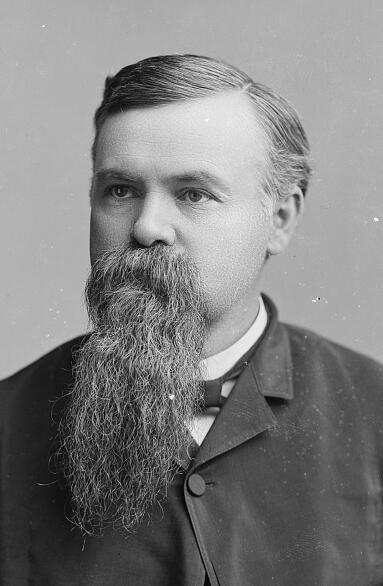
Samuel Willis Tucker Lanham (July 4, 1846 – July 29, 1908) was a conservative Democrat who served as a Representative from Texas in the United States Congress from 1883 to 1903 and as the 23rd governor of Texas from 1903 to 1907. Over the course of eight terms in Congress and two terms as governor, he played a significant role in Texas and national politics during a transformative period in American history, representing first the vast, largely frontier 11th Congressional District of West Texas and later the more urbanized 8th District.
Lanham was born on July 4, 1846, in Spartanburg District (now Spartanburg County), South Carolina, to James Madison Lanham and Louisa de Aubrey (Tucker) Lanham. He was named for his maternal grandfather, Samuel Willis Tucker. Raised in the antebellum South, he came of age as sectional tensions were escalating toward civil war. When the Civil War began, despite being only fifteen years old, Lanham volunteered for service in the Confederate States Army. He fought primarily in Virginia and was wounded at the Battle of Spotsylvania Court House in May 1864, one of the bloodiest engagements of the war. After the Confederacy’s defeat, he returned to civilian life, married, and soon afterward migrated west, joining the many Southerners who sought new opportunities in Texas.
After the war, Lanham and his wife settled in Weatherford, Texas, in Parker County, where he worked while studying law. He was admitted to the bar in 1869 and quickly established himself as a capable attorney. Shortly after his admission, he was appointed district attorney, a position in which he gained statewide attention. His most famous case was the prosecution of Kiowa chiefs Satanta and Big Tree for their role in the Warren Wagon Train Raid of 1871, one of the earliest major criminal trials in Texas involving Native American leaders. The case underscored the tensions of the postwar frontier and helped solidify Lanham’s reputation as a determined and effective prosecutor. In 1868 he had joined the Masons, and he later became a member of Phoenix Lodge No. 275 of the Grand Lodge of Texas in Weatherford, reflecting his growing prominence in local civic and fraternal life.
Lanham’s legal and public profile led naturally into electoral politics. In 1882 he was elected to the United States House of Representatives as a Democrat from Texas’s 11th Congressional District, a vast area encompassing much of West Texas. He entered Congress on March 4, 1883, and served five consecutive terms from that district, remaining in the House for a decade. During these years, Samuel Willis Tucker Lanham contributed to the legislative process during eight terms in office overall, participating in debates over issues such as land policy, railroad regulation, and the needs of a rapidly developing Texas. In 1894 he sought higher office, running for governor of Texas; he lost in the Democratic primary to Charles Allen Culberson, a setback that temporarily interrupted his congressional career. Lanham later returned to the House of Representatives, this time from Texas’s 8th Congressional District, where he served four additional terms. His service in Congress thus spanned from 1883 to 1903, during which he represented both frontier and more settled constituencies and participated in the democratic process at a time of industrial expansion, agrarian unrest, and the rise of regulatory politics.
In 1902 Lanham was elected governor of Texas and took office in January 1903, becoming the state’s 23rd chief executive and the last Confederate veteran to serve as governor of Texas. His administration was marked by a series of significant reforms and institutional developments. Under his leadership, the state established the Southwest Texas State Normal School at San Marcos (now Texas State University–San Marcos), expanding teacher training and public education. His tenure also saw the passage of numerous safety regulations. In his first year in office, the Texas legislature enacted laws limiting the number of hours railroad employees could work and regulating child labor, reflecting growing Progressive Era concerns about industrial working conditions and the welfare of children.
Lanham’s governorship also addressed long-standing constitutional and financial issues. The Texas Constitution had prohibited a state banking system, but in 1904 voters approved a constitutional amendment revoking that restriction. In 1905 the legislature created the state insurance and banking commission, and Lanham appointed Thomas B. Love as its first director. Over the next five years, more than 500 banks were organized under the new framework, transforming the state’s financial landscape. Lanham took the lead in tax reform in 1905, confronting the inadequacies of a revenue system that relied heavily on a general property tax. At his request, the legislature imposed taxes on the gross receipts of express companies and pipelines and increased taxes on the intangible assets of railroads and other corporations, broadening the tax base to support expanding state functions.
Election law reform was another hallmark of Lanham’s administration. Before he took office, Texas lacked a uniform procedure for nominating candidates, a situation that fostered fraud and manipulation designed to suppress or distort the vote. During his governorship, the legislature passed two major election reform measures sponsored by Judge Alexander W. Terrell. The first, enacted in 1903, allowed political parties to nominate candidates either by convention or by primary election. The second, in 1905, established voter qualifications, required candidates to file itemized campaign expense statements, mandated primary elections for major parties (at that time, effectively the Democratic Party in Texas), and set a uniform date for primaries. These laws helped institutionalize more orderly and transparent electoral practices in the state.
Near the end of Lanham’s second term, a major political scandal erupted involving the Waters-Pierce Oil Company, a Texas subsidiary of Standard Oil. Before Lanham became governor, the state had sued Standard Oil and Waters-Pierce, resulting in the revocation of Waters-Pierce’s license to operate in Texas, a decision upheld by the U.S. Supreme Court in 1900. Under Governor Joseph D. Sayers, and in part at the urging of U.S. Senator Joseph Weldon Bailey, Waters-Pierce obtained a new license after claiming to have severed ties with Standard Oil. In 1905, however, Texas filed suit again when it was discovered that Standard Oil still owned most of Waters-Pierce’s stock. The ensuing trial revealed Bailey’s extensive influence and the fact that he had been on the company’s payroll. Although Lanham and his administration were not accused of wrongdoing, the controversy over Bailey’s ethics dominated state politics and cast a shadow over the final phase of Lanham’s governorship. Lanham himself later admitted that he did not enjoy his time as governor, remarking that “office seekers, pardon seekers, and concession seekers overwhelmed me. They broke my health,” and he often expressed a wish that he had remained in Congress.
After leaving office in 1907, Lanham retired to his longtime home in Weatherford, Texas. His standing in the state’s educational and civic life remained high: in June 1905 Baylor University had conferred upon him an honorary doctorate, and in 1907 Governor Thomas M. Campbell appointed him a regent of the University of Texas, recognizing his contributions to public service and education. A Freemason since the late 1860s, he continued his association with Phoenix Lodge No. 275 in Weatherford. He was widely regarded as an eloquent speaker and writer and frequently addressed Confederate veterans’ camps throughout Texas, maintaining close ties with fellow former soldiers and participating in the broader culture of Confederate remembrance.
Samuel Willis Tucker Lanham died in Weatherford, Texas, on July 29, 1908. His family continued his legacy of public service and literary accomplishment. His son, Fritz Garland Lanham, served fourteen terms in the U.S. House of Representatives from 1919 to 1947, representing Texas and carrying forward the family’s congressional tradition. Lanham’s grandson, Edwin Lanham, became a successful novelist, adding a literary dimension to the family’s prominence. Through his long career as a lawyer, congressman, and governor, Lanham’s life traced the trajectory of Texas from the Reconstruction era through the Progressive Era, and his public record remained an important part of the state’s political history.
Congressional Record