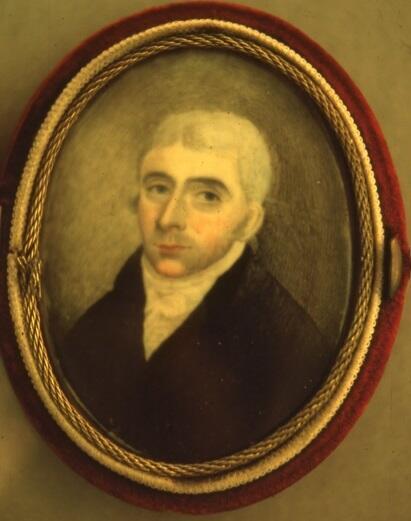
Samuel Holten (June 9, 1738 – January 2, 1816) was an American Founding Father, physician, jurist, and politician from Danvers, Massachusetts. Born in Salem Village (now Danvers) in the Province of Massachusetts Bay, he was raised in a community that would later become historically notable for its early colonial and revolutionary heritage. After studying medicine under a local physician, Holten established a medical practice in nearby Gloucester. He soon returned to Danvers, where he continued to practice as a physician and became a respected figure in local affairs.
Holten’s early professional life as a physician coincided with the growing tensions between the American colonies and Great Britain. As the imperial crisis deepened, he aligned himself firmly with the Patriot cause. By the mid-1770s he had emerged as an active participant in the revolutionary movement in Massachusetts, using his standing in the community to support resistance to British policies and to help organize the colony’s emerging self-governing institutions.
During the American Revolution, Holten served in the militia as a major in the First Essex County Regiment, contributing to the colony’s military readiness. He was a member of the Massachusetts Provincial Congress from 1774 to 1775, the extralegal body that effectively replaced the royal government in the province. In this capacity, he helped shape the colony’s response to British authority. He was also named to the Massachusetts Committee of Safety, which oversaw military supplies and defensive preparations at a critical moment in the conflict.
Holten’s prominence in Massachusetts politics led to his appointment to the Continental Congress in 1778 as a delegate representing the Massachusetts Bay Colony. While serving in that body, he signed the Articles of Confederation, thereby participating directly in the creation of the first constitutional framework for the United States. He left the Continental Congress in 1780 and returned to state service, becoming a member of the Massachusetts Senate for two years. From 1780 to 1782, he also served on the Massachusetts Governor’s Council, an executive advisory body, a role he would hold again in eight of the next fourteen years, reflecting his continuing influence in state governance.
In 1783, Holten was appointed to the Congress of the Confederation, which, under the Articles of Confederation, functioned as the new nation’s sole branch of the federal government. Near the end of his two-year tenure, he briefly served as chairman of Congress when the presiding officer was absent due to illness, an event recorded in the journals of the time: “His Excellency the president, being, by indisposition, prevented from attending the House, Congress proceeded to the election of a Chairman, and, the ballots being taken, the (honorable) Samuel Holten was elected.” Holten returned to the Massachusetts Senate in 1784 and completed additional terms in 1786, 1789, and 1790. In 1787, between Senate terms, he served in the Massachusetts House of Representatives and also returned to the Congress of the Confederation for another year, continuing his dual engagement in both state and national affairs.
As the United States transitioned from the Articles of Confederation to the federal Constitution, Holten sought election to the new national legislature. He was an unsuccessful candidate for the U.S. House of Representatives from Massachusetts’s 2nd congressional district in 1788 and again in 1790, and he was also an unsuccessful candidate for the United States Senate in 1790. Nevertheless, he remained a significant political figure and, in 1792, was elected to represent Massachusetts’s 1st congressional district in the U.S. House of Representatives. As a member of the Unknown Party representing Massachusetts, Samuel Holten contributed to the legislative process during one term in office. His service in Congress, from 1793 to 1794, occurred during a significant period in American history, as the new federal government under the Constitution was taking shape. In that capacity, he participated in the democratic process and represented the interests of his constituents in the early years of the republic.
After his term in the U.S. House of Representatives, Holten returned to public service at the state and local level. He was appointed judge of the Essex County Probate Court in 1796, a position he held for nearly two decades. He sat on the probate bench from 1796 until his resignation in 1815, overseeing matters related to wills, estates, and guardianships, and helping to stabilize legal and property relations in a rapidly developing region. In addition to his judicial duties, Holten served as treasurer of the First Church of Danvers for forty years, underscoring his longstanding involvement in the religious and civic life of his community.
Samuel Holten died in Danvers on January 2, 1816. He was buried at Holten Cemetery in Danvers, where his grave marks the resting place of a physician, legislator, and jurist who had participated in the founding era of the United States. In 1974, the Danvers Historical Commission placed a plaque in front of his house listing his achievements, and the street on which it stands has been named in his honor, reflecting the town’s continuing recognition of his contributions to both Massachusetts and the nation.
Congressional Record