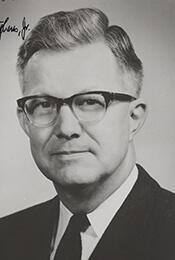
Samuel Hammond (September 21, 1757 – September 11, 1842) was a lieutenant colonel during the American Revolutionary War, a prominent territorial official and governor‑level leader in the Louisiana and Missouri Territories, and a United States Representative from Georgia in the Eighth United States Congress. A member of the Republican (Democratic‑Republican) Party, he served one term in the U.S. House of Representatives, participating in the legislative process during a formative period in the early republic and representing the interests of his Georgia constituents.
Hammond was born in Farnham Parish in the Virginia Colony to Elizabeth Hammond Steele and Charles Hammond, who were second cousins. His father, Charles Hammond, worked as a secretary for the Virginia House of Delegates and, like Samuel and three of his other sons, served during the Revolutionary War. Samuel attended the common schools of colonial Virginia. From an early age he was drawn into frontier and military affairs, experiences that would shape his long public career.
Before the outbreak of the American Revolution, Hammond served as a volunteer under Royal Governor John Murray, Earl of Dunmore, in campaigns against Native Americans on the western frontier. He distinguished himself at the Battle of Kanawha, now commonly known as the Battle of Point Pleasant, fought on October 10, 1774, in present‑day West Virginia. In July 1776 he fought against the Cherokee under Colonel Andrew Williamson. During the Revolutionary War he entered the Continental Army, and in December 1776 he led a company of minutemen he had raised at the Battle of Great Bridge in the area later known as Great Bridge, Virginia. He subsequently served for several years in Pennsylvania and New Jersey with Virginia troops, gaining extensive combat experience in the northern theater.
In 1779 Charles Hammond moved his family to South Carolina, and Samuel continued his Revolutionary service from his new home state. He was promoted to assistant quartermaster at the siege of Savannah and served as a member of the “council of capitulation” at Charleston, where he was made a lieutenant colonel. Over the course of the southern campaigns he commanded troops in numerous engagements, including battles at Augusta, Blackstock’s Farm, Cowpens, Eutaw Springs, Guilford Courthouse, Hanging Rock, and Kings Mountain. Shortly after the war he settled in Savannah, Georgia, where he became a leading figure on the Georgia frontier. In the latter 1780s and early 1790s he again saw active service, this time in conflicts with the Creek (Muscogee) peoples, commanding a corps of Georgia Volunteers in 1793.
Hammond’s civil career in Georgia developed alongside his military and frontier service. He was appointed Surveyor General of Georgia in 1796, reflecting both his familiarity with the backcountry and the importance of land administration in the post‑Revolutionary South. He served in the Georgia House of Representatives from 1796 to 1798 and in the Georgia Senate in 1799 and 1800. Elected as a Republican to the Eighth Congress, he represented Georgia in the U.S. House of Representatives from March 4, 1803, until February 2, 1805. His term in Congress coincided with the administration of President Thomas Jefferson and the period immediately following the Louisiana Purchase, when questions of territorial organization, western expansion, and relations with Native nations were central to national policy.
On February 2, 1805, Hammond resigned from Congress to accept appointment as colonel commandant of the St. Louis District of the Louisiana Territory, a post he held from 1805 to 1824. In this capacity he exercised broad civil and military authority on the trans‑Mississippi frontier during the early years of American governance in the region. As the Missouri Territory was organized, he became the first president (often styled governor) of the Missouri Territorial Council in 1813, placing him at the head of the upper chamber of the territorial legislature and making him a key figure in the transition from military to civil rule. He also served as receiver of public moneys in Missouri, overseeing federal land receipts, and was president of the Bank of St. Louis, reflecting his prominence in the territory’s financial and administrative affairs.
In 1824 Hammond returned to South Carolina, where he resumed public service in his native region. He became a member of the South Carolina House of Representatives and continued his work in land administration as Surveyor General of South Carolina in 1825. Later he served as Secretary of State of South Carolina from 1831 to 1835, overseeing state records and official documents during a period marked by intense debates over states’ rights and federal authority. After this long succession of military, legislative, and executive posts in multiple states and territories, he retired from active public life.
Hammond married Rebecca Rae, the widow of Colonel John Rae of Augusta, Georgia, in 1783, and the couple settled in Savannah. After Rebecca’s death in 1798, he moved to Rae’s Hall Plantation. On May 5, 1802, he married his second wife, Eliza Amelia O’Keefe. Over the course of his life he had eight children. Beyond his public offices, he was active in fraternal circles as a Freemason and was a member of Solomon’s Lodge No. 1, F. & A. M., in Savannah, Georgia. This lodge, established by James Edward Oglethorpe, founder of the Georgia colony, on February 21, 1734, is recognized as the oldest continuously operating English‑constituted Masonic lodge in the Western Hemisphere, underscoring Hammond’s connection to some of the earliest institutional traditions in the region.
In retirement Hammond lived at his home, “Varello Farm,” at Beech Island, South Carolina, on the South Carolina side of the Savannah River near Augusta, Georgia. He died there on September 11, 1842. He is buried near the Hammond Cemetery at the Charles Hammond House in North Augusta, South Carolina, where a memorial commemorates the heroic actions of Colonel Samuel Hammond, Colonel LeRoy Hammond Jr., and Colonel LeRoy Hammond Sr., reflecting the extended family’s long record of military and public service.
Congressional Record