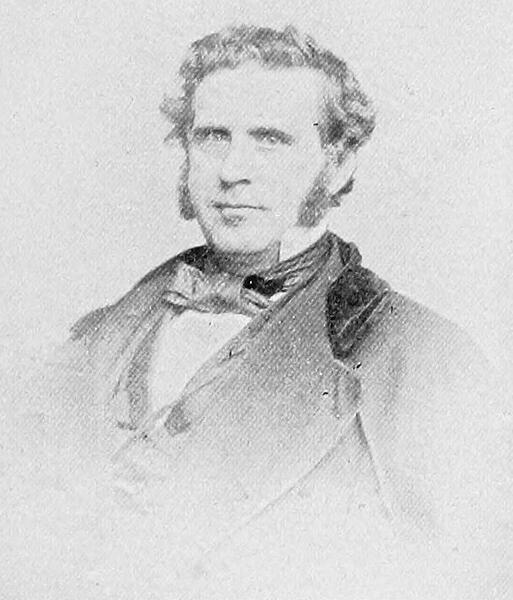
Samuel Gordon Daily (1823 – August 15, 1866) was an American lawyer and politician who represented the Nebraska Territory in the United States Congress during the Civil War era. An early Free Soiler and later a Republican, he was noted for his radical and outspoken abolitionism and for introducing the first bill to abolish slavery in the Nebraska Territory.
Daily was born in 1823 in Trimble County, Kentucky. In 1824 he moved with his parents to Jefferson County, Indiana, where he attended the common schools. He pursued further education at Hanover College in Hanover, Indiana, reflecting an early commitment to formal study unusual for many frontier politicians of his generation. After college he read law, was admitted to the bar at Indianapolis, Indiana, and commenced the practice of law in Madison, Indiana.
While living in Indiana, Daily became active in politics as a member of the Free Soil Party, which opposed the expansion of slavery into the western territories. He was an unsuccessful Free Soil candidate for election to the Indiana General Assembly, an early indication of his antislavery convictions. Following this defeat, he moved to Indianapolis and engaged in the cooperage business, gaining experience in trade and small-scale manufacturing before eventually turning his attention to opportunities in the trans-Missouri West.
In 1857, Daily moved to the Nebraska Territory and settled in Peru, in Nemaha County, Nebraska. There he built a sawmill on the Missouri River, contributing to the economic development of the young community. In 1858 he was elected to the Nebraska Territorial House of Representatives. As a territorial legislator, he was among the first public figures in Nebraska to declare himself a Republican, aligning with the new party that had emerged in opposition to the spread of slavery. A radical and outspoken abolitionist, he introduced the first bill to abolish slavery in the Nebraska Territory, although the measure failed. His legislative record and public positions established him as a leading antislavery voice on the frontier.
Daily’s prominence in territorial politics led to his election to Congress. Running as a Republican, he successfully contested the election of Democrat Experience Estabrook to the Thirty-sixth United States Congress as delegate from the Nebraska Territory. The contest was resolved in his favor, and he took his seat on May 18, 1860. The subsequent election for the Thirty-seventh Congress was again contested, this time against J. Sterling Morton, a prominent Nebraska Democrat and later founder of Arbor Day. Once more, the House decided the contest in Daily’s favor. He was then reelected without contest to the Thirty-eighth Congress. As territorial delegate, he served from May 18, 1860, to March 3, 1865, spanning the secession crisis and the entirety of the Civil War. Although delegates from territories could not vote on final passage of legislation, Daily participated in debates, served on committees, and advocated for Nebraska’s interests, including infrastructure, settlement, and the antislavery cause consistent with his Republican affiliation.
At the close of his congressional service, Daily received a federal appointment reflecting his standing within the Lincoln administration. In March 1865, at the special request of President Abraham Lincoln, he was appointed deputy collector of customs in New Orleans, Louisiana, a key Gulf port undergoing Reconstruction-era reorganization under Union control. He relocated to New Orleans to assume these duties, but his service there was cut short by illness. Daily died of yellow fever in New Orleans on August 15, 1866. His body was returned to Nebraska, and he was buried in Mount Vernon Cemetery in Peru, Nebraska, the community where he had first established himself in the territory and from which he rose to national office.
Congressional Record