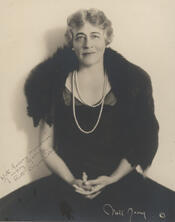
Ruth Baird Leavitt Owen Rohde (née Bryan; October 2, 1885 – July 26, 1954), also known as Ruth Bryan Owen, was an American politician, diplomat, author, educator, and early film pioneer who represented Florida’s 4th congressional district in the United States House of Representatives from March 4, 1929, to March 4, 1933, and served as United States Envoy (minister) to Denmark from 1933 to 1936. A member of the Democratic Party, she was the first woman elected to Congress from Florida and only the second woman ever elected to the House from the American South, after Alice Mary Robertson of Oklahoma. She became the first woman to earn a seat on the House Committee on Foreign Affairs and, under President Franklin D. Roosevelt, the first female chief of mission at the minister rank in U.S. diplomatic history.
Ruth Baird Bryan was born on October 2, 1885, in Jacksonville, Illinois, to William Jennings Bryan and Mary E. Baird Bryan. Her father was a prominent Democratic politician, serving as a congressman and three-time Democratic presidential nominee, and her grandfather Silas Bryan was a judge and legislator, giving her an early and intimate exposure to public life and politics. Because of her father’s political career, she moved frequently in childhood, spending part of her youth in Washington, D.C., where she attended public schools. She later studied at the Monticello Female Academy in Godfrey, Illinois, and in 1901 began taking classes at the University of Nebraska. Her formal university education was cut short when she left in 1903 to marry, but the grounding in public affairs and rhetoric she absorbed in her family home would inform her later work as a lecturer, writer, and legislator.
On October 3, 1903, Ruth Bryan married William H. Leavitt, a well-known portrait painter based in Newport, Rhode Island, whom she had met when he was painting a portrait of her father. The couple had two children before divorcing in 1909. In 1910 she married Reginald Owen, a British Army officer, with whom she had two more children. During World War I she accompanied him abroad and served as a war nurse in the Voluntary Aid Detachment in the Egypt–Palestine campaign from 1915 to 1918, and also worked as a secretary for the American Women’s War Relief Fund, gaining first-hand experience with international affairs, wartime logistics, and humanitarian work. After the war she and her family spent three years in Oracabessa, Jamaica, where she oversaw the design and construction of her home, Golden Clouds. She retained this Jamaican residence for more than three decades, spending many winters there even after she later lived in Denmark and New York City; her experiences at Golden Clouds and in the Caribbean would later be recounted in her book Caribbean Caravel. Her second husband, Reginald Owen, died in 1928, leaving her a widow and the mother of four at the time she entered national elective politics.
In the early 1920s, Ruth Bryan Owen emerged as a cultural and educational figure in Florida and as a pioneer in the American film industry. From 1925 to 1928 she served as an administrator at the newly founded University of Miami, contributing to the development of higher education in the region. At the same time, she pursued a parallel interest in motion pictures. In 1921 she began production of a feature film, Once Upon a Time (also known as Scheherazade), which was completed in 1922 and is now considered lost. She wrote, directed, and produced the film, which used the Community Players of Coconut Grove, Florida, rather than a major studio cast. The story centered on a shah dethroned by a jealous subordinate who becomes a sadistic ruler, tormenting young women who fail to amuse him, until the exiled shah returns to save the most beautiful of his would-be victims. Contemporary accounts in the Moving Picture World praised the elaborate costuming, complex staging, and exotic mise-en-scène, which drew on Owen’s extensive travels in India, Burma, Sri Lanka, China, and Japan. She funded the film from her earnings on the public-speaking circuit and, in correspondence with her Illinois friend Carrie Dunlap, expressed pride in her work and her ambition to be among the first female filmmakers in the United States. She also described the support she received from the General Federation of Women’s Clubs and its efforts to help secure a distribution arrangement with the Society for Visual Education.
Owen’s formal political career began in Florida in the mid-1920s. In 1926, a year after the death of her father, she sought the Democratic nomination for Florida’s 4th congressional district, which then encompassed nearly the entire east coast of the state from Jacksonville to the Florida Keys, including Miami, Orlando, and St. Augustine. She narrowly lost the primary to incumbent William J. Sears by fewer than 800 votes. Undeterred, and by then well known in Miami for her civic engagement, she played a significant public role in relief and recovery efforts following the devastating 1927 hurricane that struck the city. Widowed after Reginald Owen’s death in 1928, she ran again that year for the 4th District seat. Capitalizing on her hurricane relief work and an energetic newspaper and speaking campaign, she defeated Sears by more than 14,000 votes and took her seat in the Seventy-first Congress on March 4, 1929, as a Democrat, while a widow and mother of four.
Ruth Bryan Owen served two terms in the U.S. House of Representatives, from 1929 to 1933, during a period marked by the onset of the Great Depression and intense national debate over Prohibition and economic policy. Her election was contested on the grounds that she had allegedly lost her U.S. citizenship by marrying a foreign national, under earlier provisions of federal law. Although the Cable Act of 1922 had allowed women in her position to repatriate, she had formally regained her citizenship in 1925, less than the seven years of citizenship required by the Constitution for House members. She argued her case personally before the House Committee on Elections, asserting that no American man had ever lost his citizenship by marriage and that her loss of citizenship had occurred solely because she was a woman, not because of her marital status in any substantive sense. The House of Representatives ultimately voted in her favor, confirming her right to hold her seat. In Congress, she became the first woman to serve on the House Committee on Foreign Affairs, where she drew on her international experience and family background in diplomacy and politics. In the 1930 election cycle she won renomination easily, defeating Daytona Beach attorney Dewitt T. Deen by a wide margin in the June Democratic primary. Because Republicans did not field a candidate in the 4th District, the pro-Prohibition Owen was widely regarded in the press as having secured re-election by virtue of her Democratic nomination. However, in the 1932 Democratic primary she was defeated by J. Mark Wilcox, who campaigned on a platform favoring the repeal of Prohibition, and her congressional service concluded on March 4, 1933.
Following her congressional career, Owen was appointed by President Franklin D. Roosevelt as United States Envoy Extraordinary and Minister Plenipotentiary to Denmark, serving from 1933 to 1936. In this role she became the first woman to represent the United States as chief of mission in a foreign country at the ministerial rank. One of her principal objectives in Copenhagen was to improve and restore Danish-American relations, which had been strained in part by the Smoot–Hawley Tariff Act and the broader economic dislocations of the Depression. Her tenure was marked by active cultural and diplomatic engagement, including public speaking and writing that interpreted American policies and ideals to Danish audiences and vice versa. On July 11, 1936, while still a prominent public figure, she married Børge Rohde, a Danish captain of the King’s Guard, at the Hyde Park, New York, estate of President and Mrs. Roosevelt. The noted novelist Fannie Hurst, a close friend of the bride, served as matron of honor. Owen announced that she would retain her own name in her diplomatic and literary careers. Because the marriage conferred Danish citizenship upon her and gave her dual nationality, she resigned her ambassadorial post in September 1936 in keeping with U.S. diplomatic practice at the time.
In the years after her diplomatic service, Ruth Bryan Owen remained active in international affairs, public speaking, and writing. She and her husband purchased “The Cedars” in Alderson, West Virginia, in 1939 and began restoring the property; they sold it in 1945, and it was later listed on the National Register of Historic Places in 1978. During World War II and the immediate postwar period, she participated in the shaping of the new international order. In 1945 she served as a delegate to the San Francisco Conference that established the United Nations, contributing to the foundational deliberations that created the U.N. Charter. In 1948 President Harry S. Truman appointed her an alternate delegate to the United Nations General Assembly, underscoring her continuing stature in foreign affairs. She also pursued a substantial literary career, publishing works that reflected her interests in public speaking, Scandinavia, and the Caribbean. Her books included Elements of Public Speaking (New York: H. Liveright, 1931); Leaves from a Greenland Diary (New York: Dodd, Mead & Co., 1935); Denmark Caravan (New York: Dodd, Mead & Co., 1936); Picture Tales from Scandinavia (Philadelphia: J. B. Lippincott Co., 1939); The Castle in the Silver Wood and Other Scandinavian Fairy Tales (New York: Dodd, Mead & Co., 1939); Look Forward, Warrior (New York: Dodd, Mead & Co., 1942); and Caribbean Caravel (New York: Dodd, Mead & Co., 1949).
Ruth Bryan Owen died in Copenhagen, Denmark, on July 26, 1954, while in the country to accept the Danish Medal of Merit. She suffered a heart attack and was cremated, with her ashes interred at Ordrup Cemetery in Copenhagen. Her legacy as a trailblazing woman in American politics, diplomacy, and culture has been recognized in subsequent decades. In 1992 she was inducted into the Florida Women’s Hall of Fame. In 2008, Florida Chief Financial Officer Alex Sink founded Ruth’s List Florida, a political organization named in her honor and dedicated to electing more women to public office, reflecting the enduring influence of her pioneering role as Florida’s first woman member of Congress and the first female U.S. chief of mission abroad.
Congressional Record