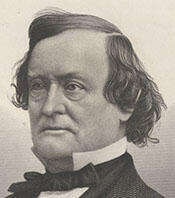
Rufus Paine Spalding (May 3, 1798 – August 29, 1886) was a nineteenth-century American politician, lawyer, and judge from Ohio who served three terms as a Republican Representative in the United States House of Representatives from 1863 to 1869. Over the course of a long public career, he also served in the Ohio House of Representatives from 1839 to 1842 and as an associate justice of the Ohio Supreme Court from 1849 to 1852, and he played a prominent role in the anti-slavery and Free Soil movements and in the early organization of the Ohio Republican Party.
Spalding was born in West Tisbury, Massachusetts, on May 3, 1798. He pursued higher education at Yale College, from which he graduated in 1817. After leaving Yale, he read law in Connecticut under Zephaniah Swift, a distinguished lawyer, jurist, and legal writer who was then serving as chief justice of the Connecticut Supreme Court. Swift, the author of several influential legal digests, became both Spalding’s mentor and, later, his father-in-law. In December 1819, after completing his legal studies, Spalding left New England and moved to Little Rock, in what was then Arkansas Territory, where he entered into a law partnership with Samuel Dinsmoore. The firm practiced for about a year and a half before Spalding dissolved the partnership and left Arkansas. In 1821 he settled in Warren, Ohio, to continue the practice of law, and in 1835 he moved to Ravenna, Ohio, where he again engaged in private practice and became increasingly active in local and state affairs.
Spalding entered elective office in 1839, when he was chosen as a Democrat to the Ohio House of Representatives. During his first term in the General Assembly, he was instrumental in securing passage of legislation creating Summit County, Ohio, a measure that had failed several years earlier due to partisan opposition from representatives of the affected counties. By forging a coalition of Democrats and Whigs after the 1839 elections, Spalding helped overcome that resistance, and following the establishment of Summit County he moved from Ravenna to Akron, the new county seat. He was reelected to the Ohio House in 1841 and served one term as Speaker of the House. In that role he presided over debates on state finance during a period of post-boom deflation and led the successful opposition to a proposal to repudiate Ohio’s public debt, arguing that refusal to honor the state’s obligations would damage its credit and impair its future ability to borrow.
In 1849 Spalding was elected an associate justice of the Ohio Supreme Court, serving on the state’s highest court from 1849 through 1852. Throughout his early political and judicial career he was aligned with the Democratic Party, but during the 1840s his views on slavery increasingly diverged from the party’s national leadership. While he did not advocate federal interference with slavery in states where it already existed, he insisted that slavery must not be extended into the territories and argued that if the institution had been confined to the original thirteen states it might have withered away. His anti-slavery speeches, including a notable address in Akron in 1847, attracted the attention of the emerging Free Soil movement. In 1849, while still a Democrat, he was invited to speak at a Free Soil convention in Cleveland, where he sharply criticized southern Democrats and urged Free Soilers to remain steadfast in opposing the spread of slavery. The passage of the Fugitive Slave Act of 1850, which he regarded as making the Democratic Party a pro-slavery organization, prompted him to leave the Democrats and join the Free Soil Party.
Spalding’s Free Soil activism extended to the national stage. In 1852 he was selected as one of thirteen delegates to the Free Soil Party’s national convention in Pittsburgh, which met to choose a presidential nominee. Although he was a longtime associate of fellow Ohioan Salmon P. Chase, with whom he had toured Toledo and Cleveland denouncing the Fugitive Slave Act, Spalding supported John P. Hale for the presidential nomination. He campaigned vigorously for Hale throughout northeastern Ohio, though Hale ultimately failed to carry any state in the general election. During these years Spalding also maintained an active law practice, increasingly focused on defending opponents of slavery and challenging the enforcement of federal fugitive slave laws. In 1859 he represented Simon Bushnell, an Underground Railroad supporter, in the case of Ex parte Bushnell, arguing unsuccessfully that the Fugitive Slave Act was unconstitutional; Bushnell was convicted of obstructing the recapture of an escaped slave named John and sentenced to sixty days in the Cuyahoga County jail and a $600 fine. In 1861 Spalding again attacked the fugitive slave laws in court when he represented a runaway slave named Lucy who had been seized in Cleveland. Although he failed to prevent her return to her owner, Lucy was the last enslaved person sent back to the South from Ohio under the Fugitive Slave laws, underscoring the waning enforcement of those statutes on the eve of the Civil War.
Following the passage of the Kansas–Nebraska Act in 1854, Spalding emerged as a major figure in the formation of the Ohio Republican Party. Anti-slavery politicians from several parties convened at the Town Street Methodist Episcopal Church in Columbus to organize what was initially called the Fusion Party. At that convention Spalding chaired the Resolutions Committee, which drafted six resolutions, including one pledging to render inoperative the portion of the Kansas–Nebraska Act that effectively repealed the Missouri Compromise’s restriction on slavery in certain territories. The Fusion Party soon evolved into the Ohio Republican Party. Spalding continued to be active in national politics as well; at the first Republican National Convention in Philadelphia in 1856 he served as a delegate at large from Ohio and managed the presidential nomination campaign of Supreme Court Justice John McLean. On the eve of the convention he wrote optimistically to McLean about his prospects against John C. Frémont, but on the opening day of the balloting he unexpectedly announced McLean’s withdrawal from consideration, clearing the way for Frémont’s nomination.
In 1862 the Republican Party nominated Spalding to represent Ohio’s 18th congressional district in the U.S. House of Representatives. He won the election and took his seat in the Thirty-eighth Congress in March 1863, serving continuously through the Fortieth Congress until March 1869. During his first term he was appointed to the Standing Committee on Naval Affairs and the Committee on Revolutionary Pensions and served as chairman of the Select Committee on Bankruptcy Law. His three terms in Congress coincided with the Civil War and the initial phase of Reconstruction, and he was an ardent supporter of President Abraham Lincoln. Early in his congressional service he introduced legislation to repeal the federal fugitive slave laws of 1793 and 1850, consistent with his long-standing opposition to those statutes. After Lincoln’s assassination in 1865, Spalding was one of twenty-two Representatives chosen to meet the late President’s remains when the funeral train arrived in Springfield, Illinois.
Spalding was reelected in 1864 and again in 1866. During his second term he became a member of the powerful House Committee on Appropriations while retaining his chairmanship of the Bankruptcy Committee. In the immediate postwar years he took a leading role in congressional debates over Reconstruction policy. On January 22, 1864, he delivered a speech in the House on the confiscation of rebel property, and many of the measures he advocated were later incorporated into the Reconstruction Acts that shaped the reintegration of the former Confederate states. As tensions mounted between Congress and President Andrew Johnson over Reconstruction, Spalding remained aligned with the Republican congressional majority. On January 27, 1868, he introduced a successful resolution directing the House Select Committee on Reconstruction to conduct an impeachment inquiry into Johnson. After the committee recommended impeachment, the House voted in late February 1868 to impeach the President, initiating the first presidential impeachment trial in American history. Spalding’s congressional service, from 1863 to 1869, thus spanned the Civil War, the abolition of slavery, and the beginning of Reconstruction, and he contributed significantly to the legislative response to those events while representing his Ohio constituents.
In his private life, Spalding married Lucretia A. Swift, daughter of his legal mentor Zephaniah Swift, on October 1, 1822. The couple had at least three children: Charles G. Spalding, Elizabeth B. Spalding, and Colonel Zephaniah Swift Spalding. Lucretia died sometime between 1850 and 1858. On January 11, 1859, Spalding married his second wife, Nancy Pierson. Through his daughter Emily, he was the grandfather of William R. Day, who later served as U.S. Secretary of State and as an associate justice of the Supreme Court of the United States, extending the family’s influence into a subsequent generation of national public service.
Rufus Paine Spalding spent his later years in Cleveland, Ohio, where he continued to be regarded as a respected elder of the bar and a veteran of both state and national politics. He died in Cleveland on August 29, 1886, at the age of eighty-eight. He was interred in Lake View Cemetery in Cleveland, a resting place for many of the city’s and the state’s leading figures of the nineteenth century.
Congressional Record