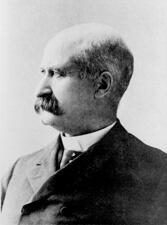
Rufus Blodgett (October 9, 1834 – October 3, 1910) was a United States senator from New Jersey, a long-serving railroad executive, and a prominent municipal leader in Long Branch, New Jersey. A member of the Democratic Party, he served one term in the United States Senate from 1887 to 1893, during which he participated actively in the legislative process and represented the interests of his New Jersey constituents in a period of significant economic and political change in the United States. Over the course of his career he also became known for his leadership in local government and for his influential role in regional transportation.
Blodgett was born on October 9, 1834, in Dorchester, New Hampshire. He grew up in rural New England at a time when the region was undergoing rapid economic development and the early expansion of the railroad system. His early life in New Hampshire exposed him to the practical demands of transportation and commerce that would later shape his professional path. Although detailed records of his formal schooling are limited, his subsequent career in railroad management and public office suggests a strong grounding in practical business, administration, and civic affairs typical of self-made men of his era.
By the mid-nineteenth century, Blodgett had moved into the railroad industry, a sector that was transforming both regional economies and national politics. He eventually became Superintendent of the New York & Long Branch Railroad, a position he held for 25 years. In that capacity he oversaw operations on a key coastal line serving New Jersey communities, including the growing resort city of Long Branch. His long tenure as superintendent reflected both his administrative competence and his ability to navigate the complex relationships among private capital, local communities, and emerging state and federal regulatory interests in transportation.
Blodgett’s prominence in Long Branch extended beyond the railroad. He became a leading figure in local politics and civic life, serving as Mayor of Long Branch, New Jersey, on five occasions. His repeated elections as mayor testified to the confidence placed in him by local voters and business interests, particularly at a time when Long Branch was developing as a major seaside resort and commercial center. In municipal office he was involved in the oversight of local infrastructure, public services, and economic development, roles that dovetailed with his experience in rail transportation and regional planning.
Blodgett’s statewide and national political career culminated in his election as a United States senator from New Jersey. A Democrat, he served in the Senate from March 4, 1887, to March 3, 1893, completing one full term. His service in Congress coincided with a significant period in American history marked by industrial expansion, the rise of large corporations and trusts, and growing public debate over federal regulation of commerce. As a member of the Senate, Blodgett contributed to the legislative process, participated in debates over economic and regulatory policy, and worked to represent New Jersey’s interests in matters affecting industry, transportation, and trade.
During his Senate tenure, Blodgett became particularly noted for his stance on antitrust legislation. He was the only person in either house of Congress to vote against the Sherman Antitrust Act, the landmark 1890 law aimed at curbing monopolies and combinations in restraint of trade. His solitary dissent distinguished him from his contemporaries and has drawn historical attention to his views on federal intervention in the economy. While most legislators supported the act as a necessary check on corporate power, Blodgett’s vote reflected a more skeptical perspective on the scope and implications of federal regulatory authority, especially as it might affect railroads and other large enterprises.
After leaving the Senate in 1893, Blodgett continued to be associated with the railroad industry and with civic affairs in New Jersey. His long service as superintendent of the New York & Long Branch Railroad and his repeated terms as mayor ensured that he remained an influential figure in Long Branch and in the broader region. He lived through the transition from the post–Civil War era into the early twentieth century, witnessing the consolidation of the modern industrial economy that had shaped much of his public life and legislative work.
Rufus Blodgett died on October 3, 1910, in Long Branch, New Jersey, just six days short of his seventy-sixth birthday. His career spanned local, state, and national arenas, combining business leadership in the railroad sector with sustained public service as a municipal executive and as a United States senator from New Jersey. His unique vote against the Sherman Antitrust Act and his long tenure in railroad management have secured him a distinct place in the political and economic history of the late nineteenth-century United States.
Congressional Record