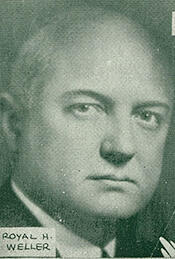
Royal Hurlburt Weller (July 2, 1881 – March 1, 1929) was an American politician and attorney who served as a United States Representative from New York from 1923 to 1929. A member of the Democratic Party, he contributed to the legislative process during four terms in office, representing the interests of his constituents in the House of Representatives during a significant period in American history.
Weller was born in New York City on July 2, 1881. He was educated in the public schools of New York City and went on to attend the College of the City of New York. Pursuing a legal career, he enrolled at New York Law School, from which he graduated in 1901. The combination of public schooling, collegiate study, and formal legal education prepared him for a professional life in law and public service in his native city.
After completing his legal studies, Weller was admitted to the bar in 1902 and commenced the practice of law in New York City. He built his early career as a practicing attorney before entering public office. In 1911 he was appointed assistant district attorney of New York County, a position he held until 1917. During these six years he participated in the prosecution of criminal cases in one of the nation’s busiest urban jurisdictions. In 1917 he resigned as assistant district attorney and returned to private practice. Shortly thereafter, in the context of World War I and its aftermath, he served as counsel for the Alien Property Custodian in 1918 and 1919, advising the federal government on the administration and disposition of property seized from enemy nationals.
Weller’s experience as a lawyer and prosecutor provided the foundation for his subsequent congressional career. A Democrat, he was elected to the Sixty-eighth Congress and took his seat in the U.S. House of Representatives on March 4, 1923. He was reelected to the Sixty-ninth and Seventieth Congresses, and his service in Congress extended through a period marked by postwar economic adjustment and the social and political changes of the 1920s. During his tenure, he participated in the democratic process at the national level and worked to represent the needs and concerns of his New York constituents.
In Congress, Weller was associated with legislation reflecting both cultural and educational interests. The Library of Congress has cataloged a bill with which he was connected: a proposal “to establish a national conservatory of music for the education of pupils in music in all its branches,” printed by the Government Printing Office in 1927. This measure illustrated his engagement with broader national questions of arts and education policy in addition to the routine legislative business of the House.
Royal Hurlburt Weller was serving in the Seventieth Congress and had been reelected to the Seventy-first Congress when his career was cut short. He continued in office from March 4, 1923, until his death in New York City on March 1, 1929. His death made him one of the members of the United States Congress who died in office during the first half of the twentieth century. He was interred in Woodlawn Cemetery in New York City, closing a life spent largely in the service of his city, state, and nation.
Congressional Record