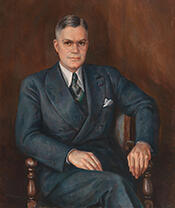
Royal Cleaves Johnson (October 3, 1882 – August 2, 1939) was a U.S. Representative from South Dakota, a member of the Republican Party, and a highly decorated veteran of World War I who served in the military while still a sitting member of Congress. He represented South Dakota in the United States House of Representatives from March 4, 1915, to March 3, 1933, serving nine consecutive terms during a period that encompassed World War I, the postwar era, and the early years of the Great Depression. Over the course of his congressional career, he contributed to the legislative process and represented the interests of his South Dakota constituents, while also emerging as a prominent advocate for veterans.
Johnson was born in Cherokee, Iowa, on October 3, 1882. In 1883 he moved with his parents to Highmore, Hyde County, South Dakota, where he attended the public schools. He pursued higher education in law and enrolled at the University of South Dakota School of Law, from which he graduated in 1906. That same year he was admitted to the bar, marking the beginning of a legal and public service career that would soon lead him into state and national politics.
After his admission to the bar in 1906, Johnson commenced the practice of law in Highmore. Almost immediately he entered public office, becoming assistant state’s attorney for Hyde County in 1906. He advanced quickly, serving as State’s Attorney for Hyde County in 1908 and 1909. His rising profile in South Dakota legal and political circles led to his election as Attorney General of South Dakota in 1910, a position he held during a period of Progressive Era reforms. In 1913 he moved to Aberdeen, South Dakota, where he returned to private law practice while preparing for a bid for national office.
Johnson was elected as a Republican to the United States House of Representatives and took his seat in the Sixty-fourth Congress on March 4, 1915. He served continuously through the Sixty-fifth, Sixty-sixth, Sixty-seventh, Sixty-eighth, Sixty-ninth, Seventieth, Seventy-first, and Seventy-second Congresses, leaving office at the end of his ninth term on March 3, 1933. During his tenure, he held key committee leadership roles, serving as chairman of the Committee on Expenditures in the Department of War from 1921 to 1925 and chairman of the Committee on World War Veterans’ Legislation from 1929 to 1932. His service in Congress occurred during a significant period in American history, and he participated actively in the legislative and democratic processes of the House. He chose not to be a candidate for reelection in 1932.
Johnson’s congressional career was dramatically shaped by World War I. On April 5, 1917, he voted against the United States declaration of war on Germany. Nevertheless, in 1918 he absented himself from Congress and took a leave of absence in order to enlist in the United States Army. He served in the 313th Infantry Regiment, 79th Division, American Expeditionary Forces, rising through the ranks from private and sergeant to second lieutenant and then first lieutenant. In combat at Montfaucon, France, on September 26–27, 1918, he repeatedly exposed himself to intense enemy fire, setting an example of personal courage for his men. Severely wounded by an exploding shell, he assisted two wounded soldiers of his company to the rear and refused to occupy space in an ambulance until his comrades had been cared for. For this extraordinary heroism, he received the Distinguished Service Cross from the United States government. The Republic of France also recognized his valor, awarding him the War Cross 1914–1918 (Croix de Guerre) with gold star.
After returning from the war, Johnson resumed his seat in Congress and became one of the leading legislative advocates for veterans. He was the House sponsor of the legislation creating a federal charter for The American Legion, with Senator Josiah Wolcott of Delaware serving as the Senate co-sponsor. The bill was introduced on June 27, 1919, passed the House on August 27, passed the Senate on September 5, and was signed into law by President Woodrow Wilson on September 16, 1919. In 1930, in testimony before the U.S. War Policies Commission, Johnson advocated legislation calling for the mandatory conscription of “everything,” including all private property and all United States citizens, in the event of a future declaration of war. This proposal was intended to eliminate war profiteering and to align the sacrifices of the civilian population and economic interests with those of members of the armed forces.
Upon retiring from the House in 1933, Johnson remained in Washington, D.C., where he continued to practice law. He lived and worked there until his death on August 2, 1939. He was buried with military honors at Arlington National Cemetery, reflecting both his distinguished military record and his long public service. In 1953 he was posthumously awarded the Distinguished Service Medal by The American Legion in recognition of his contributions to veterans and to the organization he had helped to charter. His legacy in South Dakota and in the national veterans’ community is further commemorated by the Veterans Administration hospital in Sioux Falls, South Dakota, which bears his name as the Royal C. Johnson Veterans Memorial Medical Center.
Congressional Record