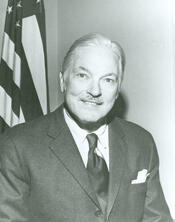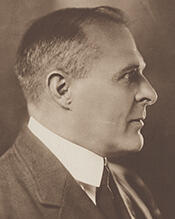
Roy Gerald Fitzgerald (August 25, 1875 – November 16, 1962) was an attorney, soldier, preservationist, and Republican member of the United States House of Representatives from Ohio, serving five consecutive terms from 1921 to 1931. Over a long public career, he combined legal practice, military service, legislative work, and historic preservation, and became a prominent civic figure in Dayton, Ohio.
Fitzgerald was born in Watertown, New York, on August 25, 1875, the son of Michael Gerald and Cornelia Maria (née Avery) Fitzgerald. In 1890, when he was a teenager, he moved with his parents to Dayton, Ohio, after his father’s employer, the Davis Sewing Machine Company, was purchased by George P. Huffman and relocated from Watertown to Dayton. He attended the public schools and then read law in the Dayton office of attorney John M. Sprigg, following the then-common practice of legal apprenticeship rather than formal law school. He was admitted to the bar in 1896 and commenced practice in Dayton as a partner in the firm of Sprigg & Fitzgerald, which later became Fitzgerald & Sprigg.
In 1900, Fitzgerald married Caroline L. Wetecamp of Greenville, Ohio. The couple had two daughters and a son, Roy Jr. Their son served as a major in World War II, survived the Battle of the Bulge, but died five months after V-J Day. Caroline Fitzgerald was in fragile health during the later years of her husband’s congressional service and died in 1935. After her death, Fitzgerald married Alverda J. Sinks of Miami County, Ohio. Alongside his family life, he developed a substantial legal and business profile in Dayton, including long service as a director of the Merchants National Bank & Trust Company, a position he held for more than fifty years.
During World War I, Fitzgerald enlisted in the United States Army. He was later commissioned a captain of infantry and served as commanding officer of Headquarters Company, 329th Infantry Regiment, American Expeditionary Forces, in France. His continuing interest in military affairs was reflected in his later commission as a lieutenant colonel of Infantry in the United States Army Reserve Corps in 1928. His military experience informed his later legislative interest in national defense and aviation policy.
Fitzgerald entered national politics as a Republican and was elected from Ohio’s Third Congressional District to the Sixty-seventh Congress, taking office on March 4, 1921. He was subsequently reelected to the four succeeding Congresses, serving continuously until March 3, 1931. His decade in the House of Representatives coincided with a significant period in American history, encompassing the post–World War I era, the Roaring Twenties, and the onset of the Great Depression. As a member of the House of Representatives, he participated in the legislative process and represented the interests of his Dayton-area constituents, often championing causes that placed him at odds with more conservative colleagues in his party.
Within Congress, Fitzgerald held several important committee assignments. He served as chairman of the Committee on Expenditures in the Department of Commerce in the Sixty-eighth Congress. In the Seventieth and Seventy-first Congresses, he served on the Committee on Revision of the Laws, where he authored a cumulative codification system for the statutory law of the United States and the District of Columbia, an effort aimed at making federal law more coherent and accessible. He was defeated for reelection in 1930 to the Seventy-second Congress, ending his formal congressional service in 1931.
Fitzgerald was particularly active on issues of social reform and national defense. During his decade in Congress, he supported child labor laws, federal care of the needy aged—anticipating elements of what would later become Social Security—and the reorganization of the U.S. Army Air Corps as an independent body. In 1922, he introduced a proposed constitutional amendment to allow Congress to regulate the labor and working hours of children under eighteen. Congress approved the amendment in 1924, but by 1938 only twenty-eight states had ratified it, short of the required number. That same year, however, Congress enacted the Fair Labor Standards Act (29 U.S. Code Chapter 8), which incorporated many of the child labor protections envisioned in the amendment. His advocacy for federal responsibility toward the aged and for stronger regulation of child labor placed him among the more progressive voices in the Republican Party of his era.
An early and enthusiastic advocate of aviation, Fitzgerald was a licensed pilot and personally acquainted with the Wright brothers. He was instrumental in securing the location of Wright Field in Dayton, a facility that later became part of Wright-Patterson Air Force Base. The New York Times once described him as the “aerial daredevil” of Congress after he flew the roughly 500 miles from Dayton to Washington, D.C., for the reconvening of a lame-duck session in 1922, a notable feat at the time, though the plane was piloted by someone else. In 1927, he urged that the air arm be reorganized as an independent department of national defense, arguing that recent transoceanic flights and tests of heavy bombers had demonstrated aviation’s tremendous power and cost-effectiveness as an instrument of national defense.
After leaving Congress, Fitzgerald resumed the practice of law in Dayton, entering into partnership with Thomas H. Ford and Wayne F. Lee. He also remained active in international and intellectual affairs. From 1927 to 1930, he served as a delegate to the Carnegie Foundation’s Inter-Parliamentary Union meetings in Paris, Berlin, Geneva, and London, where he studied methods of classifying international law. Personally vigorous and adventurous, he climbed Mount Rainier in 1925 and, four years later, swam the Bosphorus from Europe to Asia in a cold rain, completing the crossing in approximately thirty minutes. In June 1934, he purchased a 133-acre farm on Rural Road 11, about one and a half miles south of Alexandersville and three miles east of Miamisburg, from Frederick B. Patterson, president of the National Cash Register Corporation.
Fitzgerald also emerged as a leading preservationist and civic leader in Montgomery County. He served as president of the Montgomery County Historical Society for twenty-two years, during which he helped preserve several of Dayton’s most important historic landmarks, notably Newcom Tavern and the Old Court House. Under his leadership, a six-million-dollar bond issue was approved to construct a new courthouse, with the condition that the Old Court House be preserved intact. The historic courthouse later became the headquarters of the Historical Society. He oversaw the conservation of Newcom Tavern and initiated deliberations that eventually led to its relocation to Carillon Historical Park. Although not a native of Dayton, he was widely recognized for his enthusiasm in preserving the city’s heritage and for his long-standing role in local banking and civic affairs.
Roy Gerald Fitzgerald died in Dayton, Ohio, on November 16, 1962, after a long illness. He was interred with his family at Woodland Cemetery in Dayton. His life encompassed service as an attorney, soldier, legislator, aviation advocate, and preservationist, and his influence remained visible in both the legal and physical landscape of his adopted city.
Congressional Record