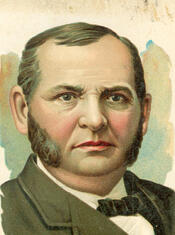
Roswell Pettibone Flower (August 7, 1835 – May 12, 1899) was an American politician and financier who served as a Representative from New York in the United States Congress from 1881 to 1893 and as the 30th governor of New York from 1892 to 1894. A member of the Democratic Party, he contributed to the legislative process during three terms in office and played a prominent role in state politics and national finance in the late nineteenth century.
Flower was born on August 7, 1835, the sixth of nine children of Nathan Monroe Flower and Mary Ann Flower. Raised in modest circumstances, he worked at various odd jobs in his youth to help support himself and to pay for his schooling at a local village school. He graduated from high school in 1851 and, for a short period thereafter, worked as a teacher in a district school. These early experiences of self-support and local public service shaped his reputation for industry and practicality.
In 1853, Flower was appointed Deputy Postmaster of Watertown, New York, at a salary of $600 a year. Over six years in that position he was able to save $1,000, which he invested in a jewelry business he opened with a partner in Watertown. About two years later he bought out his partner and continued to operate the jewelry store on his own until 1869. His success as a small businessman established him as a rising figure in the commercial life of northern New York.
Flower’s transition from local merchant to financier came in 1869, when Henry Keep, a former president of the New York Central Railroad, lay dying and asked Flower—whose wife was a sister of Keep’s wife, Emma—to manage his approximately $4,000,000 estate for his widow. In seeking guidance on trustworthy associates, Flower mentioned the Wall Street operator Daniel Drew, to which Keep reportedly replied, “He is as honest a man as there is in the State of New York, but for fear that somebody else will cheat, he will always begin first.” The administration of Keep’s estate brought Flower to New York City, where he soon became known as a shrewd financial administrator. He eventually established the banking house of R. P. Flower & Co., gaining prominence in the city’s financial community.
Flower entered national politics as a Democrat and was elected to the 47th United States Congress to fill the vacancy caused by the resignation of Levi P. Morton, who had been appointed Minister to France. Flower represented New York’s 11th Congressional District and served from November 8, 1881, to March 3, 1883. He later returned to the House of Representatives, winning election to the 51st and 52nd Congresses. In these later terms he represented New York’s 12th Congressional District and served from March 4, 1889, to September 16, 1891. Over the course of these three terms, spanning the years 1881 to 1893, he participated actively in the democratic process and represented the interests of his constituents during a significant period in American history marked by industrial expansion and political realignment. He resigned his House seat in September 1891 upon receiving the Democratic nomination for governor of New York.
Elected governor in 1891, Flower served as the 30th governor of New York from 1892 to 1894 and was the last governor of the state to serve a three-year term. His administration coincided with a period of rapid urban and industrial growth. Among the notable acts of his governorship was signing into law the creation of the City of Niagara Falls, formalizing the municipal status of a community that was emerging as a major industrial and tourist center. As governor, he remained closely identified with the Democratic Party’s interests in New York and continued to be regarded as an influential figure in both political and financial circles.
After leaving the governorship, Flower further developed his reputation as a canny and influential investor. He attracted the attention of traders and investors across the United States, and his market moves were closely watched. His aggressive accumulation of stock in Brooklyn Rapid Transit drove the company’s share price from about $6 to more than $130 in a relatively short period, an advance widely credited with helping to trigger the bull market that ran from 1898 to 1899. By the late 1890s, Flower’s standing on Wall Street was such that he possessed an extraordinary capacity to influence market sentiment.
In addition to his political and financial activities, Flower was active in educational and agricultural affairs. He served as chairman of the Cornell University Board of Trustees from 1897 until his death in 1899, playing a leadership role in the governance of one of New York’s leading institutions of higher education. In 1899 he also served as president of the New York State Agricultural Society, reflecting his continuing interest in the state’s agricultural development and public institutions.
Flower died of a heart attack on May 12, 1899, at the Long Island Country Clubhouse in Eastport, New York. His sudden death disrupted a planned purchase by a consortium of investors, including Flower and William Henry Moore, of the steel-related holdings of Andrew Carnegie, a transaction that was being contemplated about a year and a half before J. P. Morgan acquired those same interests in the deal that formed the United States Steel Corporation. In the years following his death, Flower’s memory was honored in his longtime home city of Watertown. A monument designed by noted sculptor Augustus Saint-Gaudens in 1902 was erected on lower Washington Street in the Public Square Historic District, which was listed on the National Register of Historic Places in 1984. The Roswell P. Flower Memorial Library, constructed in 1903–1904 as a memorial to him, was itself listed on the National Register of Historic Places in 1980, underscoring the enduring local and state recognition of his public career and philanthropy.
Congressional Record