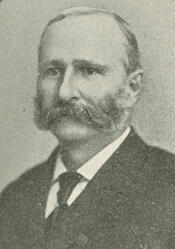
Roswell Peter Bishop (January 6, 1843 – March 4, 1920) was an American Civil War veteran, lawyer, and Republican politician from the state of Michigan who served six terms in the United States House of Representatives from 1895 to 1907. His congressional service occurred during a significant period in American history, and as a member of the House of Representatives he participated in the legislative process and represented the interests of his constituents in Michigan’s 9th congressional district.
Bishop was born in Sidney, Delaware County, New York, on January 6, 1843. He was educated in several institutions in upstate New York, attending Unadilla Academy, Cooperstown Seminary, and Walton Academy. After completing his studies at these academies, he taught school for several years, beginning a professional life that combined education, public service, and eventually the law.
During the American Civil War, Bishop enlisted as a private in Company C of the 43rd Regiment, New York Volunteer Infantry, in 1861. His military service was cut short when he was severely wounded, and in December 1862 he was discharged from the Union Army because of a wound that necessitated the amputation of his right arm. Despite this grave injury, he resumed his education and professional ambitions in the postwar period.
In September 1868, Bishop entered the University of Michigan, where he remained until December 1872. He subsequently studied law and was admitted to the bar in Ann Arbor, Michigan, in May 1875. After his admission to the bar, he commenced the practice of law in Ludington, Mason County, Michigan. Establishing himself as an attorney, he quickly became active in local public affairs and Republican Party politics.
Bishop’s early political career developed at the county and state levels. He was elected prosecuting attorney of Mason County in 1876, re-elected in 1878, and again in 1884, reflecting sustained local confidence in his legal abilities and public service. He also served in the Michigan House of Representatives, first elected in 1882 and returning a decade later in 1892. Through these roles he gained legislative experience and a reputation that helped propel him to national office.
A member of the Republican Party, Bishop was elected from Michigan’s 9th congressional district to the Fifty-fourth Congress and to the five succeeding Congresses, serving in the United States House of Representatives from March 4, 1895, to March 3, 1907. Over the course of his six terms in Congress, he contributed to the legislative process during a transformative era that included debates over industrial regulation, expansion of federal authority, and America’s emerging role on the world stage. He served as chairman of the House Committee on Ventilation and Acoustics during the Fifty-seventh, Fifty-eighth, and Fifty-ninth Congresses, overseeing matters related to the physical environment and functionality of the House chamber and other federal buildings. In 1906 he was an unsuccessful candidate for renomination, ending his continuous service in the House.
After leaving Congress in March 1907, Bishop resumed the practice of law in Ludington. That same year he continued his involvement in public affairs as a member of the Michigan constitutional convention of 1907, participating in efforts to revise and modernize the state’s fundamental law. In December 1907 he was appointed a member of the Spanish Treaty Claims Commission, which was charged with adjudicating claims arising from the Spanish–American War and the Treaty of Paris of 1898; he served on that body until it completed its work.
In 1910, Bishop moved to Hollister, California, where he engaged in fruit growing, marking a late-life shift from law and politics to agricultural pursuits. He later resided in Pacific Grove, California, where he died on March 4, 1920, at the age of 77. He was interred in El Carmelo Cemetery in Pacific Grove. His former home at 302 North Harrison Street in Ludington, erected in 1892 during his Michigan career, later became the rectory of Grace Episcopal Church in 1945, providing a lasting physical link to his life and service in that community.
Congressional Record