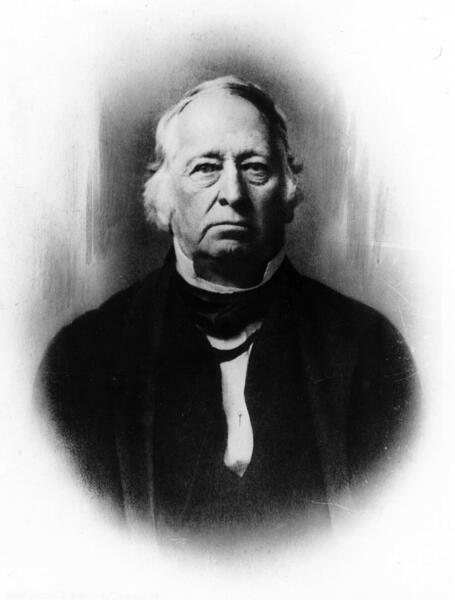
Romulus Mitchell Saunders (March 3, 1791 – April 21, 1867) was an American lawyer, legislator, judge, diplomat, and Democratic politician from North Carolina whose long public career spanned the early republic through the Civil War era. He was born near Milton in Caswell County, North Carolina, the son of William and Hannah Mitchell Saunders. His mother died when he was an infant, and his father subsequently moved with him to Sumner County, Tennessee. After William Saunders’s death in 1803, Romulus’s uncle, James Saunders, became his legal guardian and returned him to Caswell County, where he attended Hyco and Caswell Academies. These early years in both North Carolina and Tennessee helped shape his attachment to the South and to the emerging Democratic-Republican, and later Democratic, political tradition.
In 1809, Saunders enrolled at the University of North Carolina at Chapel Hill. His time there was brief and turbulent: in March 1810 he was expelled for firing a pistol on campus and throwing “a stone at the Faculty.” Despite this episode, his relationship with the institution was ultimately restored and deepened. In 1819 he was elected to the university’s board of trustees, on which he served for forty-five years, underscoring his long-term commitment to higher education in the state. After his expulsion from Chapel Hill, Saunders moved again to Tennessee, where he read law under Hugh Lawson White, a prominent attorney who later became a United States senator. Saunders was admitted to the bar in Nashville in 1812 and that same year returned to Caswell County to begin his legal practice.
Saunders’s political career began in the North Carolina General Assembly. In 1815 he was elected to the North Carolina House of Commons and soon thereafter also served in the North Carolina Senate. Returning to the House of Commons in 1818, he quickly rose in influence and was chosen Speaker of the House, serving in that capacity from 1819 to 1820. His early legislative experience in Raleigh established him as a forceful advocate of states’ rights and a skilled parliamentary leader. During this period he also consolidated his position within the state’s Democratic-Republican ranks, aligning himself with the more radical, states’ rights wing of the party that would later find intellectual kinship with the ideas of John C. Calhoun.
In 1820, Saunders was elected as a Democratic-Republican to the U.S. House of Representatives from North Carolina, inaugurating the first phase of his congressional service. As a member of the Democratic Party representing North Carolina, he ultimately served five terms in the U.S. House, contributing to the legislative process during a significant and contentious period in American history. In Congress he was known for his unabashed pro–states’ rights opinions and his strong support for William H. Crawford in the presidential election of 1824. His partisanship was so intense that John Quincy Adams referred to him as the most “cankered or venomous reptile in the country.” An admirer of North Carolina statesman Nathaniel Macon, Saunders was a fiscal conservative who believed that “men in power are apt to think the peoples’ money is intended to be expended in such way as their distempered fancy may support,” yet he nonetheless supported internal improvements such as road and railroad projects, reflecting a pragmatic approach to economic development in his state.
In 1828, Saunders left Congress to become North Carolina Attorney General, a position he held until 1834. That year he received a presidential appointment to serve on the French spoliations claims commission, which dealt with long-standing American claims arising from French depredations on U.S. commerce. In 1835 the North Carolina legislature appointed him to the state Superior Court, where he served as a judge until 1840. That year he became the Democratic nominee for governor of North Carolina. The campaign was hard-fought and highlighted divisions within the state’s political culture, but Saunders was defeated by the Whig candidate, John Motley Morehead. During these years the North Carolina Democratic Party split into two factions: Saunders led the states’ rights faction, while the more moderate wing was led by his fellow Caswell County native and political adversary, Bedford Brown. When Democrats gained control of the state legislature in 1842, both Saunders and Brown sought election to the U.S. Senate; neither secured a majority, and the legislature ultimately chose William Henry Haywood Jr. instead.
Saunders returned to national office following his election to Congress in 1840, entering the second major phase of his congressional service. During this period he became an outspoken opponent of Martin Van Buren and his allies who resisted the annexation of Texas, aligning himself with expansionist Southern Democrats. At the 1844 Democratic National Convention, he played a pivotal procedural role by sponsoring a resolution requiring a two-thirds vote for the selection of the party’s presidential nominee. This change undermined Van Buren’s candidacy and helped clear the way for the nomination of James K. Polk, thereby significantly influencing the direction of national politics in the mid-1840s.
In 1846, President Polk, perhaps in appreciation for Saunders’s assistance in securing his nomination, appointed him minister plenipotentiary to Spain. His mission coincided with a period of intense American interest in acquiring Cuba, both as an expression of manifest destiny and as a means of strengthening Southern political power, given the island’s large enslaved population. In the late 1840s Polk dispatched Saunders to offer Spain $100 million for Cuba. Saunders, who did not speak Spanish and whose command of English Secretary of State James Buchanan wryly observed he “sometimes murders,” proved an awkward negotiator. His efforts alternately amused and irritated Spanish officials, who responded that they would “prefer seeing [Cuba] sunk in the ocean” rather than sold. In any case, the Whig majority in the U.S. House of Representatives was unlikely to approve such an overtly pro-Southern acquisition, and the election of Whig President Zachary Taylor in 1848 effectively ended formal attempts during that era to purchase the island.
After his diplomatic service, Saunders settled in Raleigh, North Carolina, at Elmwood, an estate the family had acquired around 1831 and formerly the home of jurist John Louis Taylor. In 1850 he was elected to represent Wake County in the North Carolina House of Commons, where he became a prominent supporter of constructing the North Carolina Railroad, a major internal improvement project intended to spur economic growth. He again sought election to the U.S. Senate in 1852, but the legislature remained deadlocked and left the seat vacant until the appointment of David Settle Reid in 1854. The General Assembly did, however, reappoint Saunders to the North Carolina Superior Court, returning him to the bench. In 1851 he also served on a commission to codify North Carolina’s laws, working alongside Bartholomew F. Moore and Asa Biggs, an important step in modernizing and systematizing the state’s legal framework.
Saunders’s personal life was marked by two marriages and a large family. On December 27, 1812, he married Rebecca Peine Carter, with whom he had five children: James, Franklin, Camillus, Anne Peine, and Rebecca. After Rebecca’s death, he married Anne Heyes Johnson, daughter of U.S. Supreme Court Justice William Johnson, on May 26, 1823. This second marriage produced at least four children: William Johnson, Margaret Madeline, Jane Claudia, and Julia A. His family connections, particularly through his second marriage, further linked him to the broader Southern legal and political elite. Saunders spent his later years at Elmwood in Raleigh, remaining a respected if sometimes controversial figure in North Carolina public life. He died there on April 21, 1867, and was buried in Raleigh’s Old City Cemetery, closing a career that had touched nearly every level of state and national government over more than half a century.
Congressional Record