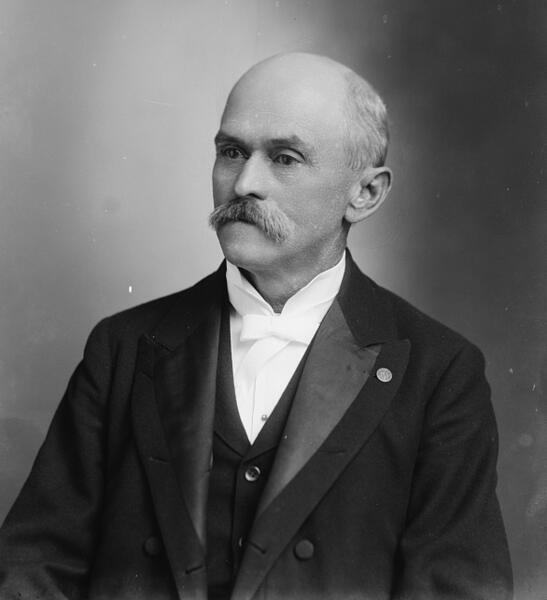
Romeo Hoyt Freer (November 9, 1846 – May 9, 1913) was an American attorney, soldier turned pacifist, judge, and politician who became a prominent Republican officeholder in West Virginia at the turn of the twentieth century. He was born in Bazetta Township, Trumbull County, Ohio, and came of age during the American Civil War, an experience that shaped both his early military service and his later commitment to pacifism. His family background and upbringing in the rural Midwest exposed him to the political and social upheavals of the era, providing an early context for his later public career.
Freer’s formal education was limited by the disruptions of the Civil War, but he pursued legal studies after his military service and was admitted to the bar, beginning a career in law that would underpin his later roles as judge and public official. His early legal practice developed in the postwar period, when the reconstruction of civic institutions and the expansion of commerce in the Ohio Valley region created new opportunities for ambitious young attorneys. Through self-directed study and practical experience, he established himself as a capable lawyer, which in turn opened the way to judicial and political appointments.
As a young man, Freer served as a soldier during the Civil War, an experience that initially aligned him with the martial spirit of the age but ultimately led him to embrace pacifist convictions. The transition from soldier to pacifist reflected both personal reflection on the costs of war and the broader national debate over violence and reconciliation in the decades following the conflict. After the war, he devoted himself to the law and to public service, channeling his energies into civic and political life rather than military pursuits. His evolving views on war and peace informed his later reputation as a thoughtful and principled public figure.
Freer’s legal and judicial career in West Virginia developed alongside the state’s growth as an industrial and political center in the late nineteenth century. As an attorney, he became known for his advocacy and understanding of the legal issues confronting a rapidly changing society, including questions of property, commerce, and public order. His standing at the bar and his reputation for integrity contributed to his selection for judicial responsibilities, and he served as a judge, further solidifying his role in the state’s legal community. These experiences provided him with a detailed understanding of both statutory law and the practical administration of justice, which later informed his work in statewide office.
Freer entered national politics as a member of the Republican Party, reflecting his alignment with the party that had led the Union during the Civil War and dominated national politics in the postwar era. He was elected as a Republican to the United States House of Representatives from West Virginia’s 4th congressional district and served one term in the Fifty-sixth Congress, from March 4, 1899, to March 3, 1901. During this period, he represented his constituents in a time of significant national transformation, including the aftermath of the Spanish–American War and the emergence of the United States as an imperial power. As a Representative from West Virginia in the United States Congress, he contributed to the legislative process, participated in the democratic deliberations of the House, and represented the interests of his district’s citizens in federal policymaking.
Freer’s congressional service, though limited to a single term, coincided with important debates over economic policy, veterans’ issues, and America’s expanding role on the world stage. His background as a Civil War veteran and later pacifist gave him a distinctive perspective on questions of military engagement and national responsibility. While in Congress, he worked within the Republican majority to advance the party’s legislative priorities, and his service in the House of Representatives from 1899 to 1901 formed a key part of his broader public career. After leaving Congress, he remained an influential figure in West Virginia politics and law.
Following his term in Congress, Freer continued his public service at the state level. He was elected Attorney General of West Virginia and served from 1901 to 1905, a period in which the state confronted complex legal issues arising from industrial expansion, labor relations, and the regulation of corporate activity. As Attorney General, he oversaw the state’s legal affairs, represented West Virginia in important litigation, and provided formal legal opinions to guide the actions of state officials and agencies. His tenure in this office drew on his long experience as an attorney and judge and further cemented his reputation as a leading legal authority in the state.
In his later years, Freer remained identified with the legal and political life of West Virginia, even as he gradually withdrew from active officeholding. His career traced a path from Civil War soldier to pacifist, from local attorney to judge, and from state leader to member of the national legislature and chief law officer of his state. Romeo Hoyt Freer died on May 9, 1913, closing a life that had spanned the Civil War, Reconstruction, and the emergence of the modern American state. His record as a Republican Representative from West Virginia, his service in the U.S. House of Representatives from 1899 to 1901, and his tenure as Attorney General of West Virginia from 1901 to 1905 remain central elements of his legacy in the political and legal history of West Virginia.
Congressional Record