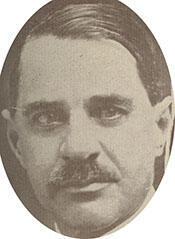
Rollin Carolas Mallary (May 27, 1784 – April 15, 1831) was an American lawyer and politician who served as a U.S. Representative from Vermont during a formative period in the nation’s history. He was born in Cheshire, New Haven County, Connecticut, on May 27, 1784. Details of his early family life are sparse in the historical record, but his subsequent education and professional advancement indicate a background that valued learning and public service.
Mallary pursued higher education at Middlebury College in Middlebury, Vermont, and graduated in 1805. Soon after completing his studies, he moved to Poultney, Vermont, where he read law in preparation for a legal career. He was admitted to the bar and began the practice of law in Castleton, Vermont, in 1807. During these early professional years, he also became involved in local educational affairs, reflecting an interest in civic improvement. Mallary married Ruth Stanley Mallary, and the couple had four children, establishing a family life alongside his growing legal and political responsibilities.
In addition to his legal practice, Mallary quickly assumed roles of public trust. In 1807 he was elected a trustee of the Rutland County Grammar School, underscoring his engagement with educational institutions in the region. That same year, he was appointed by Governor Israel Smith as Secretary to the Governor and Council, a position he first held in 1807 and then again from 1809 to 1812 and from 1815 to 1819. In this capacity, he was closely involved in the administrative work of Vermont’s executive branch. Mallary also served as State’s attorney for Rutland County from 1811 to 1813, prosecuting cases on behalf of the state and further solidifying his reputation as a capable lawyer and public official. In 1816 he moved from Castleton back to Poultney, Vermont, continuing his legal practice and political activities there.
Mallary’s entry into national politics came through a contested path. He was an unsuccessful candidate for Congress in 1819, a defeat attributed not to a lack of support but to the failure of several towns to return their votes in time to be counted. The disputed election led to a notable contest with Orsamus C. Merrill for the seat in the Sixteenth Congress. As a Democratic-Republican, Mallary successfully contested Merrill’s election, and he was seated in the U.S. House of Representatives on January 13, 1820. This marked the beginning of his long tenure in Congress, during which he represented Vermont as a member of what contemporary sources describe as the “Unknown Party,” a reflection of the shifting and evolving party alignments of the era.
Over the course of his congressional career, Mallary served seven terms in the U.S. House of Representatives, participating actively in the legislative process and representing the interests of his Vermont constituents during a significant period in American history. He was elected as a Democratic-Republican to the Seventeenth Congress, reelected as an Adams-Clay Democratic-Republican to the Eighteenth Congress, and then elected as an Adams candidate to the Nineteenth and Twentieth Congresses. As party structures continued to realign in the 1820s, he was reelected as an Anti-Jacksonian candidate to the Twenty-first and Twenty-second Congresses. His service in Congress extended from January 13, 1820, until his death on April 15, 1831. During this time, Mallary became particularly prominent in matters related to economic policy and industrial development.
Mallary’s most notable committee assignment was his service as chairman of the House Committee on Manufactures in the Nineteenth, Twentieth, and Twenty-first Congresses. In this role, he helped shape federal policy toward American manufacturing at a time when debates over tariffs, internal improvements, and economic development were central to national politics. His work on this committee placed him at the center of discussions about the emerging industrial economy and the protection of domestic industries, issues that were especially important to many of his constituents and to the broader Adams and Anti-Jacksonian coalitions with which he was associated.
Rollin Carolas Mallary died in office in Baltimore, Maryland, on April 15, 1831, while still serving as a member of the Twenty-second Congress. His death brought to a close more than a decade of continuous service in the U.S. House of Representatives. He was interred in East Poultney Cemetery in East Poultney, Vermont, returning in death to the community that had long been his home and political base. His career, spanning local legal practice, state office, and extended congressional service, reflected the complex partisan realignments of the early nineteenth century and the growing importance of economic and manufacturing policy in the federal government.
Congressional Record