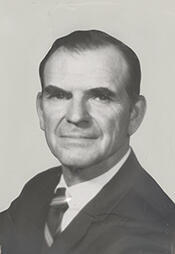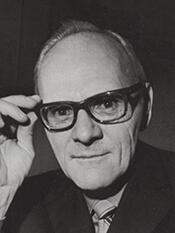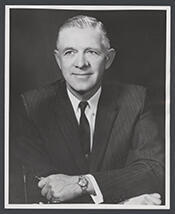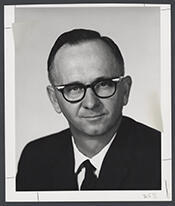
Rolland William Redlin (February 29, 1920 – September 23, 2011) was an American farmer, businessman, and public official who represented North Dakota in the United States House of Representatives from 1965 to 1967. A lifelong member of the Democratic–Nonpartisan League (Democratic-NPL) Party, he was one of the leading Democratic figures in North Dakota politics in the second half of the twentieth century and became the first Democratic Representative to represent western North Dakota in Congress. He later served for decades in the North Dakota Senate, where he held senior leadership positions and helped shape state policy over a span of more than forty years in public life.
Redlin was born on February 29, 1920, in Lambert, Richland County, Montana, and grew up in a rural setting during the Great Depression. He attended public schools in Montana and North Dakota and was raised in an agricultural environment that would later inform both his professional work and his legislative priorities. As a young man he worked on farms and in related businesses, gaining firsthand experience with the economic and social challenges facing rural communities in the northern Plains. This background contributed to his reputation as an advocate for farmers, small towns, and working families throughout his political career.
Redlin pursued higher education intermittently while working, attending what was then known as the North Dakota State School of Forestry at Bottineau (later Dakota College at Bottineau). His formal education was complemented by extensive self-education in public affairs, history, and economics, and he became active in civic and community organizations. Before entering elective office, he worked variously in farming, business, and local enterprises near Minot, North Dakota, establishing himself as a community leader and a supporter of the emerging Democratic-NPL movement in a state long dominated by the Republican Party.
Redlin’s political career began in the North Dakota Senate, where he was first elected in 1958 and served from 1959 to 1963. Representing a district in northwestern North Dakota, he was part of a growing cadre of Democratic-NPL legislators who sought to expand state services, improve infrastructure, and support family agriculture. After leaving the Senate at the end of his first term, he turned his attention to federal office. In 1964, amid a national Democratic landslide, he ran for the U.S. House of Representatives and won, unseating incumbent Republican Don L. Short. His victory made him the first Democratic Representative to represent western North Dakota, a historically Republican region.
In the U.S. House of Representatives, Redlin served one term from January 3, 1965, to January 3, 1967. His service in Congress occurred during a significant period in American history, as the nation grappled with the civil rights movement, the Great Society legislative agenda, and the early escalation of the Vietnam War. As a member of the House of Representatives, he participated in the legislative process and represented the interests of his largely rural constituents. Redlin later stated that his vote for the Voting Rights Act of 1965 was the accomplishment of which he was most proud during his time in Congress, reflecting his support for expanding democratic participation and protecting civil rights. He also expressed disappointment in the breakdown of civil discourse in American politics in the decades that followed, contrasting it with the more cooperative atmosphere he had known earlier in his career.
Redlin sought reelection to the House in 1966 but was defeated by former Bismarck mayor Thomas Kleppe, a Republican. He ran again for the same at-large seat in 1968 and lost by a narrow margin, underscoring the competitive but still challenging environment for Democrats in North Dakota at the federal level. After these campaigns, he refocused his efforts on state politics, where he would leave an enduring mark.
Returning to the North Dakota Senate in 1973, Redlin served continuously until his retirement in 2000. Over this twenty-seven-year period of renewed service, he became one of the chamber’s most experienced and influential members. He held the position of President Pro Tempore of the North Dakota Senate from 1987 to 1989 and later served in Minority Leadership during his final decades in office, helping to organize and articulate the Democratic-NPL agenda in a legislature where Republicans generally held the majority. In these roles he was involved in debates over education funding, agricultural policy, taxation, and state economic development, and he was widely regarded as a skilled legislator and a strong voice for rural and working-class constituents.
Throughout his long career, Redlin remained closely tied to his home region. A member of the Democratic-NPL, he lived near Minot, North Dakota, for many years while serving in the state legislature and remained active in party affairs, community organizations, and public policy discussions even when not in office. In 2009, he moved to Rapid City, South Dakota, to be closer to family members. Rolland William Redlin died on September 23, 2011, at his home in Rapid City at the age of 91, closing a life marked by more than four decades of service in both state and federal government and a sustained commitment to democratic participation and civil discourse.
Congressional Record