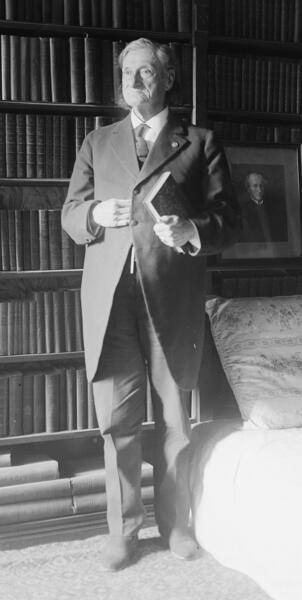
Roger Atkinson Pryor (July 19, 1828 – March 14, 1919) was an American newspaper editor, lawyer, politician and judge. A journalist and U.S. Congressman from Virginia known as a Southern “fire eater” for his fiery oratory in favor of slavery and later secession from the United States and belligerence toward abolitionist colleagues, during the American Civil War Pryor served as a general in the Confederate Army as well as in the Confederate Congress. Following the conflict, Pryor moved to New York City, and in 1868 his family joined him. He resumed his legal practice and is now considered among influential southerners in the North sometimes called “Confederate carpetbaggers.”
Pryor’s law partner became Boston-based Benjamin F. Butler, hated in the South for his service as a Union general during the conflict. Their partnership was financially successful, and Pryor also became active in the Democratic Party in the North. In 1877 he was chosen to give a Decoration Day address, in which, according to one interpretation, he vilified Reconstruction and promoted the Lost Cause, while reconciling the noble soldiers as victims of politicians. In 1890 he joined the Sons of the American Revolution, one of the new heritage societies that was created following celebration of the United States Centennial.
Appointed as judge of the New York Court of Common Pleas from 1890 to 1894, and justice of the New York Supreme Court from 1894 to his retirement in 1899. On April 10, 1912, he was appointed official referee by the appellate division of the state Supreme Court, where he served until his death. Particularly after raising their children described below, his wife Sara Agnes Rice published several histories, memoirs and novels, as well as helped found heritage societies and organize fundraising for historic preservation. Her memoirs have been important sources for historians doing research on southern society during and after the Civil War.
Congressional Record