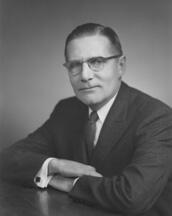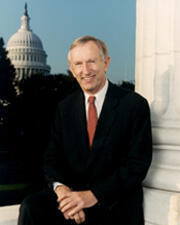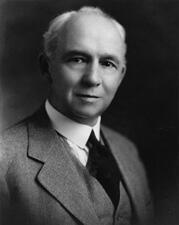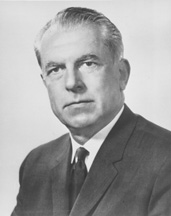
Robert Theodore Stafford (August 8, 1913 – December 23, 2006) was an American politician from Vermont who served as the state’s 71st governor, a United States representative, and a United States senator. A Republican, he was generally considered a liberal, or “Rockefeller Republican,” and is best remembered for his staunch environmentalism, his work on higher education, and his later-life support for the 2000 Vermont law legalizing civil unions for gay couples. Stafford served in Congress during a significant period in American history, holding federal office from 1961 to 1989 and contributing to the legislative process over nine terms in the House and Senate.
Stafford was born in Rutland, Vermont, to Bert Linus Stafford and Mabel R. (Stratton) Stafford. His father, a 1901 graduate of Middlebury College, practiced law in Rutland and was president of the Rutland County National Bank. Bert Stafford also served as Rutland County’s State’s Attorney, mayor of Rutland from 1915 to 1917, president of the Vermont Bar Association in 1930, and chairman of the Vermont Board of Education, giving the younger Stafford early exposure to public service and civic leadership. Robert Stafford attended the public schools of Rutland and graduated from Rutland High School in 1931. He went on to Middlebury College, where he received a Bachelor of Science degree in 1935 and joined the Delta Upsilon fraternity. He briefly attended the University of Michigan Law School before completing his legal education at Boston University School of Law, earning an LL.B. in 1938.
Upon completing law school, Stafford was admitted to the bar and returned to Rutland to practice law with the firm of Stafford, Abatiell, and Stafford. He quickly became active in local Republican politics and served as Rutland’s grand juror, or prosecutor in the municipal court, from 1938 to 1942. His early legal and prosecutorial work laid the foundation for a career that would combine law, military service, and public office at the local, state, and national levels.
In 1942, during World War II, Stafford joined the United States Navy Reserve and was commissioned as an ensign. Assigned to naval intelligence, he completed initial training at Dartmouth College and at Fort Dix, New Jersey, and then served in intelligence postings at the Navy Department in Washington, D.C., and at Navy bases on Cape Cod, Massachusetts. Seeking sea duty, he later served as senior watch officer aboard USS West Point, the Navy’s largest troop transport ship, which made numerous voyages across the Atlantic to Europe and Africa. Stafford advanced to lieutenant commander during the war, and by its end in 1945 he was the ship’s chief transportation officer. He returned to Rutland in February 1946 while remaining in the Navy Reserve. Called back to active duty in October 1951 during the Korean War era, he served as gunnery officer aboard USS Mission Bay, a Reserve training ship berthed in Bayonne, New Jersey, until February 1953. He continued in the Navy Reserve after this second period of active duty and retired at the rank of captain in March 1971.
Between his periods of military service, Stafford advanced in Vermont’s legal and political circles. He served as Rutland County’s State’s Attorney from 1947 to 1951 while practicing law in a new firm, Stafford and LaBrake. After his Korean War–era deployment, he entered statewide politics, serving as Vermont’s deputy attorney general from 1953 to 1955. In 1954 he was elected Vermont Attorney General and held that office from 1955 to 1957. In 1956 he was elected lieutenant governor, marking a rapid rise through Vermont’s statewide offices. His ascent was notable in a state long governed by the Republican “Mountain Rule,” which informally allocated statewide offices geographically and favored candidates who had risen through legislative leadership; Stafford was one of the few Vermont governors who had not previously served in the state legislature.
In 1958, Stafford was elected governor of Vermont. His victory over Democrat Bernard J. Leddy, with 50.3 percent of the vote, came at a time when the Democratic Party was becoming increasingly competitive in the state and signaled a shift away from the rigid application of the Mountain Rule. As governor, Stafford pursued initiatives to streamline state government, including creation of the Agency of Administration, and promoted infrastructure investments in roads and bridges to spur economic growth. His administration also supported scholarships for Vermont students attending state colleges, an early indication of his long-term interest in expanding access to higher education.
In 1960, Stafford was the Republican nominee for Vermont’s lone seat in the United States House of Representatives. Backed by all factions of his party as the strongest challenger to Democrat William H. Meyer, who had broken the Republicans’ century-long hold on statewide offices in 1958, Stafford won the election. He was reelected four times and served in the House from January 3, 1961, to September 16, 1971. During his House tenure, he supported key civil rights legislation, voting in favor of the Civil Rights Acts of 1964 and 1968, the 24th Amendment to the Constitution, and the Voting Rights Act of 1965. His record reflected a moderate-to-liberal Republican approach on social issues, consistent with his Rockefeller Republican reputation.
In September 1971, Stafford resigned his House seat to accept appointment to the United States Senate, temporarily filling the vacancy caused by the death of Senator Winston L. Prouty. He won the special election in January 1972 to complete Prouty’s term and subsequently won reelection twice, including a hard-fought 1976 contest against outgoing Governor Thomas P. Salmon. Stafford served in the Senate from 1971 until his retirement in 1989, a period of slightly more than 17 years, and his combined service in the House and Senate spanned from 1961 to 1989. During his Senate career he chaired the Committee on Environment and Public Works from 1981 to 1987, where he played a central role in environmental legislation. He helped pass a landmark law coordinating federal natural disaster assistance, later named the Robert T. Stafford Disaster Relief and Emergency Assistance Act, commonly known as the Stafford Act. His support for U.S. weapons sales to the Nicaraguan contras in the 1980s prompted the “Winooski 44” protest, in which demonstrators occupied his office to oppose his position on Central America policy. Known in Washington for his low-key style and preference for keeping his own counsel, he was described by a New York Times writer as possibly giving “the worst interview of any public official in the capital,” to which Stafford wryly responded, “I talked more when I was younger.”
After leaving the Senate, Stafford was widely regarded as the elder statesman of Vermont Republicans. He remained influential in state politics and public debates. In 1998, when Jack McMullen, a recent arrival to Vermont, sought the Republican nomination for the U.S. Senate, Stafford’s dismissive reference to him as “Mulholland or whatever his name is” in an interview underscored his view that McMullen was too new to the state to represent it, and the remark became a running joke in Vermont political circles. In the Republican primary, McMullen was defeated by Fred Tuttle, a retired dairy farmer and star of the mock documentary “Man with a Plan,” who ran partly to lampoon McMullen as a carpetbagger. In 2000, Stafford publicly supported Vermont’s move to allow civil unions for gay and lesbian couples, stating that love was “one of the great forces in our society” and that same-sex unions did no harm to society, a stance that further cemented his image as a socially liberal Republican.
Stafford’s contributions to education and environmental policy were recognized in several lasting ways. In 1988, Congress renamed the Federal Guaranteed Student Loan program the Robert T. Stafford Student Loan Program in honor of his work on higher education and student aid. In 2007, the White Rocks National Recreation Area in Vermont was renamed the Robert T. Stafford White Rocks National Recreation Area, commemorating his environmental leadership. Stafford died in Rutland on December 23, 2006, and was buried at Evergreen Cemetery in Rutland. His wife, Helen Stafford, died on February 27, 2011, at the age of 93.
Congressional Record