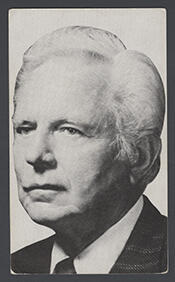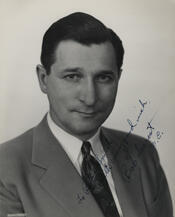
Robert Thompson Secrest (January 22, 1904 – May 15, 1994) was an American Democratic representative to the United States Congress from the state of Ohio who served ten terms in the U.S. House of Representatives between 1933 and 1967. Over the course of a public career that spanned more than four decades, he held elective office at both the state and federal levels, served in the United States Navy during World War II, and later occupied key administrative and regulatory posts, including membership on the Federal Trade Commission. His service in Congress occurred during a significant period in American history, encompassing the New Deal, World War II, the early Cold War, and the civil rights era, and he participated in the legislative process during three distinct periods of congressional service: 1933 to 1942, 1949 to 1954, and 1963 to 1966, resigning each time prior to the end of his term.
Secrest was born on January 22, 1904, in Senecaville, Guernsey County, Ohio, the eldest son of Robert Waits Secrest, a miner (1880–1929), and his wife Amelia (née Thompson). Raised in a working-class family in southeastern Ohio, he attended the public schools of the state, an experience that helped shape his later interest in education and public service. After completing his early schooling, he enrolled at Muskingum College in New Concord, Ohio, from which he graduated in 1926. His pursuit of higher education continued throughout his early political career; he later studied law at the Washington, D.C. College of Law, earning a degree in 1938, and undertook further graduate study at Columbia University in New York City, where he graduated in 1943. During World War II he also completed training at the British School of Civil Affairs in Wimbledon, England, in 1943, preparing him for administrative responsibilities in wartime and postwar civil governance.
Before entering national politics, Secrest worked in education and state government. He served as superintendent of schools in Murray City, Ohio, from 1931 to 1932, overseeing a small public school system during the early years of the Great Depression. At the same time, he entered elective office as a member of the Ohio House of Representatives, serving from 1931 to 1932. This combination of educational administration and legislative experience provided him with a foundation in public policy and local concerns that he carried into his later congressional service.
Secrest was first elected as a Democrat to the United States House of Representatives in the 1932 election, winning a seat in the Seventy-third Congress. He represented Ohio in the House from March 4, 1933, to August 3, 1942, serving in the Seventy-third through Seventy-seventh Congresses during the New Deal and the early years of World War II. As a member of the House of Representatives, he participated in the democratic process and represented the interests of his constituents during a period of profound economic and social change. On August 3, 1942, he resigned his seat in order to join the United States Navy, thus interrupting his first period of congressional service to enter active military duty.
During World War II, Secrest served in the United States Navy from 1942 until February 28, 1946. He was later promoted to the rank of commander and was assigned to duty in multiple theaters, including England, Africa, Italy, and the Pacific. His wartime service coincided with his completion of studies at Columbia University and the British School of Civil Affairs in 1943, reflecting a dual focus on both military and civil affairs. After leaving active duty, he sought to return to Congress but ran unsuccessfully in 1946. He then served as legal supervisor for the Library of Congress from 1946 to 1947, applying his legal training and legislative experience in a nonpartisan institutional role in the nation’s principal legislative library.
Secrest returned to elective office in 1948, winning election to the Eighty-first Congress and subsequently to the Eighty-second and Eighty-third Congresses. He served in this second period in the House from January 3, 1949, to September 26, 1954. During these years he participated in the legislative deliberations of the early Cold War era. On September 26, 1954, he resigned from Congress for a second time, this time to accept appointment as a member of the Federal Trade Commission. He served on the Federal Trade Commission from 1954 to 1961, contributing to federal oversight of commerce and trade practices. After leaving the commission, he returned to state-level administration as Director of Commerce for the State of Ohio in 1962, overseeing economic and regulatory matters within the state.
In 1962, Secrest again sought and won election to Congress, beginning his third and final period of service in the House of Representatives. He was elected to the Eighty-eighth and Eighty-ninth Congresses and served from January 3, 1963, to December 30, 1966. This tenure placed him in the House during the Kennedy and Johnson administrations, a period marked by major civil rights and Great Society legislation. He resigned on December 30, 1966, after failing to secure re-election that year, thus ending his third separate stretch of congressional service. Across these three periods—1933 to 1942, 1949 to 1954, and 1963 to 1966—he served ten terms in Congress and repeatedly left office before the formal expiration of his mandates in order to undertake other forms of public service.
Following his final departure from the U.S. House of Representatives, Secrest continued to be active in public life in Ohio and in veterans’ affairs. He served as a member of the Ohio State Senate from 1969 to 1973, extending his legislative career at the state level. Later, he was a member of the National Council of the American Legion from 1978 to 1987, reflecting his ongoing engagement with issues affecting veterans and his continued connection to his World War II service. Robert Thompson Secrest died on May 15, 1994, in Cambridge, Ohio. At the time of his death, he was recognized as the earliest-serving former congressman then living and the last surviving former member of the House of Representatives to have served during the administration of President Herbert Hoover.
Congressional Record