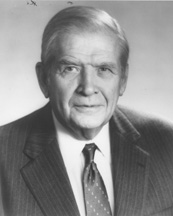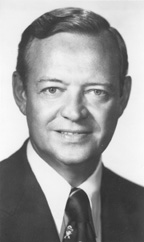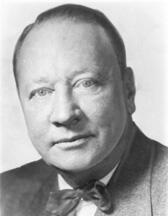
Robert Rice Reynolds (June 18, 1884 – February 13, 1963) was an American lawyer and Democratic politician who represented North Carolina in the United States Senate from 1932 to 1945. Known to his supporters as “Our Bob,” he gained prominence as a populist campaigner and New Deal supporter, but also acquired national notoriety as a passionate isolationist, an advocate of severe immigration restriction, and an apologist for Nazi aggression in Europe. His Senate career spanned three terms and coincided with the Great Depression, the New Deal era, and the Second World War.
Reynolds was born on June 18, 1884, in Asheville, North Carolina, at his family’s estate, the Reynolds House. He was the son of William Taswell Reynolds (1850–1892) and Mamie Elizabeth Spears (1862–1939). He came from a family that traced its lineage to Revolutionary War heroes, pioneers, politicians, and substantial property owners; among his notable ancestors was his maternal great-grandfather, Colonel Daniel Smith, a Revolutionary War hero of the Battle of Kings Mountain. Reynolds grew up with two siblings, George Spears Reynolds (1881–1924) and Jane Reynolds Wood (1888–1927), in an environment of local prominence and historical consciousness that helped shape his sense of public identity.
Reynolds attended both public and private schools in North Carolina, including Weaver College, then a preparatory institution, before entering the University of North Carolina at Chapel Hill. At UNC he was active in student life, playing football, running track, and serving as editor of the sports section of The Daily Tar Heel. He left the university without taking a degree but was nevertheless accepted at the University of North Carolina School of Law. Although he did not formally enroll, he attended lectures and read law, and in 1908 he was admitted to the North Carolina Bar, beginning a legal career without having completed a traditional law program.
After passing the bar, Reynolds began practicing law in Asheville in partnership with his brother. He entered public service early, being elected prosecuting attorney, a post he held from 1910 to 1914. During World War I, he registered for military service and briefly served in the National Guard, though he was never drafted into federal service. His ambition for higher office soon became evident. In 1924 he ran unsuccessfully for lieutenant governor of North Carolina, losing in the Democratic primary to J. Elmer Long. Two years later, in 1926, he made his first bid for the United States Senate but was defeated in the Democratic primary by incumbent Senator Lee Overman. During the 1920s he also traveled widely and later drew on those experiences in his book “Gypsy Trails, Around the World in an Automobile,” published in Asheville by Advocate Publishing Company (presumed date 1923).
Reynolds’s breakthrough came in 1932, when he again sought a Senate seat. Running a highly populist and often bitter campaign, he challenged former governor and interim senator Cameron Morrison in the Democratic primary. He attacked Morrison as a supposed Communist sympathizer and used colorful rhetoric to contrast himself with his opponent, famously declaring, “Cam likes fish eggs, and Red Russian fish eggs at that. Don’t you want a Senator who likes North Carolina hen eggs?” In the primary runoff he defeated Morrison by nearly two to one, securing the Democratic nomination and then election to the Senate from North Carolina. He would serve in the United States Congress from 1932 to 1945, completing three terms in office and representing his state during a period of profound national economic and political transformation.
In his early Senate years, Reynolds aligned himself closely with President Franklin D. Roosevelt’s New Deal. He supported federal programs that brought jobs and infrastructure to North Carolina, including projects that contributed to the construction of the Blue Ridge Parkway and the development of the Great Smoky Mountains National Park. He favored taxing the wealthy and imposing stronger regulations on the economy, and he backed major New Deal measures such as Social Security, the Fair Labor Standards Act, the Works Progress Administration, the Tennessee Valley Authority, and the Agricultural Adjustment Act, which was especially important in raising tobacco prices for his agrarian constituents. Initially, he supported Roosevelt’s 1937 Judicial Procedures Reform Bill, commonly known as the court-packing plan, but later joined other Democrats in sending the bill back to the Judiciary Committee, effectively helping to kill the proposal.
At the same time, Reynolds became one of the Senate’s most outspoken isolationists. He advocated a “Fortress America” strategy that combined a strong national defense with opposition to foreign entanglements. He supported expansion of the United States Armed Forces but resisted efforts to revise the Neutrality Acts to allow greater aid to nations resisting aggression. Reynolds and Senator John Overton of Louisiana were the only Southern senators to vote against the repeal of the arms embargo, a stance that drew the ire of the Roosevelt administration. In response, Roosevelt quietly encouraged Congressman Franklin W. Hancock Jr. to challenge Reynolds in the 1938 Democratic primary, but Reynolds prevailed easily and secured reelection. His isolationism was accompanied by a harsh stance on immigration. He spoke out against the Wagner–Rogers Bill, which proposed admitting 20,000 Jewish refugee children from Nazi Germany, and his rhetoric elicited praise from Social Justice, the magazine associated with the demagogic radio priest Charles Coughlin.
By the late 1930s, Reynolds’s views had moved into increasingly extreme territory. In 1939, less than three months before the outbreak of World War II in Europe, he called for a ten-year ban on all immigration to the United States and declared that “the time has come for changing the tradition that the U.S.A. is an asylum for the oppressed.” He described newly arrived immigrants as “millions of foreigners who are about to begin the rape of this country” and urged that they be deported or detained in concentration camps. He was described by the leftist newspaper PM as “the Senate’s No. 1 alien-baiter.” Unusually for a major American politician, Reynolds openly praised aspects of Nazi Germany and associated himself with fascist intellectuals and propagandists such as Gerald L. K. Smith and George Sylvester Viereck. He partly owned and collaborated on The Defender, an antisemitic newspaper, and he publicly endorsed Smith’s propaganda efforts, including Smith’s publication The Cross and the Flag, which “violently assailed the United States war effort and America’s allies.” Reynolds occasionally turned over his Senate office facilities to subversive propagandists and allowed them to use his franking privilege to mail their literature postage-free. A contemporary study of subversive elements in America cited these activities as evidence of his alignment with extremist causes.
With the onset of World War II and the Japanese attack on Pearl Harbor on December 7, 1941, followed by Germany’s declaration of war on the United States, Reynolds’s position shifted in part. By seniority he became chairman of the Senate Committee on Military Affairs in 1941, a development that many observers regarded with alarm. A confidential 1943 analysis of the Senate Foreign Relations Committee prepared by Isaiah Berlin for the British Foreign Office described Reynolds as “exceptional among Southerners, in that he is a bitter Isolationist of a disreputable kind. His Anglophobia is proverbial and his journal The Vindicator is a low-grade Fascist sheet. He is distrusted by the majority of his colleagues and his assumption of the chairmanship of the Military Affairs Committee (by seniority) was universally regarded as disastrous outside his own circle of chauvinist demagogues. His State produces cotton and tobacco and he, therefore, votes for reciprocal trade pacts.” Despite his prior pro-German and pro-fascist sympathies, Reynolds, under the pressure of war, introduced legislation to extend the Selective Training and Service Act at the request of the War Department, reflecting a partial realignment with the national war effort even as suspicion and distrust of his motives persisted in Washington.
By 1944, Reynolds’s controversial record and extremist associations had eroded his standing within the Democratic Party. Party leaders in North Carolina turned instead to former governor Clyde R. Hoey as their preferred candidate for the Senate. Faced with this opposition and diminished influence, Reynolds chose not to seek reelection. Hoey won the Democratic primary and then the general election in a landslide over his Republican opponent, succeeding Reynolds in the Senate. Reynolds attempted a political comeback in 1950, seeking to return to the Senate, but by then he was widely regarded as discredited. In the Democratic primary he received only about 10 percent of the vote, finishing far behind Frank Porter Graham and Willis Smith, and his defeat effectively ended his career in elective office.
Following his departure from the Senate, Reynolds returned to Asheville, where he resumed the practice of law and engaged in real estate activities. He remained largely outside the national political spotlight, his earlier prominence overshadowed by the controversy surrounding his isolationism and his associations with fascist and antisemitic figures. He continued to live at Reynolds House in Asheville, the family estate where he had been born, and maintained a measure of local presence but no longer held public office.
Reynolds’s personal life was marked by a series of marriages and family tragedies. He married five times and had four children. His first marriage, in 1910, was to Frances Jackson (1889–1913). Before her death from typhoid fever in 1913, they had two children: Frances Jackson Reynolds (1910–1955) and Robert Rice Reynolds Jr. (1913–1950). In 1914 he married his second wife, 17-year-old Mary Bland (b. 1897). Less than a year after their marriage, Reynolds left his new wife and their child; the couple divorced in 1917 after she had entered into three subsequent marriages. They had one daughter, Mary Bland Reynolds, who later died of Hodgkin’s disease. In 1921 he married for the third time, to Denise D’Arcy, a French woman he met in New York City after accidentally striking her with his truck as she crossed the street. Within five days of the accident, he announced that they had fallen in love and would marry. The marriage quickly deteriorated; D’Arcy obtained a legal separation in 1922 and returned to France, and the divorce was finalized in 1929.
On February 27, 1931, Reynolds married his fourth wife, Eva Brady (1898–1934), a former Ziegfeld Follies dancer from Chicago who had come to Asheville seeking a cure for tuberculosis. Their marriage lasted until her death from illness on December 13, 1934. On October 9, 1941, at age 57, Reynolds married for the fifth and final time, to 19-year-old Evalyn Washington McLean (1921–1946), daughter of Edward B. McLean, former publisher and owner of The Washington Post, and Evalyn Walsh McLean, noted socialite and owner of the Hope Diamond. The couple had one daughter, Mamie Spears Reynolds (1942–2014). Mamie later became an owner and driver for the Reynolds Racing Team of Asheville, was the first woman to qualify for the Daytona 500, and served as co-owner of the American Basketball Association’s Kentucky Colonels professional basketball team. In 1963 she married Luigi “Coco” Chinetti Jr., son of Italian racecar driver and Ferrari agent Luigi Chinetti, and they divorced two years later. On September 20, 1946, Evalyn McLean Reynolds died of an accidental overdose of sleeping pills, a death that some observers linked, in popular lore, to the so‑called “curse” of the Hope Diamond.
Robert Rice Reynolds died of cancer on February 13, 1963, at Reynolds House in Asheville, North Carolina, the same estate where he had been born nearly seventy-nine years earlier. His life and career, encompassing early legal and political success, energetic support for the New Deal, and later infamy for his isolationist and extremist views, have been the subject of historical study, including Julian M. Pleasants’s 2000 biography, “Buncombe Bob: The Life and Times of Robert Rice Reynolds.”
Congressional Record