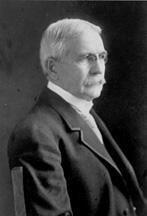
Robert Jackson Gamble (February 7, 1851 – September 22, 1924) was an American politician who served as both a U.S. Representative and a U.S. Senator from South Dakota. A member of the Republican Party, he represented South Dakota in Congress from 1895 to 1913, contributing to the legislative process during four terms in office. He was part of a prominent political family, being the father of Ralph A. Gamble and the brother of John Rankin Gamble, both of whom were also active in public life.
Gamble was born in Genesee County, near Akron, New York, the son of Robert Gamble and Jennie (Abernethy) Gamble. In 1862, during his childhood, he moved with his parents to Fox Lake, Wisconsin. He was educated in Wisconsin and enrolled at Lawrence University in Appleton, from which he graduated in 1874 with a Bachelor of Science degree. While attending Lawrence, he taught school during the summers to pay his tuition, demonstrating an early commitment to education and self-support. He later received a Master of Science degree from Lawrence University, further solidifying his academic credentials.
After completing his undergraduate studies, Gamble read law with the Milwaukee firm of Jenkins, Elliot & Wheeler and was admitted to the bar in 1875. That same year he moved west to Yankton, in the portion of Dakota Territory that would later become the state of South Dakota, where he began the practice of law. Establishing himself in the legal profession, he quickly became involved in public affairs and Republican Party politics in the growing territory.
Gamble’s early public career developed within Dakota Territory. A Republican, he was appointed district attorney for the second judicial district of the Territory of Dakota in 1880. He also served as city attorney of Yankton in 1881 and 1882, roles that increased his visibility and influence in territorial legal and political circles. In 1885, he was elected to the Territorial Council, the upper house of the territorial legislature, where he participated in shaping laws and policies during the final years before statehood. In his personal life, he married Carrie S. Osborne of Portage, Wisconsin, in 1884; the couple became the parents of two sons, Ralph and George.
With the admission of South Dakota to the Union, Gamble transitioned to national office. In 1894, he was elected as a Republican to Seat B, one of South Dakota’s two at-large seats in the U.S. House of Representatives, and served in the Fifty-fourth Congress from March 4, 1895, to March 3, 1897. Although he ran unsuccessfully for reelection in 1896, he returned to the House after winning election again to Seat B in 1898, serving in the Fifty-sixth Congress from March 4, 1899, to March 3, 1901. During the Fifty-sixth Congress he was chairman of the House Committee on Expenditures on Public Buildings, overseeing federal spending on government structures. His service in Congress during this era placed him at the center of national debates in a period of rapid economic growth and expanding federal responsibilities.
In 1901, Gamble advanced to the United States Senate, having been elected by the South Dakota legislature as a Republican senator. He was reelected in 1906 and served in the Senate from March 4, 1901, until March 3, 1913, a period that spanned the administrations of Presidents William McKinley, Theodore Roosevelt, and William Howard Taft. His Senate tenure coincided with a significant period in American history marked by progressive reforms, questions of regulation and conservation, and the nation’s growing international role. As a senator, he participated in the democratic process and represented the interests of his South Dakota constituents, while also holding several important committee chairmanships. He served as chairman of the Committee on Indian Depredations during the Fifty-seventh Congress, chairman of the Committee on Transportation Routes to the Seaboard from the Fifty-eighth through the Sixtieth Congresses, and chairman of the Committee on Indian Affairs in the Sixty-second Congress. He was also listed as chairman of the Committee on Enrolled Bills in the Sixty-fourth Congress. After more than a decade in the Senate, he was an unsuccessful candidate for renomination in 1912, and his service ended in March 1913.
Following his departure from the Senate, Gamble returned to private life and the practice of law. In 1915, he moved to Sioux Falls, South Dakota, where he resumed his legal career. From 1916 to 1924, he served as a referee in bankruptcy for the southern district of South Dakota, applying his legal expertise to the administration of federal bankruptcy proceedings. He also remained engaged in national public affairs as a member of the National Executive Committee of the League to Enforce Peace, an organization that advocated for international cooperation and mechanisms to prevent war in the years surrounding World War I. In recognition of his career and public service, Lawrence University awarded him the honorary degree of Doctor of Laws (LL.D.) in 1909.
Robert Jackson Gamble died in Sioux Falls on September 22, 1924, at the age of 73. He was buried in Yankton City Cemetery in Yankton, South Dakota, returning in death to the community where he had first established his legal and political career.
Congressional Record