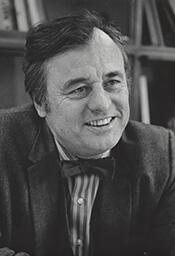
Robert Christian Eckhardt (July 16, 1913 – November 13, 2001) was an American lawyer, legislator, and Democratic United States Representative who represented the 8th District of Texas from 1967 to 1981. Over seven consecutive terms in the U.S. House of Representatives, he contributed to the legislative process during a significant period in American history, participating actively in the democratic process and representing the interests of his constituents in northern Houston and the surrounding area. Trained as a labor lawyer, he became known for his liberal voting record, his work on environmental and constitutional issues, and his authorship of landmark legislation at both the state and federal levels.
Eckhardt was born in Austin, Texas, on July 16, 1913, into a family with deep political and civic roots. He was the grand-nephew of Democratic Congressman Rudolph Kleberg, the nephew of Republican Congressman Harry Wurzbach, and a cousin of Richard Mifflin Kleberg Sr., heir to the King Ranch in South Texas, a background that exposed him early to public affairs and the workings of government. Raised in the Texas capital, he attended local schools before enrolling at the University of Texas at Austin, where he received his undergraduate degree in 1935. He continued his studies at the University of Texas School of Law, earning his law degree in 1939 and beginning a legal career that would focus on labor law and public-interest issues.
During World War II, Eckhardt served in the United States Army from 1942 to 1944, contributing to the national war effort. Following his military service, he was appointed Southwestern Director of the Office of the Coordinator of Inter-American Affairs from 1944 to 1945, a wartime and immediate postwar agency that sought to strengthen political, economic, and cultural ties between the United States and Latin American nations. This experience broadened his perspective on international relations and public administration and helped shape his later interest in foreign policy and constitutional questions.
After the war, Eckhardt moved to Houston, where he established his legal practice and became increasingly involved in Texas politics. A member of the Democratic Party, he was elected to the Texas House of Representatives in 1958 and served there until 1966. In the state legislature he compiled a fairly liberal voting record, often aligning with reform-minded and progressive causes. One of his most enduring accomplishments in the Texas House was writing the Texas Open Beaches Act, passed in 1959, which guaranteed public access to the state’s Gulf Coast beaches and became a model for coastal access legislation. Beyond his legislative work, he was also a co-founder of the Texas Observer magazine, a publication that became an influential voice for investigative journalism and liberal politics in the state.
In 1966, Eckhardt was elected as a Democrat to the United States House of Representatives from Texas’s 8th congressional district, which at the time included most of northern Houston. He took office in January 1967 and served seven terms, remaining in Congress until January 1981. During his fourteen years in the House, he became recognized for his expertise in environmental, consumer protection, and constitutional law. He was the sponsor of the War Powers Act, which sought to clarify and limit the president’s authority to commit U.S. forces to armed conflict without congressional approval, and he played a leading role in the development of the Toxic Substances Control Act, aimed at regulating the introduction and use of industrial chemicals to protect public health and the environment. His legislative work reflected a consistent concern for civil liberties, governmental accountability, and regulatory safeguards.
Throughout his congressional service, Eckhardt was reelected six times without serious difficulty, reflecting a strong base of support in his district and within the Democratic Party. His tenure coincided with major national debates over the Vietnam War, civil rights, environmental protection, and executive power, and he was an active participant in these discussions, contributing to the shaping of federal policy in these areas. In 1980, however, amid a shifting political climate in Texas and nationally, he was narrowly defeated for reelection by Republican Jack Fields, losing by only about 4,900 votes. His departure from Congress in 1981 marked the end of his formal legislative career but not his engagement with public affairs.
Beyond elected office, Eckhardt continued to contribute to legal and constitutional discourse. He co-authored the book The Tides of Power: Conversations on the American Constitution between Bob Eckhardt, Member of Congress from Texas, and Charles L. Black Jr., Sterling Professor of Law, Yale University (New Haven: Yale University Press, 1976), which reflected his deep interest in constitutional law, separation of powers, and the proper balance between the branches of government. His papers from 1931 to 1992, preserved at the Center for American History at the University of Texas at Austin, document his long career in law, politics, and public policy and have served as a resource for scholars, including in the biography Eckhardt: There Once was a Congressman from Texas by Gary A. Keith (Austin: University of Texas Press, 2007).
Robert Christian Eckhardt died on November 13, 2001, in his native Austin, Texas. He was interred in Austin Memorial Park Cemetery. His career as a labor lawyer, state legislator, and seven-term member of Congress left a legacy in Texas and national law, particularly through the Texas Open Beaches Act, the War Powers Act, and the Toxic Substances Control Act, and through his broader efforts to strengthen democratic governance and public accountability.
Congressional Record