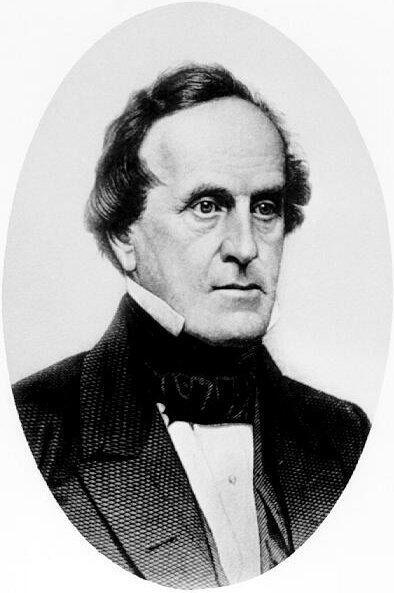
Robert Pinckney Dunlap (August 17, 1794 – October 20, 1859) was the 11th governor of Maine and a U.S. Representative from Maine. Born in Brunswick, in what is now the State of Maine but was then a part of Massachusetts, he was the son of John Dunlap, born in Dracut, Massachusetts, in 1738, a Massachusetts Bay Colonial Militia captain who served during the French and Indian War. His grandfather, the Rev. Robert Dunlap, born in 1715 in County Antrim, Ireland, was a Presbyterian minister trained at the University of Edinburgh. Raised in this milieu of public service and religious learning, Dunlap was educated by private tutors in his youth in Brunswick.
Dunlap pursued higher education at Bowdoin College in Brunswick, graduating in 1815. Shortly thereafter he studied law, reflecting the common path of early nineteenth-century American public figures who combined legal training with political ambition. He was admitted to the bar in 1818 and commenced the practice of law in Brunswick. His association with Bowdoin College continued throughout his life; beginning in 1821 he served as president of the board of overseers of Bowdoin College, a position he held until his death, underscoring his long-standing commitment to higher education in Maine.
Dunlap’s public career began in state politics and militia service. He served as a member of the Maine House of Representatives from 1821 to 1823, entering legislative life soon after Maine achieved statehood in 1820. At the same time, he was active in the state militia, reflecting the continuing importance of local military organization in the early republic. In 1824 he was delegated to receive General Lafayette when the Revolutionary War hero visited Maine during his celebrated tour of the United States, a ceremonial duty that highlighted Dunlap’s growing prominence in state affairs.
Advancing in Maine politics, Dunlap served in the Maine State Senate from 1824 to 1828 and again from 1831 to 1833. During his tenure he was elected president of the Senate in 1827, 1828, and 1831. As of 2020, he remains the only person to have served non-consecutive terms as president of the Maine Senate, a distinction that reflects both his influence and the confidence placed in his leadership by his colleagues. Between his Senate terms he was a member of the Executive Council of Maine, participating in the advisory body that assisted the governor in administering the state.
Dunlap reached the pinnacle of state office when he was elected governor of Maine. He served four one-year terms as the 11th governor, holding office from 1834 to 1838. As governor, he presided over Maine during a period of economic and political development in the young state, representing the Democratic Party’s interests and policies in a region where questions of internal improvements, land settlement, and relations with neighboring British North America were increasingly significant. His repeated reelection to the governorship testified to his standing within Maine’s Democratic Party and among the state’s voters.
After his gubernatorial service, Dunlap continued his public career at the national level. As a member of the Democratic Party representing Maine, he contributed to the legislative process during two terms in the United States House of Representatives. He was elected as a Democrat to the Twenty-eighth and Twenty-ninth Congresses and served from March 4, 1843, to March 3, 1847. His service in Congress occurred during a significant period in American history, encompassing debates over territorial expansion, economic policy, and sectional tensions. During the Twenty-ninth Congress he served as chairman of the Committee on Public Expenditures, a position that placed him at the center of oversight of federal spending and fiscal accountability, and he participated in the democratic process while representing the interests of his Maine constituents.
Following his congressional service, Dunlap held important federal administrative posts in Maine. He served as collector of customs in Portland, Maine, from 1848 to 1849, overseeing the enforcement of federal customs laws and the collection of import duties at one of the state’s principal ports. Later, he returned to his hometown to serve as postmaster of Brunswick from 1853 to 1857, managing the local operations of the United States Post Office Department at a time when reliable mail service was increasingly vital to commerce and communication. These positions reflected continued trust in his administrative abilities and his enduring role in public life.
Robert Pinckney Dunlap spent his later years in Brunswick, maintaining his long association with Bowdoin College through his presidency of its board of overseers and remaining a respected figure in Maine’s civic and political circles. He died in Brunswick on October 20, 1859. Dunlap was interred in Pine Grove Cemetery in Brunswick, closing a life that had spanned the colonial legacy of his family, the early years of the American republic, and the formative decades of Maine’s statehood and national development.
Congressional Record