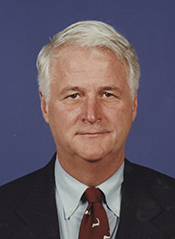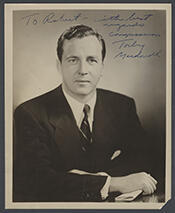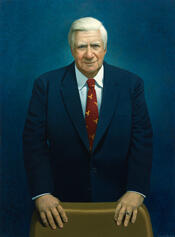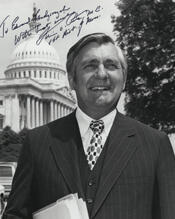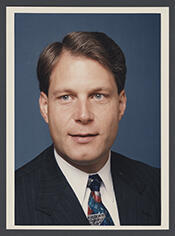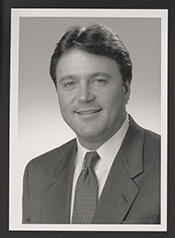
Robert Frederick Drinan (November 15, 1920 – January 28, 2007) was an American Jesuit priest, lawyer, human-rights activist, and Democratic U.S. Representative from Massachusetts. He served as a Representative in the United States Congress from 1971 to 1981, completing five terms in office. A member of the Democratic Party, he contributed actively to the legislative process during a significant period in American history, and later became a prominent legal scholar and professor at Georgetown University Law Center, where he taught for the last 26 years of his life. He left Congress in 1981 in obedience to Pope John Paul II’s directive prohibiting priests from holding elective political office.
Drinan grew up in the Hyde Park neighborhood of Boston, Massachusetts, the son of Ann Mary (Flanagan) and James John Drinan. He graduated from Hyde Park High School in 1938 and went on to Boston College, where he received both a B.A. and an M.A., finishing in 1942. That same year he entered the Society of Jesus, beginning his formation as a Jesuit. He pursued advanced studies in law and theology, earning an LL.B. and an LL.M. from Georgetown University Law Center in 1950. He was ordained a Catholic priest in 1953 and subsequently completed a doctorate in theology at the Pontifical Gregorian University in Rome in 1954. He then studied in Florence, Italy, for two years before returning to Boston, where he was admitted to the Massachusetts bar in 1956.
Upon his return to the United States, Drinan embarked on a dual career in legal education and public service. In 1956 he became dean of Boston College Law School, a position he held until 1970. As dean, he also taught as a professor of family law and church–state relations and helped transform the institution from a largely regional school into a nationally recognized leader in legal education. During this period he served as a visiting professor at other institutions, including the University of Texas School of Law, and participated in several Massachusetts state commissions convened to study legal issues such as judicial salaries and conflicts of interest among lawyers. His leadership at Boston College Law School was later credited with reshaping the school’s mission and national profile while maintaining its Jesuit commitment to educating the whole person.
In 1970, amid growing national opposition to the Vietnam War, Drinan sought a seat in Congress on an explicitly antiwar platform. Running in the Massachusetts 3rd Congressional District, he narrowly defeated longtime incumbent Representative Philip J. Philbin, a member of the House Armed Services Committee, in the Democratic primary. He then won the general election and took his seat in the U.S. House of Representatives in January 1971. He was re-elected four times, serving until January 3, 1981. Drinan was one of the first two Catholic priests ever to serve as a voting member of Congress, the other being Robert John Cornell of Wisconsin. During his tenure, he sat on various House committees and became chair of the Subcommittee on Criminal Justice of the House Judiciary Committee. He also served as a delegate to the 1972 Democratic National Convention and was recognized as an outspoken advocate on issues of war, peace, and human rights.
Drinan’s congressional service coincided with the climax of the Vietnam War and the constitutional crisis of the Watergate era. In July 1973 he introduced a resolution calling for the impeachment of President Richard M. Nixon, not on the basis of the Watergate scandal that would ultimately end Nixon’s presidency, but on the grounds that Nixon’s secret bombing of Cambodia was illegal and constituted a “high crime and misdemeanor.” House Majority Leader Thomas P. “Tip” O’Neill Jr. persuaded Drinan not to press the resolution because of concern that it would complicate the emerging Watergate-based impeachment process. O’Neill arranged with House whips John J. McFall and John Brademas, and with House Minority Leader Gerald Ford, to prevent the resolution from coming to a vote. When the House Judiciary Committee later drafted articles of impeachment against Nixon, it voted 21 to 12 against including the Cambodia bombing among the charges reported to the full House. Throughout his service, Drinan participated in the democratic process and represented the interests of his Massachusetts constituents during a turbulent decade in American political life.
Throughout his political career, Drinan’s strong public support for abortion rights drew sustained criticism from many Catholic Church leaders. They repeatedly urged him not to hold political office and challenged his stance on abortion. Drinan attempted to reconcile his position with Church teaching by stating that he was personally opposed to abortion, which he described as “virtual infanticide,” but that he regarded its legality as a matter distinct from its morality in a pluralistic society. This reasoning did not satisfy his ecclesiastical critics, and commentators later noted his influence in helping make a pro-choice position common among some Catholic Democratic politicians, including members of the Kennedy family. In 1980, Pope John Paul II issued an unequivocal directive that all priests withdraw from electoral politics. Drinan complied and did not seek reelection in 1980, leaving office in January 1981. Asked why he did not renounce the priesthood to remain in Congress, he told The Boston Globe that such a step was “just unthinkable,” adding that he was proud to be a priest and a Jesuit and believed there was other work for him to do that would be “more important than the work” he was required to leave.
After leaving Congress, Drinan continued to play a prominent role in public life, legal scholarship, and advocacy. In June 1981 he succeeded former Representative Patsy Mink as president of Americans for Democratic Action, serving until June 1984, when he was succeeded in that role by Barney Frank, the man who had succeeded him in his congressional seat. In 1981 he joined the faculty of Georgetown University Law Center in Washington, D.C., where he taught until his death in 2007. His academic work and teaching focused on legal ethics and international human rights. He privately sponsored human-rights missions to countries such as Chile, the Philippines, El Salvador, and Vietnam, and in 1987 he founded the Georgetown Journal of Legal Ethics. He was a prolific writer, contributing regularly to law reviews and journals and authoring several books, including “The Mobilization of Shame: A World View of Human Rights,” published by Yale University Press in 2001. He remained a vocal supporter of abortion rights and publicly backed President Bill Clinton’s 1996 veto of the Partial-Birth Abortion Ban Act, prompting sharp criticism from Cardinal John O’Connor in the Catholic New York, who wrote that Drinan had “raised [his] voice for death” rather than life.
Drinan’s later years were also marked by extensive service in professional and civic organizations. He was a member of the American Bar Association House of Delegates until his death and chaired the ABA Section on Individual Rights and Responsibilities. In 2004 he received the ABA Medal, the association’s highest honor for distinguished service in the law. On May 10, 2006, he was presented the Distinguished Service Award by Speaker Dennis Hastert and Minority Leader Nancy Pelosi on behalf of the House of Representatives. Over the course of his life he received 21 honorary doctorates. He served on the boards of directors of People for the American Way, the International League for Human Rights, the Lawyers Committee for Human Rights, the International Labor Rights Fund, Americans for Democratic Action, and the NAACP Legal Defense and Educational Fund. He was elected to the Common Cause National Governing Board in 1981 and again in 1997, chaired PeacePAC, a division of the Council for a Livable World, and was a director of the Center for Arms Control and Non-Proliferation. His legacy is commemorated through the College Democrats of Boston College, who annually present an award in his honor to prominent Catholic Democratic figures, and through Georgetown University Law Center’s Robert F. Drinan, S.J., Public Service Award, given to alumni whose careers, like his, enhance human dignity and advance justice.
In his final years, Drinan remained an influential figure at Georgetown and within the broader legal and human-rights communities. Following his death, Georgetown Law students and faculty shared extensive reminiscences of his influence on their lives, and Georgetown Law Magazine published a special tribute supplement in Spring 2007. Dean T. Alexander Aleinikoff of Georgetown Law described him as one of the rare individuals who had done so much “to make the world a better place,” while John H. Garvey, dean of Boston College Law School, credited Drinan with fundamentally transforming that institution and embodying its ideal of educating “lawyers who lead good lives.” In 2012, five years after his death, Slate writer Emily Yoffe alleged that Drinan had sexually assaulted her when she was “a teenager of 18 or 19”; his niece responded by questioning the timing of the allegation and noting that he was no longer able to defend himself. Robert F. Drinan died of pneumonia and congestive heart failure on January 28, 2007, in Washington, D.C. On January 29, 2007, the House of Representatives honored his memory with a moment of silence on the House floor, recognizing the service of a priest, legislator, and advocate whose career spanned law, politics, and human rights.
Congressional Record